






 Portuguese
  Spanish
  5 min of reading
  0 comments


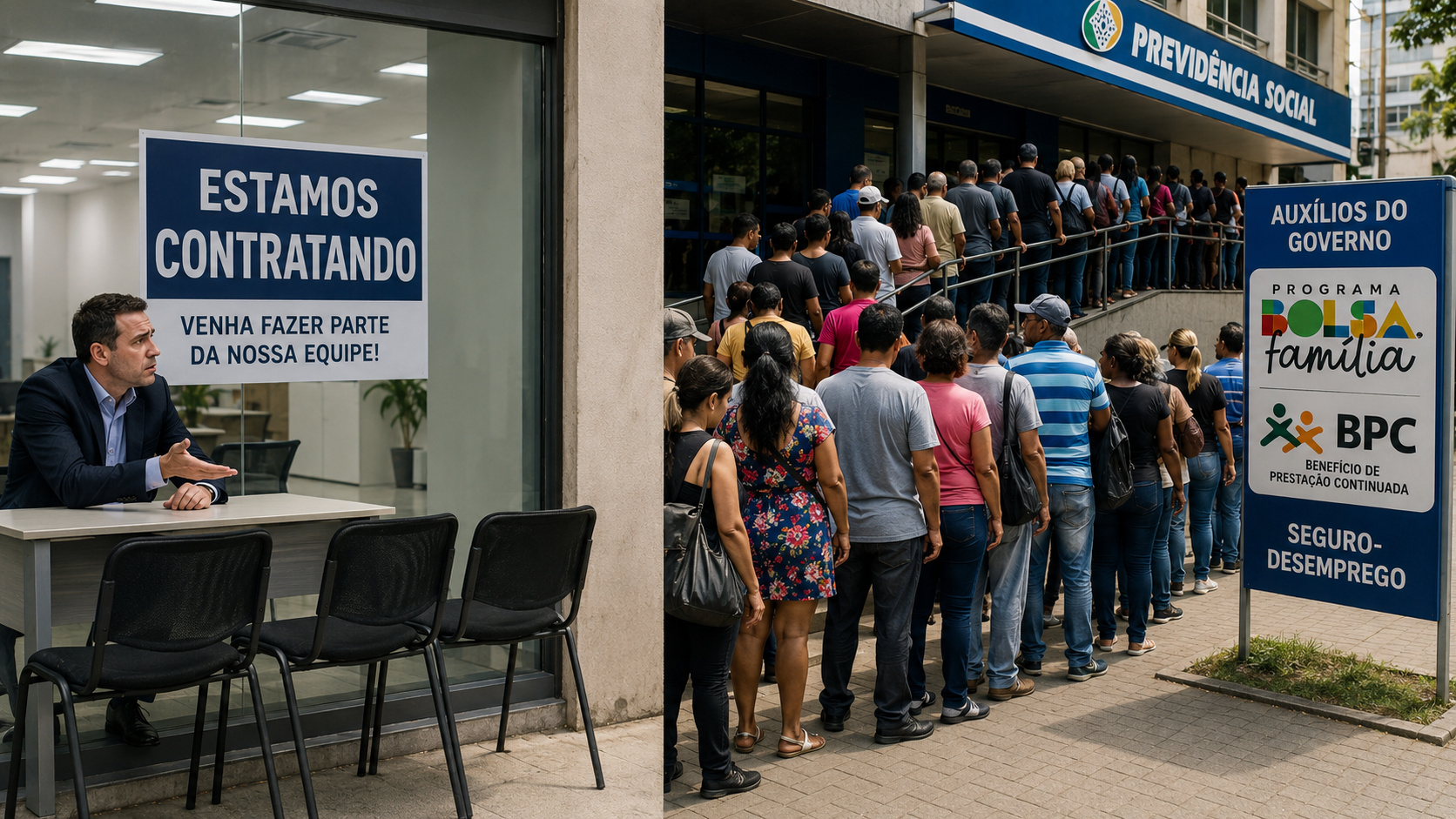
Commerce reports difficulty in hiring workers and part of the sector associates the scenario with social benefits such as Bolsa Família and BPC.
The Brazilian commerce faces an unusual combination of factors: unemployment at historically low levels, growing demand for workers, and increasing difficulty in filling operational vacancies. In various regions of the country, business owners state that finding employees for customer service, stock, cashier, replenishment, and basic services has become one of the sector’s biggest challenges. Part of the business community has started to relate this scenario to the expansion of social programs and income protection mechanisms, such as Bolsa Família, Continuous Cash Benefit (BPC), and unemployment insurance.
However, this assessment is not a consensus among economists and researchers, who point to other structural factors behind the labor shortage.
Business owners claim that Bolsa Família, BPC, and unemployment insurance influence the difficulty in filling vacancies
The debate gained momentum after meetings promoted by business and commercial entities. According to a report by Diário do Comércio, business owners and economists linked to the productive sector stated that social benefits have started to influence part of the supply of lower-skilled workers.
-
FIRJAN’s mega plan of R$ 526.3 billion for Rio de Janeiro aims to revive Brazil’s largest industry, with two-thirds of the investments going to oil and gas.

-
China signals an increase in beef imports, Brazil has already consumed 70% of the 1.106 million ton quota and seeks to renegotiate the tariff that jumps from 12% to 55%, while demand from the US also skyrockets.
-
Food inflation rose 302% in 20 years in Brazil, but the supermarket changed: purchasing power yielded 87% more mortadella and 31% less fruit, and ultra-processed foods took over the cart.
-
Petrobras sells the first batch of 3,800 m³ of aviation fuel made with certified soy, capable of reducing emissions by up to 70%, in an unprecedented project that anticipates the aviation sector’s requirements expected for 2027.



In the assessment presented during the debates, programs like Bolsa Família, BPC, and temporary income protection mechanisms would increase the so-called “reservation wage”, an economic concept representing the minimum amount a person accepts to receive to enter formal employment.
Business representatives argue that when the difference between received benefits and initial salaries offered by some vacancies becomes small, part of the workers may prefer to remain outside the formal market or work informally.
Commerce, supermarkets, bakeries, and services report increasing difficulty in hiring workers
According to reports gathered by Diário do Comércio, the labor shortage is already affecting segments such as supermarkets, bakeries, agriculture, popular commerce, and services in general. Business owners claim to face problems mainly in positions with lower technical requirements.

The problem also appears in recent analyses of the retail sector. An article published by the portal Mercado & Consumo described the scenario as a true “labor blackout,” highlighting that retail and services are among the most pressured segments due to their heavy reliance on in-person workers.
In some cases, companies report increased turnover, difficulty filling schedules, and the need to review operating hours due to the lack of available professionals.
Unemployment at historically low levels also helps explain the shortage of workers
The economists participating in the discussion affirm that the problem cannot be attributed exclusively to social programs.
Data cited by the sector show that Brazil has been operating with unemployment rates close to what is called full employment. In 2025, the unemployment rate reached 5.6%, one of the lowest in the historical series of IBGE started in 2012.

When the number of people looking for work decreases and the economy continues to demand workers, the tendency is for companies to find it more difficult to hire, especially in sectors that rely on a large volume of operational labor.
Economists point to population aging, informality, and apps as important factors
Experts consulted in the discussions also highlight structural changes that go beyond social benefits.
Among the factors cited are the reduction in population growth, the aging of the workforce, the expansion of transportation and delivery apps, informality, and behavioral changes among younger workers.
The economist Antonio Lanzana, a professor at FEA-USP cited by Diário do Comércio, stated that it is not possible to explain the scarcity solely by income transfers. According to him, there is a combination of economic, demographic, and behavioral factors simultaneously affecting the Brazilian labor market.
Other analysts also point out that younger workers have started seeking greater professional flexibility, reducing interest in certain traditional jobs with rigid hours.
FGV study found a reduction in the participation of some young men in the market after the expansion of Bolsa Família
Part of the criticism made by the productive sector uses as a reference a study by researcher Daniel Duque, from FGV Ibre.
According to the survey cited by Diário do Comércio, the expansion of Bolsa Família after the pandemic would have contributed to a reduction in the participation of young men in the labor market, especially in formal occupations.

The study observed that families that came to meet the program’s criteria showed a drop in labor force participation compared to similar groups that were ineligible due to a small income difference.
Even so, the economic debate itself remains divided, as other research points to positive effects of income transfer programs on formalization, poverty reduction, and improvement of social indicators.
The clash between social benefits and labor shortage has become one of the most sensitive discussions in the Brazilian economy
While business owners report increasing difficulty in hiring employees in stores, markets, bakeries, restaurants, and services, researchers continue to discuss which factors really explain the phenomenon.
On one side, representatives of the productive sector claim that programs like Bolsa Família, BPC, and income protection mechanisms influence part of the workforce supply.
On the other hand, economists point out that population aging, informality, changes in professional profiles, and historically low unemployment also help explain the scenario.
The result is a market where vacancies remain open, companies report difficulty in filling teams, and the debate on work, social assistance, and productivity becomes increasingly intense in a country where millions of people still depend on income protection programs to survive.





Be the first to react!