






 Portuguese
  Spanish
  5 min of reading
  0 comments


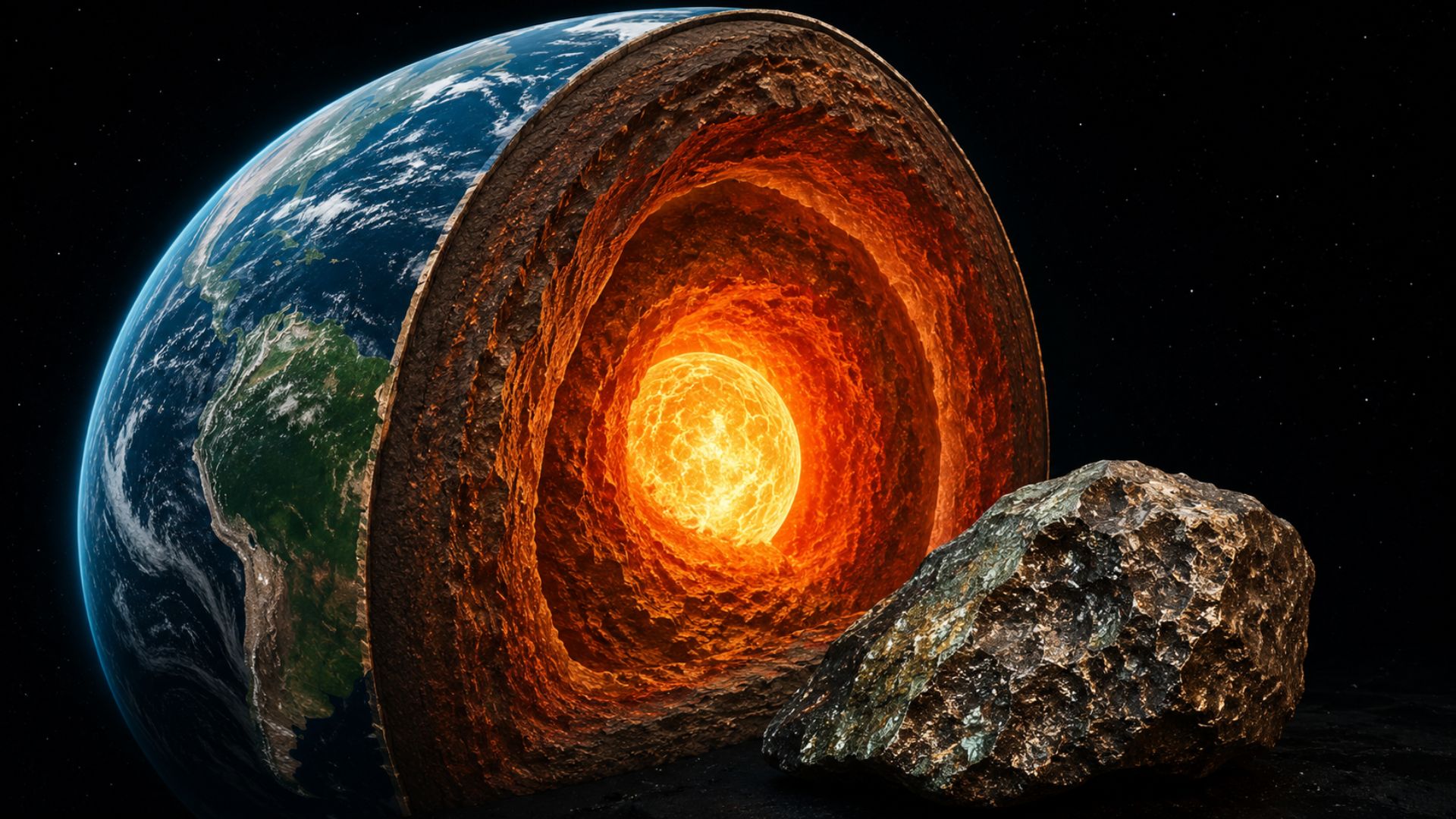
The problem is that it disintegrates when it rises: outside the extreme pressure of the mantle, it loses its crystalline structure and disappears. The missing piece was stored in a meteorite that fell in Queensland, where the impact momentarily recreated the same conditions as the planet’s interior. Only in 2014 did the material gain an official name, named in honor of a Nobel laureate in physics.
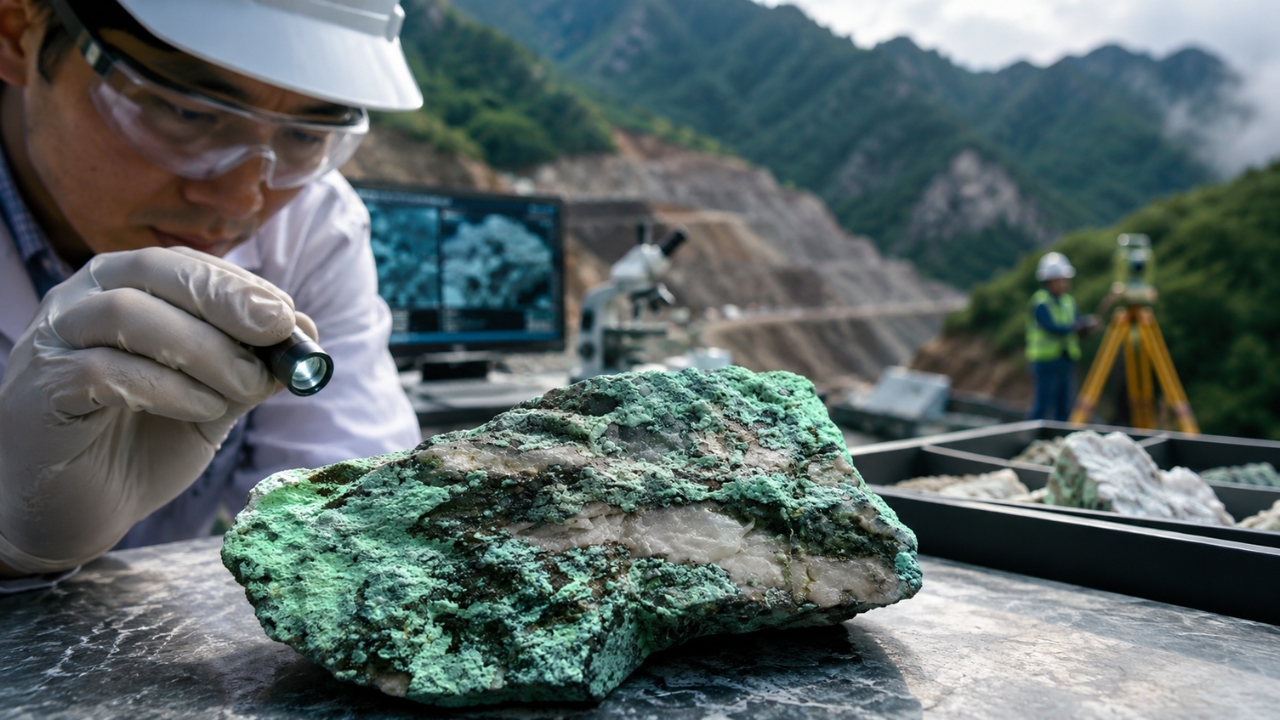
The most abundant mineral on Earth forms about 38% of the planet’s volume and dominates the mantle hundreds of kilometers deep, but it is so inaccessible that humanity only managed to touch it thanks to a meteorite that fell in Australia in 1879. Called bridgmanite, it is practically invisible to us, as it exists naturally only in the extreme depths of the Earth’s interior, beyond the reach of any drilling.
For decades, scientists knew of this mineral’s existence only indirectly, through calculations and the analysis of seismic waves that traverse the planet. However, a physical sample was needed for it to be officially recognized and named, something that only happened in 2014, when researchers found microscopic crystals of bridgmanite preserved inside a rock from space.
What is bridgmanite

Bridgmanite is a magnesium and iron silicate with a crystalline structure known as perovskite. It only remains stable under the brutal pressure and temperature conditions of the Earth’s lower mantle, the region that extends approximately from 670 to 2,900 kilometers deep, between the so-called mantle transition zone and the boundary with the planet’s core.
-
Asian battery manufacturer becomes a partner in a rare earth and niobium project in Minas Gerais, with estimated reserves of 70 million tons and operations expected to start in 2027.

-
While other countries compete for clean energy minerals, the USA looks to Brazil and promises to seek financing for projects involving rare earths, lithium, nickel, and graphite.
-
The mining company was drilling hundreds of meters below the already mapped area in Pará when it discovered new copper and gold zones in Furnas, a project that could operate for 24 years alongside Vale.
-
Rare earths, million-dollar compensation, and a farm in Goiás: understand the case in which a rural producer accuses Serra Verde of occupying his property while the legal dispute drags on for years


It is precisely because it dominates such an extensive range that the mineral is considered the most abundant on Earth, accounting for about 38% of the planet’s total volume and an even larger portion of the lower mantle. Despite this enormous presence, it remained without an official name for a long time, being referred to by researchers only by its chemical composition and structure, as a perovskite silicate.
Why It Is So Difficult to See

The great paradox of bridgmanite is that, even though it is so common, it is practically impossible to observe directly. This happens because the mineral only retains its structure under the gigantic pressures of the deep mantle. When brought towards the surface, where the pressure plummets, it simply disintegrates and loses the crystalline arrangement that defines it, becoming something else.
Adding to this is the fact that the deep interior of the Earth remains inaccessible to current technology. The deepest drilling ever done by humanity, the famous Kola Superdeep Borehole in Russia, reached about 13 kilometers, a minimal fraction compared to the more than 670 kilometers needed to reach the region where bridgmanite dominates. Extremely high temperatures and pressures make any attempt to get there unfeasible for now.
The Meteorite That Solved the Enigma


The solution to the impasse came from an unexpected place: space. The official confirmation of the mineral was only possible thanks to the Tenham meteorite, which fell in the Queensland region of Australia in 1879. Inside this space rock, scientists found small crystals of bridgmanite that were, so to speak, frozen in a vein formed by the impact shock.
This happened because, at the moment of the collision that marked the meteorite’s history, it was subjected to pressures and temperatures as high as those of Earth’s lower mantle, albeit for a very short period of time. These extreme conditions allowed the mineral to form and remain preserved, offering researchers the much-sought natural sample for analysis.
An Award-Winning Discovery and an Illustrious Name
The official recognition came in 2014, with a study published in the prestigious scientific journal Science, led by researchers Oliver Tschauner, from the University of Nevada, Las Vegas, and Chi Ma, from the California Institute of Technology, Caltech. The duo used advanced and non-destructive X-ray techniques to identify and characterize the tiny crystals without damaging them.
The name bridgmanite is a tribute to Percy Bridgman, an American physicist who won the Nobel Prize in Physics in 1946 and is considered one of the fathers of high-pressure research. The discovery ended a long-standing confusion in the mineral’s nomenclature and filled an important gap in the scientific classification of the substances that make up our planet, as a mineral can only be officially named from a sample found in nature.
Clues about the heart of the planet
More than a curiosity, bridgmanite is a key piece to understanding how the Earth works from the inside. As it dominates the lower mantle, it directly influences the heat flow from the depths towards the surface, a process linked to phenomena such as the movement of tectonic plates, volcanoes, and earthquakes, which shape the face of the planet over millions of years.
Studying this mineral, even in tiny quantities from meteorites or recreated in the laboratory under extreme pressure, helps scientists refine models about the Earth’s internal structure. Each new piece of information about bridgmanite contributes to deciphering the behavior of the deep mantle, a region that remains largely unknown territory just below our feet.
Technological promises to confirm
Part of the buzz around bridgmanite involves possible future technological applications. Some reports suggest that its properties could, in theory, inspire advances in areas such as superconducting materials, more efficient electrical grids, and even magnetic levitation systems, if they were artificially reproduced in the laboratory.
However, it is important to treat these possibilities with caution. Reference scientific sources highlight the value of bridgmanite mainly for understanding the geology and internal processes of the planet, and do not present it as a concrete basis for superconductors. It is, therefore, speculation about the future, not a proven application, something that only additional research can confirm or discard.
Bridgmanite is a fascinating reminder of how little we still know about our own planet. The most abundant mineral on Earth, which forms more than a third of its volume, remains practically invisible and out of reach, revealed to science only by a space fragment that fell almost 150 years ago. It is proof that sometimes, to understand the interior of our world, we need to look at what comes from outside it.
And you, had you heard of bridgmanite, the most abundant mineral on Earth that almost no one has ever seen? Isn’t it impressive to think that we can only touch it thanks to a meteorite? Leave your comment, tell us what surprised you most about this mineral hidden in the depths, and share the article with those who love science, geology, and the mysteries of the planet.







Be the first to react!