Portuguese
  Spanish


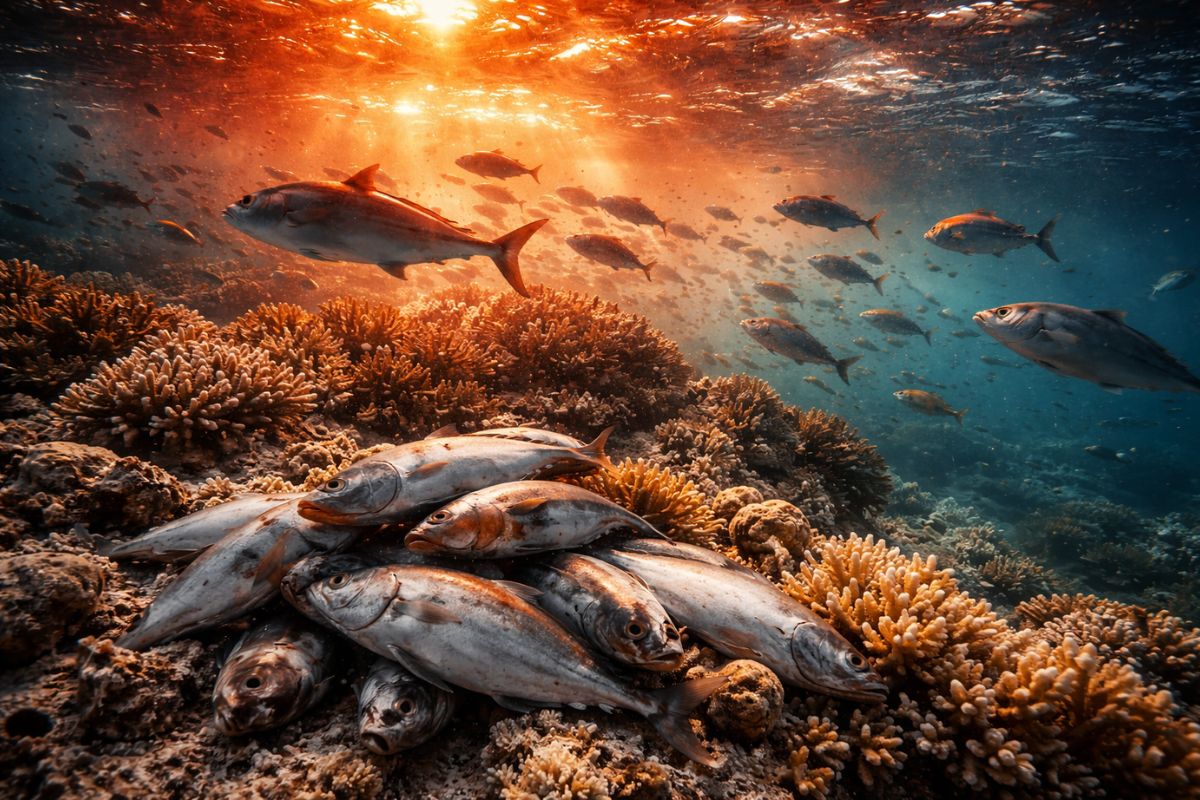


A Study In Nature Ecology & Evolution Analyzed More Than 700 Thousand Estimates Of Biomass From Almost 34 Thousand Populations, From 1993 To 2021, And Detected That Chronic Ocean Warming Is Linked To An Annual Decline Of Up To 19.8%, Aggravated By Heatwaves And Pressures Whole Food Chains.
When the average temperature of the oceans rises persistently, the impact does not just appear as a distant statistic: it starts to translate into less fish biomass year after year. A recent study points out that this chronic warming is associated with a sustained annual decline of almost 20% in biomass, a rate capable of reshaping marine life in just a few seasons.
The analysis brought together an unusual volume of records, with more than 700 thousand estimates of changes in biomass from almost 34 thousand fish populations monitored between 1993 and 2021. By looking at regions of the Northern Hemisphere and separating the effect of constant warming from the “noise” of short-term extreme events, the authors describe a concerning pattern that does not depend on a single heat spike to assert itself.
What “Fish Biomass” Measures And Why That Changes The Problem
Fish biomass is not just “how many fish there are,” but the total amount of fish in an environment multiplied by the average weight of the animals. This matters because biomass captures, at the same time, abundance and size, two signals that can decline together or in different ways when sea temperature ceases to be stable.
-
Three teenagers transform cut cardboard into Japanese origami-style packaging that promises to retire styrofoam and bubble wrap, win a $12,500 prize, and target giants like Amazon, FedEx, and Home Depot after a robot motor arrived broken.

-
The large jar blender has a rival: Oster Ultra Power bets on 1,000 W, six stainless steel blades, and two portable cups with leak-proof lids.

-
Tesla injected an additional $250 million into the German factory, doubled the battery cell target, and opened its own production line for startups.

-
No more TV stuck on the wall: Samsung The Freestyle+, the new projector with over 400 lumens projects on walls, floors, and ceilings, bringing cinema to any corner of the house.




This detail helps to understand why chronic warming of the oceans is so concerning: it does not need to cause dramatic die-offs in a single day to reduce the available “live stock.” A constant negative pressure can gradually decrease the overall populations over time, altering the balance of the ecosystem and the availability of resources for predators, for fishing, and for communities that depend on the sea.
Where The Data Was Observed And Who Signed The Conclusions
The researchers who conducted the analysis are from the National Museum of Natural Sciences in Spain and the National University of Colombia.
They worked with records collected in areas of the Mediterranean, North Atlantic, and Northeast Pacific, focusing on populations monitored in the Northern Hemisphere.
By synthesizing changes over almost three decades, the study describes that when the effect of short-term extreme events is removed, the constant warming of the oceans appears associated with an annual decline of up to 19.8% in biomass.
Researcher Shahar Chaikin summarizes this idea by highlighting that without the “noise” of extremes, the pattern of sustained loss becomes clearer, as if the sea were getting warmer and, at the same time, more “poor” in biomass.
Marine Heatwaves: Rapid Declines And Gains That Seem Like Good News
Just like on land, heatwaves in the oceans are becoming more frequent, and the study describes that the effect varies according to the ideal temperature range of each species.
In other words, there is no one-size-fits-all response: some populations lose biomass, while others temporarily increase, depending on how close they were to their “thermal comfort.”
When a heatwave pushes fish from already warm waters beyond this comfort zone, biomass can plummet by up to 43.4%. In contrast, in cooler areas, the temporary rise in temperature can benefit certain populations, increasing biomass by up to 176%.
It’s a misleading contrast because a momentary increase may sound like a relief, but it does not erase the underlying trend when warming is persistent.
The Hidden Risk When Fishing “Improves” For A Short Time
The study draws attention to a delicate point: in cooler areas, the temporary gain in biomass during heatwaves may seem like an opportunity. However, Chaikin emphasizes that this “good phase” tends to be transitory, and catching more during this interval can have a reverse effect when temperatures return to normal.
This mechanism helps to explain why chronic warming of the oceans is the main stressor for marine species in the long term.
Juan David González Trujillo of the National University of Colombia reinforces the difference between short-term extremes and persistent warming: while the extremes fluctuate, the chronic maintains a constant negative pressure.
The sum of small repeated losses can push populations to a point where recovery becomes more difficult.
What Can Happen To Entire Ecosystems When The Sea Accumulates Heat
The increase in average temperature of the oceans is cited as a direct consequence of climate change, and the impact goes beyond fish. The very structure of ecosystems can change when species shift in abundance, when food chains reorganize, and when sensitive habitats begin to fail.
A highlighted example is coral bleaching, which occurs when rising temperatures break the relationship between corals and the microalgae that live in their tissues and provide energy. Recent figures indicate that the third global bleaching event has affected 80% of the planet’s reefs, either moderately or severely.
When corals lose health, the “address” of marine life also weakens because reefs support a huge diversity of species and interactions.
Why Concern Grows Right Now, Even Before The End Of The Century
The study is grounded in a broader context: recent records of emissions and warming have pushed ocean temperatures to unprecedented levels, with the risk of irreversible consequences.
The World Meteorological Organization warns that impacts on the oceans can last for millennia, a reminder that the sea does not “cool down” at the same rate it warms up.
Cited climate projections indicate that ocean warming is expected to continue for at least the rest of the 21st century, even in low-carbon emission scenarios.
In 2024, noted as the hottest year on record, surface temperatures in marine areas also hit records, and about 10% of the global marine surface was affected by heatwaves. This is not just an isolated event, but a sign of frequency and scale that increases ecosystems exposure to repeated shocks.
In practice, what this scenario suggests is that the oceans are being subjected to two forces at the same time: a continuous warming trend and increasingly common heat spikes. This combination alters fish biomass, confuses the perception of temporary “gains,” and amplifies the risk for habitats like coral reefs.
And you, what kind of change do you notice when you think about the sea and fishing: less fish, smaller fish, different species appearing, or more unpredictable seasons?
If you live in a coastal area, work in fishing, or monitor seafood consumption, what signal stands out to you and what do you think should change first to reduce the risk to marine ecosystems?