Portuguese
  Spanish


Expanded polystyrene, popularly known as styrofoam, has been used in construction as part of on-site molded wall systems, with steel and coatings of mortar, microconcrete, or concrete. This solution does not replace bricks in any construction but appears as an alternative in projects seeking lightness, execution rationalization, and controlled technical performance.
According to PBQP-H, from the Ministry of Cities, the SiNAT Guideline No. 011 deals with the technical evaluation of on-site molded walls made up of EPS components, steel, and mortar, microconcrete, or concrete. This means that the use of the material should be analyzed as a construction system, not as a simple swap between brick and styrofoam.
How EPS is used in walls
In construction, EPS functions as part of the set that forms the wall. It can act as a core or molding component, receiving reinforcements and cementitious layers that help compose the final performance of the structure.
-
Abandoned Brazilian Coastal Stadium, Once Hosting Major Soccer Matches, to Be Demolished for $10 Million NASCAR-Inspired Racetrack

-
Brazil’s First Immersed Tunnel to Connect Santos and Guarujá in 2 Minutes at a Cost of $1.2 Billion

-
British Asphalt May Soften in 40°C Heatwaves, While Indian Roads Withstand Harsh Heat with Tougher Materials, Highlighting Engineering Challenges Amid Climate Change
-
World’s Tallest Bridge Opens in China, Cutting Travel Time from 2 Hours to 2 Minutes


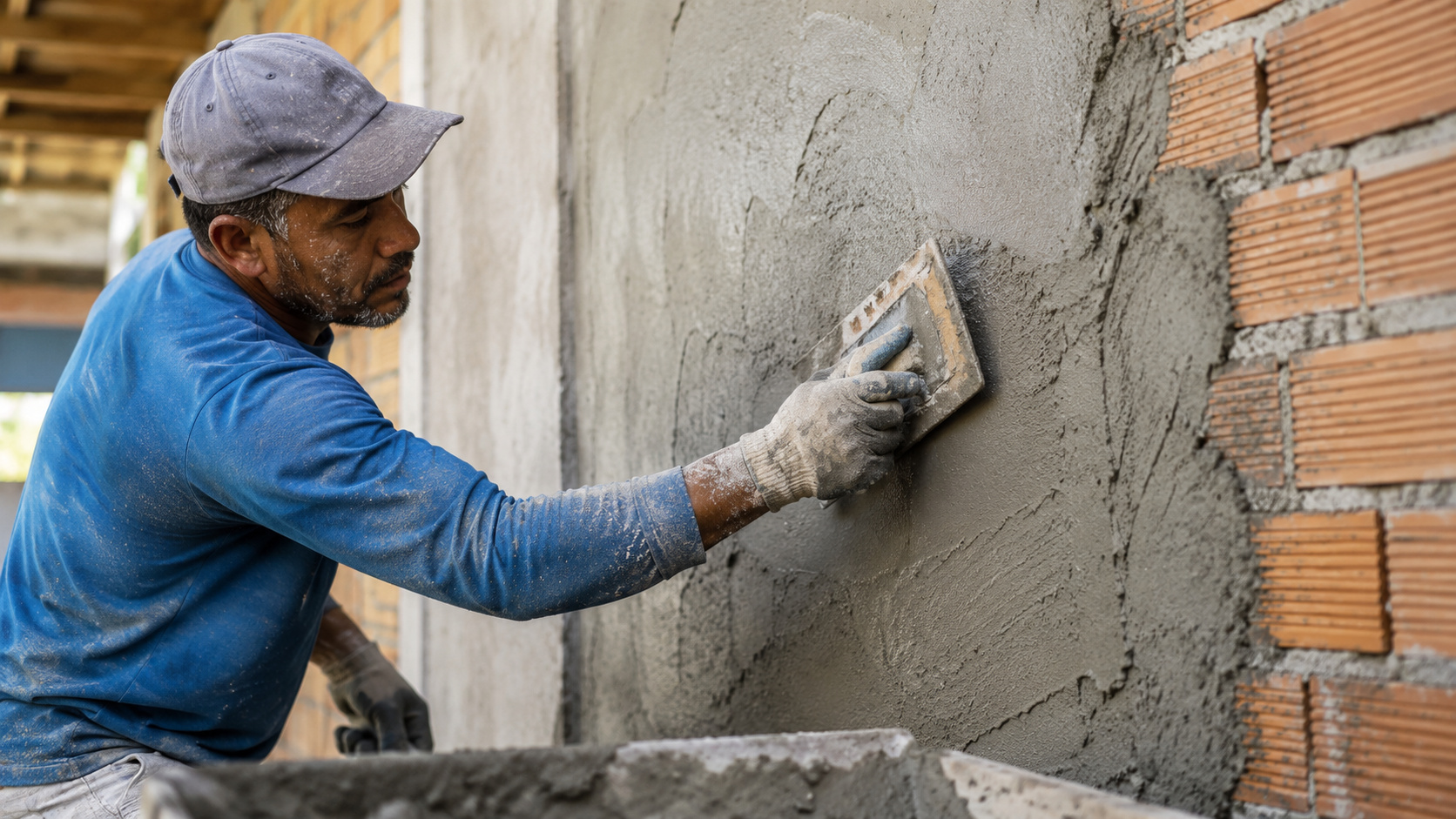
This logic is different from conventional masonry. While bricks and blocks are laid piece by piece, the system with EPS usually depends on assembly, alignment, metal reinforcements, and subsequent application of concrete, microconcrete, or mortar.
Therefore, the material should not be seen as fragile just because it is associated with common styrofoam. On-site, EPS is part of a composite solution, in which steel, concrete, and coatings are responsible for essential functions of resistance, stability, and protection.
Difference between EPS and traditional masonry
The main change compared to brick is in the construction process. Instead of relying solely on the manual laying of blocks, the system with EPS can allow for a more streamlined assembly of walls, provided the project and team are prepared.
This characteristic can favor site planning, reduce repetitive steps, and facilitate the handling of components. Still, the real time gain depends on factors such as the type of construction, logistics, supplier, available team, and finishing standard.
There is no secure basis, in the official sources consulted, to state that EPS reduces any construction by a fixed percentage. Percentages of economy or speed should only be used when directly linked to a study, test, or identified technical comparison.
Lightness can help, but does not eliminate calculation
The low mass of EPS is one of the points that explain its use in industrialized or streamlined construction systems. The material facilitates transport, movement, and assembly, especially when compared to heavier components.
Even so, the foundation cannot be automatically reduced just because the construction uses EPS. The calculation needs to consider the final weight of the coated wall, the building loads, the type of soil, the coverage, the wind action, and the structural set.
In practice, any possible savings in foundation must be defined by the responsible engineer. Without this analysis, the lightness of the system becomes just a characteristic of the material, not a guarantee of cost reduction or structural change.
Safety depends on technical evaluation
The Ministry of Cities informs that SiNAT evaluates innovative products used in construction when there are not enough prescriptive Brazilian technical standards for a given system. The goal is to verify performance, quality, and compliance for use in residential construction.
A Technical Evaluation Document related to the iForms system, for example, states that IPT conducted an evaluation according to SiNAT Guideline No. 011 for walls molded on site with EPS and concrete. The document also mentions ABNT standards applicable to concrete and care for use and maintenance.
This type of reference shows that performance does not depend solely on EPS. The final result involves design, components, thicknesses, reinforcements, concrete, execution, technological control, and planned maintenance for the system.
Where EPS can make sense
The system tends to be more attractive in projects that value rationalization, lightness, and better execution control. Residences, enclosures, and repetitive projects can benefit when there is a qualified supplier and trained team.
On the other hand, bricks and ceramic blocks remain very present in Brazil due to their wide availability, known cost, and the familiarity of the workforce. In many cities, hiring professionals accustomed to conventional masonry is still simpler.
The choice, therefore, should compare the overall cost, not just the price of the material. Transportation, productivity, coatings, installations, losses, training, and technical requirements need to be considered before making a decision.
EPS does not make bricks obsolete
The advancement of EPS shows that Brazilian civil construction has alternatives beyond traditional masonry. Even so, the material should not be treated as a universal solution, nor as an automatic substitute for brick, cement, and ceramic block.
When specified correctly, the system can expand options for projects seeking lightness and organization on the construction site. When used without design, evaluation, and qualified execution, it loses some advantages and increases the risk of future problems.
The safest decision is to treat EPS as a technical construction system, with professional responsibility and appropriate documentation. Its advantage appears when design, execution, and control work together, without turning a useful technology into a generic promise of savings.