Portuguese
  Spanish


Hanging 625 meters above a canyon, Guizhou’s new crossing set an engineering record and changed the lives of those who used to circle the mountain for hours
The world’s highest bridge was inaugurated in China and is suspended an impressive 625 meters above the Beipan River in the southwest of the country. The structure, called the Huajiang Grand Canyon Bridge, transformed a journey that used to take about two hours through the mountains into a trip of just two minutes.
The structure is in Guizhou province and is 2,890 meters long, with a main span suspended 1,420 meters. Inaugurated in October 2025 after three years of construction, it surpassed the previous record, which was also in the same region, and became a symbol of China’s race for megastructures.
625 meters of free fall to the Beipan River
The defining number of the work is the height. There are 625 meters between the deck and the water of the Beipan River, equivalent to a skyscraper of more than 200 floors hanging between two mountains. The location is so deep that the canyon’s crack in the terrain is nicknamed “the world’s crack.”
-
Proper Cement Mix Extends Plaster Durability, Prevents Early Detachment, and Reduces Home Structural Risks

-
Brazilian Researchers Develop Plant Fiber Cement Absorbing 100 kg of CO2 per Cubic Meter, Aiming for Low-Carbon Construction

-
Brazil’s Largest Sewage Plant Boosts Capacity with New High-Performance Pumps, Treating Over 1 Billion Liters Daily
-
Brazilian Mother and Homemaker Becomes Bioconstructor, Builds 24-Ton Earth Dome and Teaches Technique Across Argentina


To give an idea of the scale, according to the Portuguese broadcaster Renascença, the bridge extends 2,890 meters over this span. The combination of record height with a huge free span is precisely what makes the project technically challenging, as the wind and the structure’s own weight become much more dangerous at this distance from the ground.
From 2 hours to 2 minutes
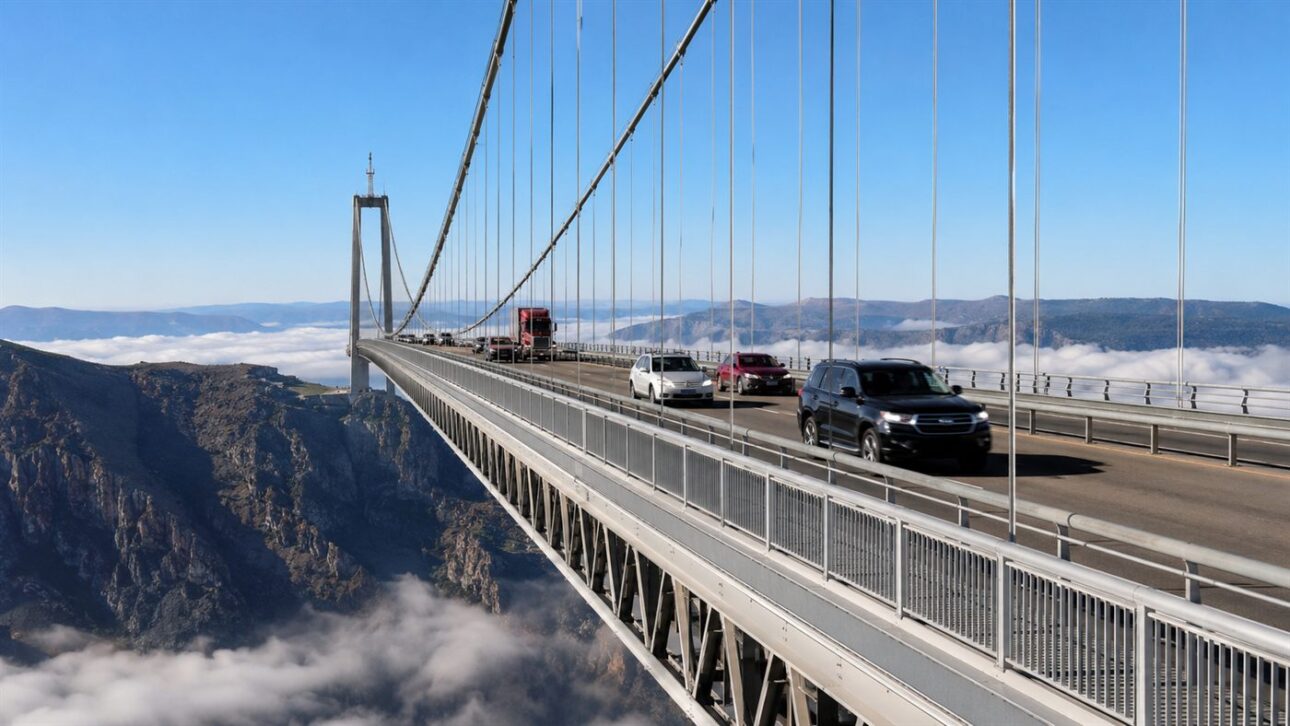
The work is not just a spectacle; it solves a real logistics problem. Before the bridge, crossing the canyon required descending and ascending the mountain through winding roads, a journey that took about two hours. With the crossing open, the same route now takes two minutes.
This leap in efficiency justifies the investment. Every truck, bus, and car that crosses the bridge stops burning fuel and time circumventing the terrain. In a mountainous region, shortening distances means reducing costs, which is why China treats bridges as pieces of economic development, not just as postcards.
The tallest bridge in the world is almost nine times the Golden Gate
To understand the magnitude of the achievement, comparisons are worthwhile. According to Euronews, the structure is almost nine times taller than the Golden Gate Bridge in San Francisco, and more than twice as tall as The Shard skyscraper in London.
These reference points help the reader feel the vertigo of the work. The Golden Gate, a symbol of 20th-century engineering, seems modest next to this work. Chinese engineering has raised the global bar to a level that seemed unattainable. The Huajiang Bridge doesn’t just break the record, it shatters it, making it clear that the global height standard has changed.
Three years of construction with drones, satellites, and ultra-high-strength steel
Building at 625 meters high, between two rock walls, required cutting-edge technology. The assembly used satellite navigation, drones, and ultra-high-strength materials, with intelligent monitoring systems that ensured millimeter precision during the fitting of the pieces.
All this was done in just three years. The bridge is classified as the largest in free span of the truss beam type suspended in mountainous terrain, a specific category that measures the challenge of covering a huge span amid mountains. Erecting such a structure without it swaying too much in the wind is the kind of feat that separates common engineering from record-breaking engineering.
Guizhou, the province that became the world’s bridge capital
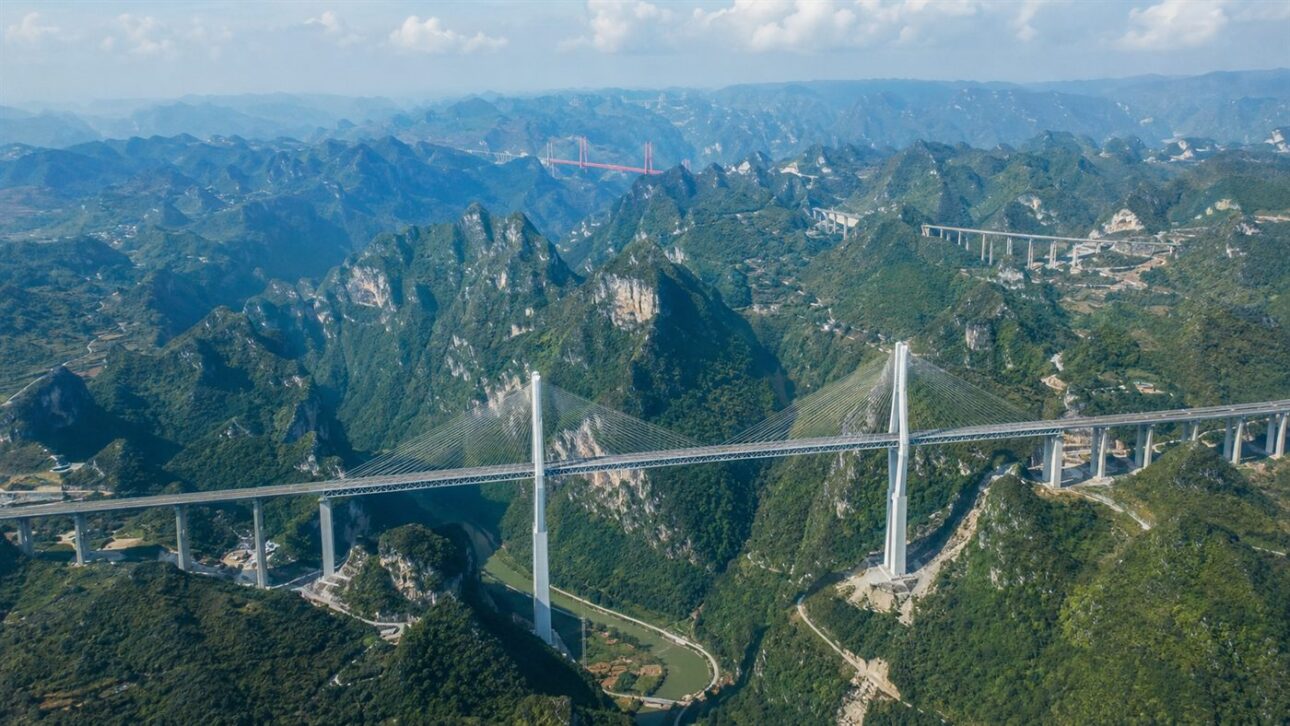
It is no coincidence that the tallest bridge in the world was born in Guizhou. The province concentrates about half of the 100 tallest bridges on the planet and houses more than 30,000 bridges in total. The rugged terrain, full of canyons and enclosed rivers, has turned the region into an open-air engineering laboratory.
This accumulation of works created a learning curve. Each new bridge takes advantage of the knowledge from the previous one, which explains why records fall so quickly there. Guizhou has become a showcase of construction technology, and the government uses these structures as proof of industrial capability to the world.
The record it took from another Chinese bridge
The most revealing detail is who it dethroned. The previous record for the highest bridge was also Chinese and also spanned the Beipan River, at 565.4 meters, inaugurated in 2016. In other words, in less than a decade, China itself surpassed its own record in the same region and over the same river.
This shows a pace of advancement that is hard to keep up with. While many countries spend years discussing the feasibility of a single major project, the region strings together world records almost in series. The 60-meter difference between one bridge and another is a measure of how much local engineering has evolved in just a few years.
Why building such extreme bridges pays off
It may seem excessive to spend so much to cross a canyon, but the math works out due to geography. The southwest of China is cut by mountains that have historically isolated cities and hindered the flow of production. Each bridge that spans an abyss connects markets that were previously separated by hours of road travel.
The effect is both economic and social. Companies gain access to suppliers and customers, tourism grows, and isolated populations can reach hospitals and schools more quickly. The project is expensive, but isolation was even more costly, and it is in this calculation that projects like Huajiang are justified.
A milestone that redefines what is possible
The world’s highest bridge consolidates China as an absolute reference in major engineering works, capable of erecting structures that would have seemed impossible a few decades ago. The height record is the visible part, but what truly impresses is the speed and precision with which everything was done.
The question remains that every project of this magnitude leaves in the air: how long until the next bridge surpasses this mark, probably in the same Chinese province? Would you have the courage to drive across a bridge 625 meters high over a canyon?