






 Portuguese
  Spanish


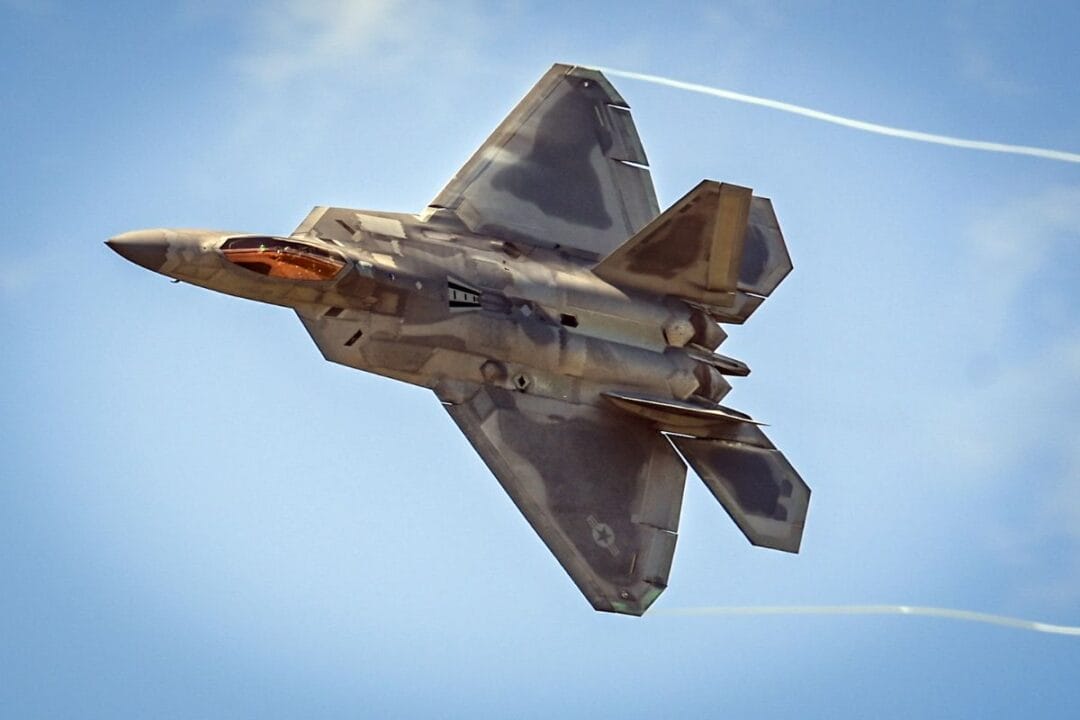


American Fighter Combines Speed, Stealth, and Cutting-Edge Engineering to Dominate the Skies Since 2005
When it comes to cutting-edge military technology, few names command as much respect as the F-22 Raptor. Developed by Lockheed Martin and Boeing, it was the world’s first fifth-generation fighter to enter service. Since 2005, it has been regarded as a benchmark in air combat and advanced engineering.
The F-22 features unique characteristics: stealth capability, sustained supersonic speed, extreme maneuverability, and a next-generation arsenal. All of this is in an aircraft designed to operate undetected, without losing power, and with unmatched agility.
Stealth Technology and Radar-Absorbing Materials
The main advantage of the F-22 Raptor is its invisibility to radars. This is made possible thanks to the use of composite materials, such as carbon fiber, and coatings that absorb electromagnetic waves. Its angular shape also reduces radar signature, making enemy detection more difficult.
-
Australian Megafactory Austal Constructs 380-Foot, $74 Million High-Speed Ferry for Canary Islands Capable of Carrying 1,100 Passengers and 278 Cars at 38 Knots

-
Scientists Develop Battery Using Mineral Found in Bones and Chalk, Surviving 1,000 Charges While Retaining 75% Capacity, Paving the Way for a Lithium-Free Future

-
Super-Earth Twice the Size of Our Planet Discovered Nearby, Offering Clues About Life Beyond the Solar System
-
Teen Invents Promising AI Device to Detect Eye Misalignment Using 3D-Printed Visor and Small Cameras for $300





With this, the F-22 can approach targets, attack, and disappear before being identified. This stealth technology has been a game-changer in the military landscape, rendering many conventional radars obsolete.
Engines with Supercruise Provide Tactical Advantage


The propulsion system of the F-22 Raptor is another highlight. It is equipped with two Pratt & Whitney F119 engines, which allow it to reach supersonic speeds without needing afterburners. This capability, known as supercruise, provides fuel efficiency and greater operational range.
The F-22 reaches speeds exceeding Mach 2, maintaining stable performance at high altitudes. This ensures a quick response in combat situations and strategic movement with greater energy efficiency.
Three-Dimensional Maneuvers with Thrust Vectoring
The F-22 Raptor also innovates with its 3D thrust vectoring system. This means that its engines can direct the thrust flow at different angles, allowing for maneuvers that no other conventional fighter can execute.
In combat situations, this capability ensures tactical superiority, enabling tighter turns, abrupt direction changes, and greater control in close-range engagements.
An Engineering Rarity with Limited Production
Despite its technological excellence, the F-22 Raptor ceased production in 2012, with only 195 units manufactured. This makes it one of the most exclusive aircraft in the world, operated exclusively by the United States Air Force.
Its legacy, however, continues to influence the development of new fighters and defense systems across the globe. The F-22 remains, nearly two decades later, a masterpiece of modern aerospace engineering.








Duas décadas, 20 anos de avanço sobre todos os outros países do mundo!!!!! Que mais terão nos USA que ainda ninguém sabes? Outro como o SR72?