Portuguese
  Spanish


Subterranean structure discovered on the Dingle Peninsula, in the southwest of Ireland, was preserved without signs of violation, had a chamber lined with stones, possible fragment of human bone and may help archaeologists understand funerary practices up to 4,000 years old
A common improvement work on a rural property in Ireland revealed an archaeological structure that was hidden beneath the soil. The discovery occurred on the Dingle Peninsula, in County Kerry, when a large slab was moved and exposed a stone-lined passage.
The structure was assessed by archaeologists associated with the National Monuments Service and the National Museum of Ireland. The initial hypothesis is that the tomb may belong to the Bronze Age, a period situated, in the context cited by researchers, between 2000 BC and 500 BC, although an older dating has not yet been ruled out.
According to Smithsonian Magazine, the find attracted attention because the tomb appeared to be in its original state, with no signs of previous opening. The publication reported that the chamber contained human remains and an oblong stone, which increased scientific interest in the site’s function.
-
NASA Targets Saturn’s Icy Moon Titan as a Waystation for Interplanetary Travel, Utilizing Its Resources for Fuel and Astronaut Support

-
Researchers Revolutionize Nanotechnology with Rocket-Inspired Modular Nanorobot for Efficient Microscopic Missions

-
AI Deciphers 1.4 Meters of Text from a 2,000-Year-Old Scroll Carbonized by Mount Vesuvius Without Unrolling It

-
Ferrari, BMW, Tesla, and Chinese Automakers Shift from Copper to Aluminum Wiring to Reduce Weight and Costs in Electric Vehicles



The exact location was kept secret to prevent invasions, damage, or removal of materials. The decision also allows the investigation to proceed with technical control, as part of the structure remains buried.
The displaced stone revealed a chamber that did not appear in the landscape
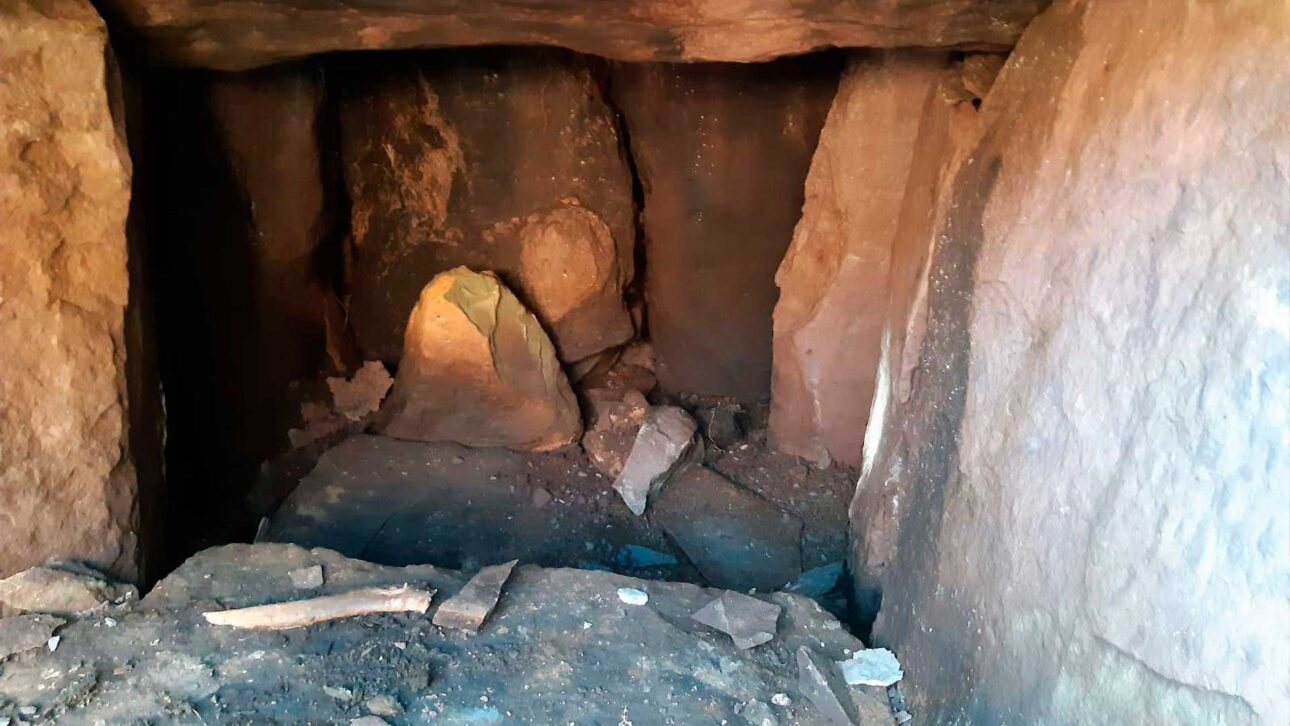
The find began when a large stone was turned during work on the land. Below it, appeared an aligned stone passage, with the appearance of planned construction rather than natural formation.
According to the Irish Times, the structure appears to have a larger chamber and a smaller one connected to it. The newspaper also reported that possible fragments of human bone and a cylindrical stone that may have been smoothed by human action were found.
For archaeologists, this detail changes the reading of the terrain. It is not just an ancient cavity, but a construction with positioned slabs, heavy covering, and internal organization, signs of collective work and deliberate choice of location.
The archaeologist Mícheál Ó Coileáin, cited in Irish reports, observed that the presence of the upper slab and the orientation of the structure resemble Bronze Age tombs. Even so, he pointed out a significant difference: the design does not completely coincide with other known burials in the region.
Why the intact tomb weighs more than the chance of discovery
The value of the find lies less in how it appeared and more in the state in which it was found. Many ancient tombs in Ireland have been disturbed over centuries by agriculture, construction, looting, or stone reuse.
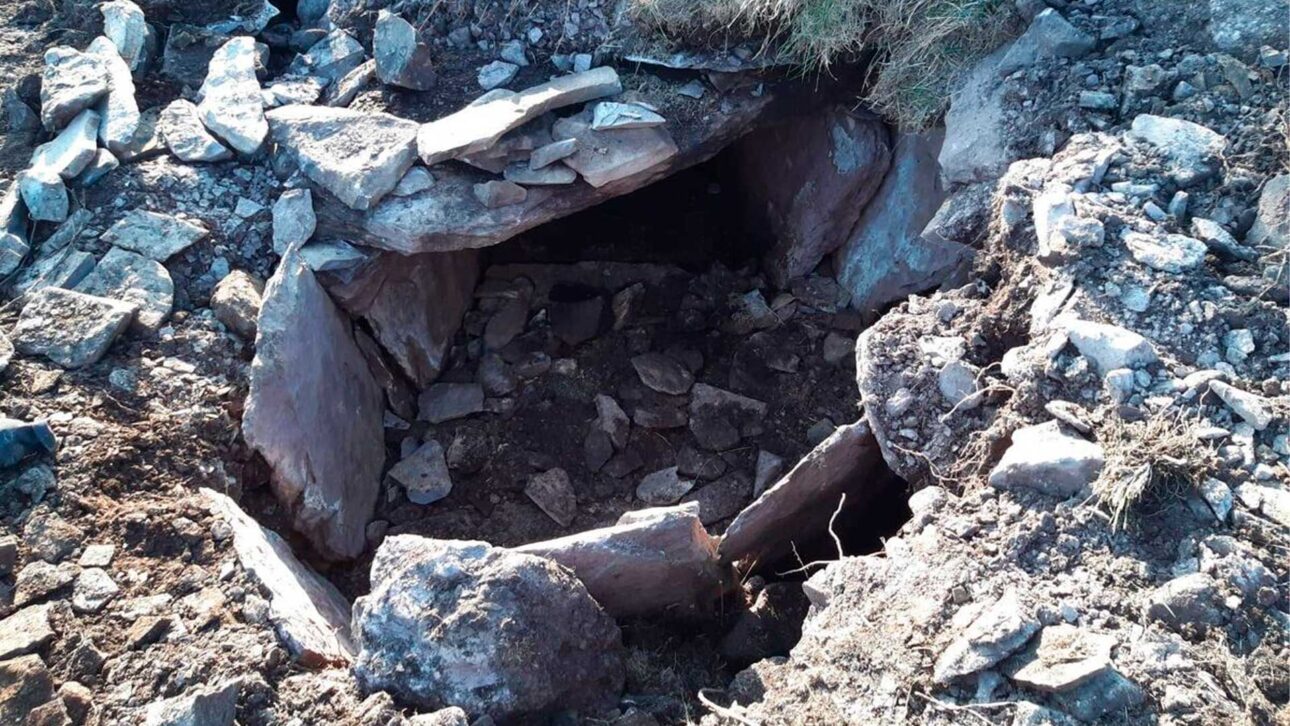
In this case, experts indicated that the structure was preserved and without apparent interference. This allows for the investigation of the position of the stones, arrangement of the remains, shape of the chamber, and relationship with the surrounding landscape.
Archaeology Magazine classified the site as a possible Bronze Age tomb lined and covered with stones, with human bone and an oval stone removed for protection during the investigation. The publication also noted the assessment that new analyses could help better define the age of the set.
This type of preservation is rare because it retains clues that normally disappear. The position of a bone fragment, the inclination of a slab, or the way the entrance was closed can indicate whether the space was used for burial, ritual, or both.
The Dingle Peninsula was already an ancient map of burials and monuments
The Dingle Peninsula is located in the southwest of Ireland and is one of the country’s richest archaeological areas. The region gathers tombs, circular forts, medieval remains, and prehistoric structures associated with communities that have occupied the territory for millennia.
Smithsonian Magazine records that the area has had human presence for about 6,000 years and houses about 2,000 ancient monuments still identifiable. This context helps explain why an isolated discovery there can connect to a larger set of occupation, routes, rituals, and land use.
Among the known types in the region are the so-called wedge tombs, wedge-shaped tombs. They usually have an elongated gallery, narrower and lower at the back, often oriented to the west or southwest.
The new structure, however, does not easily fit into this classification. One of the differences cited by archaeologists is that many wedge tombs appear above ground, while this one was completely hidden.
The question now is whether the site was a burial, ritual, or another underground structure
There is still no definitive conclusion about who built the tomb or its exact use. The main hypotheses point to a prehistoric burial chamber, possibly from the Bronze Age, or to an underground structure from a later period.
The Irish Examiner reported that, after the owner’s alert, archaeologists from the National Monuments Service and the National Museum of Ireland visited the site. The report also noted the possibility that the structure could be an early medieval souterrain, linked to nearby ringforts, or a much older burial chamber.
Souterrains were underground structures used in some contexts for storage, shelter, or protection. This hypothesis gained traction because there are other remnants in the vicinity, but it still competes with the prehistoric burial interpretation.
The safest path will be controlled archaeological investigation. The analysis of bones, the type of stone, the internal construction, and possible residues may indicate whether there was human burial, ceremony, ritual deposit, or reuse in another period.
The preservation of the site has become a central part of the investigation
After the initial assessment, the structure was kept protected and the location remained restricted. This precaution prevents curious individuals from entering the land, moving stones, or contaminating materials that can still be analyzed.
In findings of this type, damage does not always come from large clandestine excavations. A simple displacement of fragments can erase information about the original order of the chamber.
The decision to preserve the site also has scientific impact. If the tomb is indeed from the Bronze Age, it can provide data on funerary practices, social organization, and the choice of ritual areas in ancient Ireland.
The find on the Dingle Peninsula shows how part of the archaeological heritage still remains under common rural areas, outside major tourist sites. In this case, a slab moved on the land opened a passage to a structure that may have been closed for thousands of years.
Do you think archaeological discoveries on private properties should be kept confidential until the end of the analyses? Should the preservation of the site come before full public disclosure? Leave your opinion in the comments and join the discussion.