Portuguese
  Spanish




The Legendary Fenemê, Which Transported Cement to Brasília and Challenged Impassable Roads, Has Resurged in a 100% Electric Version. The Model Is Already in Testing with Companies Like Ambev and Brings Up to 355 HP of Power. But Will It Reclaim the Roads?
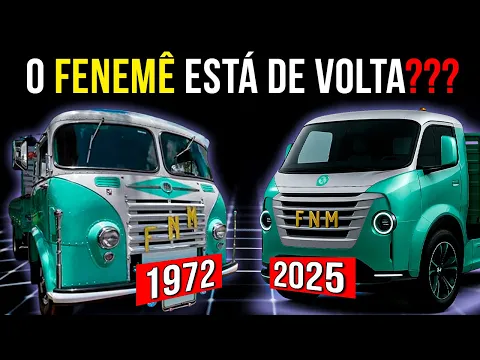
Few people from the new generation have heard the unmistakable roar of the Fenemê, that brave truck that crossed Brazil with 11 tons on its back, mired in mud or swallowed by dust. An icon of the national industry from the 1950s to the 1970s, the giant disappeared discreetly in the 1980s. But now, decades later, the improbable has happened: the Fenemê is back — and more modern than ever.
This time, without a diesel engine, without smoke, without that noise that woke up the entire neighborhood. The new version is electric, with zero emissions and a total focus on sustainability. And yes, it is already on the road — even if still timidly, but with giant companies watching.
Fenemê: From Airplane to Truck, From War to Construction Site

The Fenemê was born in 1942, at the peak of the Estado Novo, to manufacture airplane engines during World War II. But the war ended before the factory ramped up. The result: Brazil was left with a mega structure idle in Rio de Janeiro.
-
2027 Toyota Corolla Cross Unveiled: New Design, Enhanced Fuel Efficiency, Reduced Maintenance Costs, Advanced Technology, Connected Services, and Up to 10-Year Warranty

-
Fiat Cronos Precision 2018: Affordable Sedan with Spacious Trunk and Reliable Maintenance
-
Volkswagen to Cut Production by 1 Million Cars by 2030, Reducing Jobs and Platforms, Focusing on More Profitable Models

-
Toyota Launches First 100% Electric Car in Brazil: bZ4X with 343 HP, All-Wheel Drive, 361 km Range, Priced at $419,990 BRL, Limited to 99 Units



The solution? Transform the mission: from airplanes to trucks. With support from the Italian Alfa Romeo, the National Engine Factory launched its first success in 1951: the D-9500. But it was in 1958 that the Fenemê became a legend, with the D-11000, the famous “flat-nosed” truck, featuring a powerful six-cylinder diesel engine, deep noise, and brute force.
It was a key player in massive projects, such as the construction of Brasília. While the JK government promised to achieve “50 years in 5,” it was the Fenemê that transported cement, gravel, and workers through the rough cerrado. With each muddy patch conquered, it gained respect.
From National Pride to Disappearance: The Glory Cycle of the Fenemê
For two decades, the Fenemê dominated Brazilian roads. It was synonymous with robustness and independence. Many drivers rode for 20, 30 years with the same model. In some towns in the countryside, seeing a Fenemê parked was as common as seeing a Beetle.
But starting in the 1970s, with market opening and the arrival of competitors like Mercedes-Benz, Scania, and Ford, the story began to change. The FNM was sold to Alfa Romeo, then transferred to Fiat. In 1985, the last Fenemê factory was closed. And the truck that built Brazil became a museum item and a collector’s passion.
The Return of Fenemê: From Noise to Electric Silence
The turning point came in 2008. A company from Rio announced that it had purchased the rights to the FNM brand. But the new Fenemê did not want to repeat the past. The proposal was bold: to bring back the icon, now as a 100% electric truck.
The new FNM, renamed as National Mobility Factory, partnered with Agrale and began developing two models: the FNM 832 (13 tons) and the FNM 833 (18 tons). Both are electric, with 350 HP, instant torque, and a range of up to 150 km.
The first tests are already underway with fleets from Ambev, which ordered a thousand units. Production takes place in Caxias do Sul (RS), and the trucks are equipped with telemetry systems and zero emissions. It’s the Fenemê like you’ve never seen: no noise, no gears, no smoke.
Will It Work? The Challenges of the New Fenemê Era
Despite the excitement, the path of the new Fenemê still has obstacles. The biggest of these is the price. Electric trucks cost much more than diesel ones. Brazil is still lagging in charging infrastructure.
The new FNM’s bet is to offer direct sales to large companies, along with maintenance packages, fleet management, and technical support. The idea is to be more than a manufacturer — to be a partner in clean mobility.
Even so, the emotional appeal is strong. Veteran drivers and collectors cheered at the return. The classic logo has been preserved. And the name Fenemê — the same one that originated from the popular pronunciation of the letters F-N-M — is once again emblazoned on the hoods.