Portuguese
  Spanish


Silent change in flex engines alters technical specifications of popular cars and SUVs in Brazil, as manufacturers adjust power to reduce the impact of the Green IPI and maintain competitiveness in a market pressured by costs, margins, and new tax rules.
Manufacturers based in Brazil have started recalibrating flex engines to reduce the declared power of some of their cars and, with this, try to pay less IPI, the Tax on Industrialized Products, in a strategy that already reaches high-volume models.
This movement gained strength after the regulation of the Green IPI, within the Mover program, which started considering power among the criteria used in the tax calculation and changed the way manufacturers evaluate their national engines.
For years, the IPI charge was heavily influenced by engine displacement, which helped popularize 1.0 turbo engines in compacts, sedans, and higher-value SUVs sold in the Brazilian market.
-
2027 Toyota Corolla Cross Unveiled: New Design, Enhanced Fuel Efficiency, Reduced Maintenance Costs, Advanced Technology, Connected Services, and Up to 10-Year Warranty

-
Fiat Cronos Precision 2018: Affordable Sedan with Spacious Trunk and Reliable Maintenance
-
Volkswagen to Cut Production by 1 Million Cars by 2030, Reducing Jobs and Platforms, Focusing on More Profitable Models

-
Toyota Launches First 100% Electric Car in Brazil: bZ4X with 343 HP, All-Wheel Drive, 361 km Range, Priced at $419,990 BRL, Limited to 99 Units




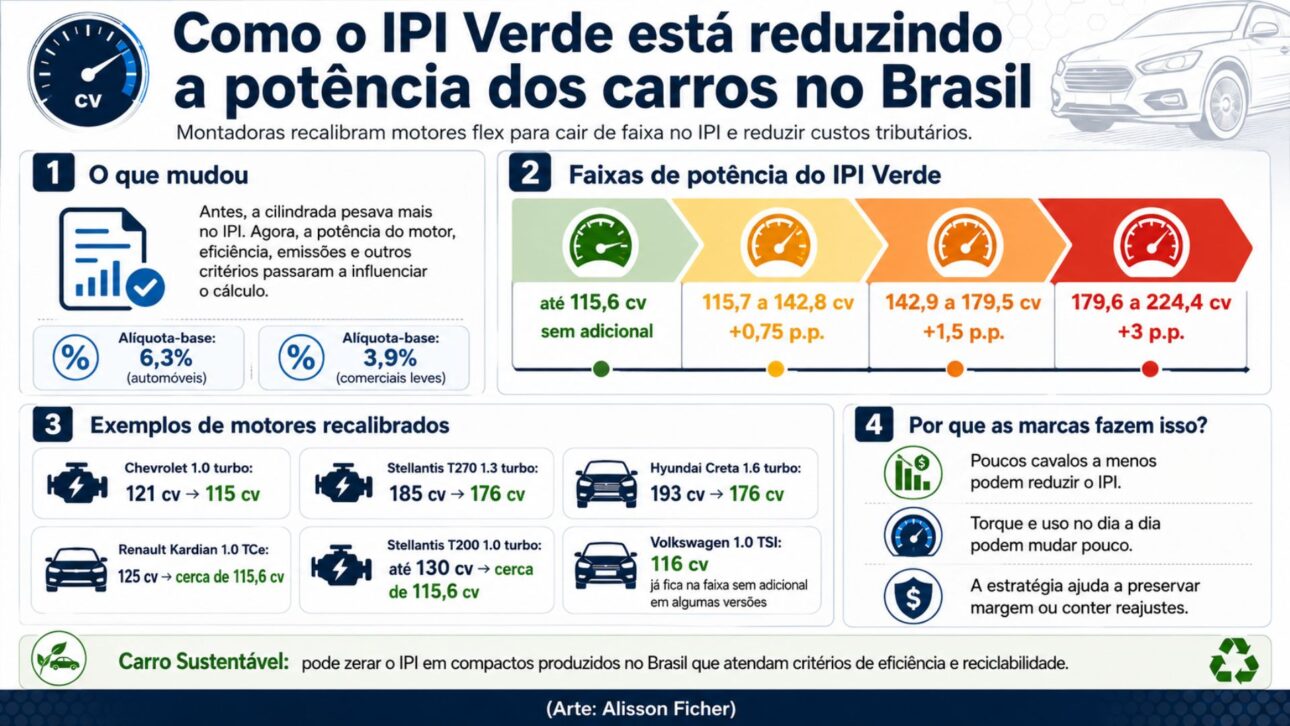
With the new table linked to efficiency, emissions, safety, recyclability, propulsion technology, and power, a few less horsepower can represent significant tax savings for brands that produce vehicles in the country.
The mechanism starts from a base rate of 6.3% for passenger cars and 3.9% for light commercials, with additions or reductions according to the technical and environmental classification of each vehicle.
In practice, more efficient and less polluting models can receive discounts, while vehicles classified in less favorable bands start to have percentage points added to the tax, which pressures costs and prices.
With power at the center of this formula, engineering areas have started adjusting calibrations of already known engines, seeking to place vehicles close to the limits of the most advantageous tax bands.
This strategy does not necessarily require a deep physical change in the mechanical set, but it can alter the maximum power reported in the technical specification to position the car in a lower tax band.
Power became a decisive factor in the calculation of the Green IPI

According to the Green IPI table, flex cars with power between 115.7 hp and 142.8 hp receive an increase of 0.75 percentage points in the tax, a range that affects several compact turbo engines.
Models between 142.9 hp and 179.5 hp, in turn, are subject to an addition of 1.5 percentage points, which makes small power reductions important for manufacturers operating near this limit.
Above this level, the charge increases more significantly, as vehicles with power from 179.6 hp to 224.4 hp have an increase of 3 percentage points in the IPI calculation.
For this reason, reducing a few horsepower can move a car from a more expensive range to a lower tax bracket, without necessarily altering its everyday use perceptibly.
This difference helps explain why several manufacturers have started working close to the limits established by the table, preserving torque whenever possible and reducing the fiscal impact on high-volume models.
In addition to the Green IPI, the federal government created the Sustainable Car category, which eliminates the tax for compact vehicles produced in Brazil and meeting specific efficiency and national production criteria.
To enter this category, the car must emit less than 83 grams of CO₂ per kilometer, have more than 80% recyclable materials, be manufactured in the country, and fit into entry-level categories.
Stellantis reduces power in Jeep and Fiat engines
Among the changes already applied, Stellantis made one of the most visible alterations to the T270 1.3 turbo flex engine, used in Jeep Renegade, Compass, and Commander, as well as Fiat Toro and Fastback.
The set, which previously delivered 185 hp with ethanol, now declares 176 hp, a reduction sufficient to drop a bracket in the tax calculation and ease the charge on these models.
With this recalibration, vehicles equipped with the T270 leave the range of 3 percentage points increase and move to the 1.5 percentage points range, maintaining presence in strategic segments.
The loss of maximum power functions, in this case, as a way to reduce the tax burden without removing these vehicles from relevant categories for the manufacturer, especially among SUVs and pickups.
Another company movement is expected to involve the T200 1.0 turbo flex engine, currently found in Fiat Pulse, Strada, and Fastback, Peugeot 208 and 2008, as well as Citroën C3, Aircross, and Basalt.
Currently advertised with up to 130 hp with ethanol, the set is expected to be recalibrated to be close to the limit of 115.6 hp, maintaining the torque of 20.4 kgfm in the planned applications.
The debut of this new calibration is expected in the national Jeep Avenger, scheduled to hit the Brazilian market within this launch cycle, before advancing to other group products.
After this first application, the adjusted engine is expected to appear in the new generation of the Fiat Argo and gradually reach other Stellantis models that share the same mechanical base.

Chevrolet adjusts power of Onix, Tracker, and Sonic
At Chevrolet, the adjustment to the new tax scenario came in July 2025, when the brand recalibrated its 1.0 turbo flex engine, reducing the power from 121 hp to 115 hp.
Even with the change in maximum power, the torque advertised for the main models remained unchanged, which helps preserve the perception of performance in urban accelerations and recoveries.
In the Onix and Onix Plus, equipped with a version without direct injection, the torque reaches 16.8 kgfm, while Tracker and Sonic, with direct injection, reach 18.9 kgfm.
With the lower power, these vehicles escape the addition of 0.75 percentage points planned for engines above 115.6 hp, reducing the tax impact on models of great commercial relevance.
The decision reinforces the importance of compact cars and entry-level SUVs for General Motors in Brazil, where small tax differences can influence costs, margins, and price positioning.
In high-volume products, an apparently discreet adjustment in the technical sheet can have a significant effect on the manufacturer’s operation, especially in a market sensitive to dealership adjustments.
Volkswagen benefited before the new rule
Even before the new IPI Verde rule came into effect, Volkswagen had already adopted the 1.0 turbo TSI engine with 116 hp in the Polo and Virtus.
The number disclosed in the commercial sheets is rounded, but the technical framework ended up placing versions of these models in a favorable position in the new table, even without direct reaction to the new tax.
With this engine, also used in the Tera, the brand remains in the range without an increase in percentage points in certain versions, which improves the competitiveness of these cars.
Models with the 200 TSI 128 hp engine, such as Nivus and T-Cross, remain subject to an additional 0.75 percentage point, as they are above the limit without an increase.
In this case, the change ended up working in favor of the manufacturer, although it did not necessarily originate as a direct response to the Green IPI or the new tax composition of automobiles.
The combination of a low-displacement turbo engine, contained power, and good energy efficiency has become even more valuable after the new taxation, especially in entry-level and mid-range models.
Hyundai recalibrates Creta’s turbo engine
Hyundai joined the same movement by recalibrating the 1.6 TGDi turbo engine of the Creta, which in the 2027 line was presented with flex fuel engine.
In this configuration, the set dropped from 193 hp to 176 hp, one of the largest reductions among the identified cases and sufficient to change the SUV’s tax framework.
With the new power, the Creta leaves the range of an increase of 3 percentage points and moves to 1.5 percentage points in the IPI calculation.
The change shows how the new table affects not only compact cars but also medium-compact SUVs and more expensive versions within the national ranges produced or sold in the country.
Another point under observation is the future compact SUV Hyundai i20, expected to be produced in Brazil, which could use the 1.0 TGDi turbo engine in its more expensive versions.
Currently associated with about 120 hp and 17.5 kgfm, this engine could be adjusted to around 115 hp, avoiding the addition of 0.75 percentage points if the brand follows the logic applied by rivals.
Renault Kardian aims for lower tax framework
The Renault Kardian should also be included in the list of recalibrated models, according to Autoesporte’s findings on the 1.0 TCe turbo flex engine, with three cylinders, 12 valves, and direct injection.
Currently, this setup delivers 125 hp and 22.4 kgfm of torque, figures that place it above the limit without the IPI increase foreseen for flex engines in the new table.
The expectation is for a reduction of about 10 hp so that a more accessible version fits into the Sustainable Car program, seeking more favorable taxation within the current rules.
In this configuration, the Kardian would not have additional percentage points, while more powerful versions would continue to be subject to an increase of 0.75 percentage point in the tax calculation.
This measure reinforces the trend of different calibrations within the same family of models, allowing entry-level versions to meet tax requirements without altering the entire line.
Thus, more accessible configurations can prioritize tax compliance, while more expensive options preserve superior performance and assume a higher tax cost within the brand’s commercial strategy.
Caoa Chery also recalibrates turbo engines
A similar path was taken by Caoa Chery with turbo engines used in national models, following the same logic of reducing power to seek a more favorable tax bracket.
The reduction in the 1.5 turbo setup would have allowed a saving of 0.75 percentage point in the IPI, while the adjustment applied to the 1.6 turbo would represent a drop of 1.5 percentage points.
In both cases, the engines came to occupy the upper limit of their new brackets, but always below the previous tax step, reducing the incidence of increases in the final account.
This logic is repeated among different manufacturers: losing a few horsepower can be enough to avoid a greater tax penalty, especially when the engine is close to the table limit.
For some consumers, the change may go unnoticed, as many calibrations preserve torque and behavior in everyday use, even with a reduction in the declared maximum power.
In the technical specifications, however, the trend is already clear: national cars become less powerful while automakers try to balance price, margin, efficiency, and competitiveness in a market sensitive to increases.