





 Portuguese
  English
  Spanish
  4 min of reading
  1 comment


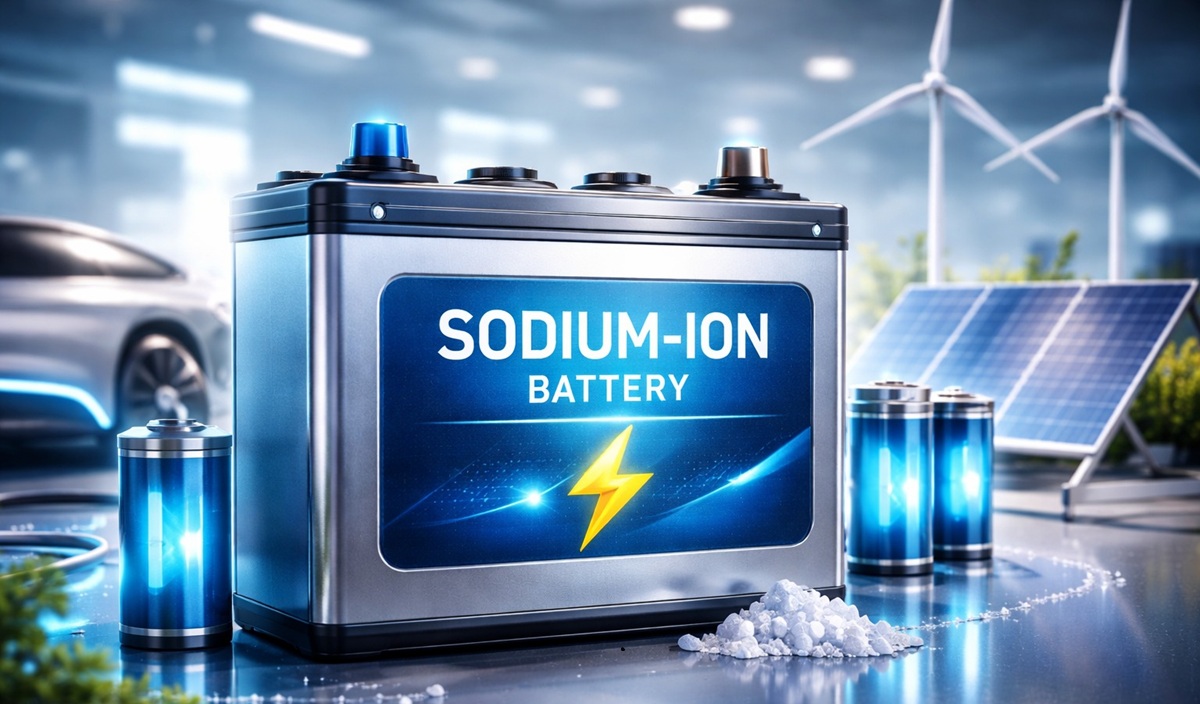


Study Published on December 15, 2025 Describes How a New Carbon-Based Electrolyte Enabled Sodium-Ion Batteries to Achieve Charging Rates Comparable to or Higher Than Lithium-Ion Batteries, with Gains in Safety, Thermal Stability, and Potential for Large-Scale Energy Storage
Researchers from the University of Tokyo’s Science Department demonstrated, in a study on December 15, 2025, that sodium-ion batteries with a new carbon-based electrolyte achieve fast charging, higher energy density, and safety improvements compared to lithium-ion batteries, with implications for large-scale storage.
Context and Motivation for Alternatives to Lithium-Ion
Scientists assert that the days of lithium-ion batteries, considered risky, may be numbered following advances in the fast charging of sodium-ion batteries. Na-ion technology is being investigated for its potential to offer greater stability and lower costs, although technical challenges have limited its adoption.
According to researchers, the newly developed sodium-ion batteries can achieve faster charging speeds, higher energy density, and safety improvements compared to conventional Li-ion batteries. The study directly addresses historical limitations that have hindered the promised practical performance.
-
Brazilian Army reaches a new level by receiving the first 100% national EOD robot to disarm explosives and reduce risks in UN missions; this unprecedented technology will be used by the 6th Combat Engineering Battalion in high-complexity operations.

-
Forget the traditional washing machine: Xiaomi surprises and launches a mini version with a double drum, 95°C sterilization, smart sensor drying, separate washing for underwear, integration with HyperOS, and a price equivalent to R$ 1,100 in China.
-
Brazilian company with 23,000 employees seeks humanoid robots in China and Japan to replace repetitive tasks in 1,400 restaurants, as the advancement of automation and the possible end of the 6×1 schedule transform the food sector.
-
Man confronts NASA astronauts and says the Artemis 2 mission was “staged” “Stop lying”: video shows accusations against crew that spent more than 10 days in space on a mission followed live by millions of people worldwide


Electrochemical Structure and Role of Hard Carbon
All batteries have anode and cathode, electrodes that determine current flow. In lithium-ion batteries, the cathode is predominantly graphite, an efficient material for storing lithium ions to be discharged later.
In sodium-ion batteries, graphite is replaced by hard carbon, a porous combination formed by thousands of basic turbostratic structural units. This complex crystalline structure excels in sodium-ion storage and, in theory, allows for very fast charging.
Previous research with hard carbon faced challenges in proving the practical viability of these rates. Ions entering dense electrolytes at high speeds experience deceleration similar to a traffic jam, reducing the performance observed in the lab.
New Electrolyte and Overcoming the Charging Bottleneck
In the study published on December 15, 2025, in the journal Chemical Science, scientists sought to overcome this obstacle. The group combined small concentrations of hydrocarbons with aluminum oxide, a chemically inert material, forming a combined electrode.
This approach allowed ions to flow freely into the hard carbon particles without traffic issues. With the bottleneck resolved, researchers demonstrated that sodium ions can enter hard carbon at rates similar to lithium ions in graphite.
Results indicate that the main limiting factor of the process is the filling rate of the pores of the hard carbon. In these nanoscopic pores, ions form pseudometallic clusters, a critical step for efficient charge storage.
Activation Energy and Implications for Speed
Detailed analysis revealed that sodium ions require less energy to form these clusters in the pores. This suggests that, under proper conditions, sodium-ion batteries can achieve faster charging rates than lithium-ion batteries.
The study’s lead author, Shinichi Komaba, a professor in the Applied Chemistry Department at the University of Tokyo, explained that achieving faster kinetics in filling the pores is essential for high charging rates.
According to the researcher, the results also suggest that sodium insertion is less temperature-sensitive, considering a lower activation energy than lithiation. This characteristic broadens the operational range of the technology and reinforces its practical potential.
Large-Scale Applications and Energy Storage
In practice, the results could contribute to the wider adoption of sodium-ion batteries in applications requiring extreme charge and discharge rates. Large-scale energy storage systems would benefit from the ability to release energy quickly on demand.
Furthermore, stability is considered critical when batteries are used on a large scale to store energy produced from renewable sources. The combination of fast charging and operational stability meets critical requirements for this sector.
Researchers highlight that Na-ion technology, under the tested conditions, can respond to demand spikes without compromising safety, a central factor for modern and resilient energy infrastructure.
Safety and Risks Associated with Lithium-Ion Batteries
Sodium-ion batteries are described as safer than lithium-ion ones, according to a 2025 study conducted by researchers from the Islamic University of Technology, Idaho State University, and the University of Waterloo. Stable sodium ions are less likely to trigger chain reactions.
The National Fire Chiefs Council in the UK declared that battery storage systems based on lithium-ion represent a significant fire risk. Once ignited, these batteries cannot be easily extinguished.
Thermal runaway, a self-sustaining process that causes lithium-ion batteries to ignite, can persist even without oxygen. The British Safety Council noted that once ignited, batteries in some electric vehicles can burn for hours or days.
Quantitative Conclusions of the Study
If produced at scale, the tested sodium-ion batteries could completely avoid these risks. The results presented quantitatively demonstrate that the charging speed of a Na-ion battery with a hard carbon anode can exceed that of a Li-ion battery.
In a statement, Komaba stated that the data confirm faster charging rates for sodium-ion batteries compared to lithium-ion batteries. The study reinforces the viability of the technology and its potential industrial impact, even with ongoing development.








Mas e o hidrogênio de etanol brasileiro, vai ou não vai prosperar!!??.. 🤔