Portuguese
  Spanish


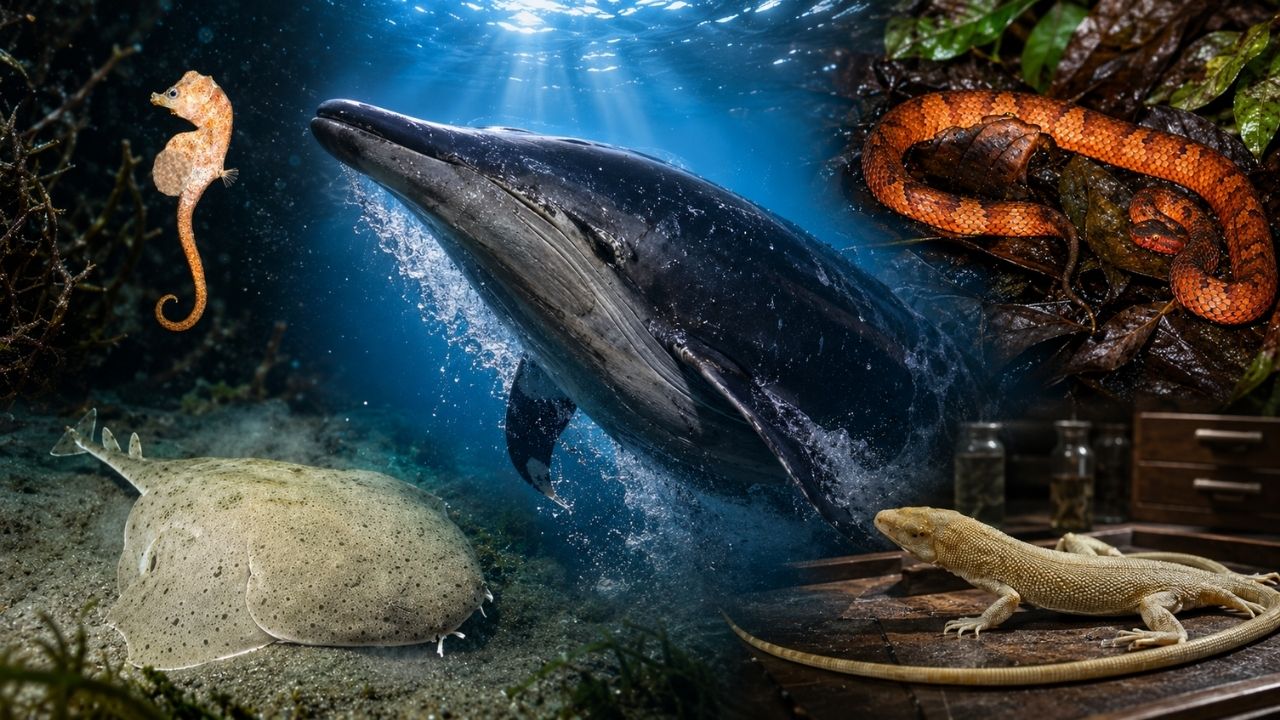

Among rare animals known by bones, accidental captures, and museums, the list includes a whale never seen alive, a shark of a single specimen, a venomous snake found in India, a deep seahorse, and a forgotten lizard, showing how species still escape science in deep oceans and remote forests of the planet even with modern technology.
The rarest animals hardest to study are not always small or discreet: there is a whale never seen alive, a shark known by a single specimen, a venomous snake found by chance, and a lizard forgotten for decades in a museum before being recognized by science.
The list compiled by the Forrest Galant channel on YouTube includes a whale that has never been observed alive, an angel shark known by a single specimen, a venomous viper found by chance, a tiny seahorse retrieved from the depths, and a monitor lizard that was forgotten for decades in a museum before being recognized as a different species.
A large whale that science has never seen alive

The spade-toothed whale is one of the most impressive cases among the rare animals known to science. It can measure about 16 to 17 feet, but despite its size, it has never been seen alive. Everything known about the species comes from individuals found dead on beaches.
-
Bottle Caps in the Garden: A Creative Solution You Won’t See the Same Way Again

-
Brazilian Producer Adopts Hydroponic Strawberry Farming in Western Paraná, Achieving Year-Round Harvests and Becoming a Model for Continuous Production

-
Vale Achieves 45% Female Hiring in Mining by 2025, Surpassing Target a Year Early with 109% Increase in Six Years

-
Over 400 Gold Coins Found in Shipwreck Linked to 17th-Century Dutch Vessel, Unveiling Historic Trade Between Morocco, the Netherlands, and England




The first record dates back to 1872, when a lower jaw was found on a remote island. At the time, scientists didn’t even realize they were facing a different species and even associated the material with another type of whale. Only much later, with DNA tests, was it clear that those remains belonged to a practically unknown species.
In 2010, a female and a calf appeared dead on a beach in New Zealand. Even so, the identification was only confirmed after genetic tests. Science had the animals before its eyes but still didn’t know exactly what it was seeing.
The explanation for so much mystery may lie in the species’ behavior. Beaked whales are deep divers, capable of spending hours submerged and reaching dark regions of the ocean. Therefore, it is possible that entire populations live in the South Pacific without direct visual contact with researchers.
Shovel-shaped teeth and nine stomachs with squid remains
The most striking detail of the shovel-toothed whale is found in the males. They have large, shovel-shaped teeth that protrude from the lower jaw and can reach about 9 inches. The hypothesis is that these teeth are used in disputes between males in the depths.
A more recent specimen allowed scientists to better study a fresh and intact body. During the analysis, nine separate stomachs with squid beaks were found, reinforcing the idea that the whale is a deep-water hunter.
Even with these clues, almost everything remains unanswered. It is not known how it behaves alive, how it reproduces, how many individuals exist, or where exactly it spends most of its time.
The most curious thing is that it is not a hidden insect or a tiny fish. It is a large whale, yet still classified among the planet’s most enigmatic rare animals because science has only encountered it after death.
Philippine angel shark was found only once

The Philippine angel shark is another example of a species that seems to have appeared and disappeared from scientific records. It is known from only one specimen: an immature female, just over one foot in length, captured on September 23, 1995 off the coast of Luzon, Philippines.
This animal was found during a deep-water trawling operation, at more than 1,200 feet deep. The environment where it lived is dark, cold, and little explored, which helps explain why it has never been recorded again.
At first glance, scientists thought it was a similar species, the Taiwan angel shark. Years later, a more careful analysis of details such as spiracle spacing, fin shape, and body characteristics showed that it was a new species, officially described in 2011.
Since then, no second specimen has been confirmed. This does not prove that the species is extinct, but it shows how some rare animals can exist in areas where science almost never manages to observe directly.
Camouflage on the seabed can hide the species
Angel sharks have an unusual appearance. Their flattened bodies resemble rays, with large wing-shaped pectoral fins. Instead of continuously swimming like many sharks, they tend to stay still on the bottom, camouflaged in the sand, waiting for prey to approach.
This strategy makes the animal extremely difficult to detect. Even if there are other individuals on the seabed, they may go unnoticed in scientific surveys, especially at less accessible depths.
The problem is that the same environment where the shark may be hiding also suffers from human activities. Deep-sea trawling and longline fishing can affect species living on the bottom, especially if the population is already small.
To rediscover the Philippine angel shark, it would be necessary to use deep-water surveys, remotely operated vehicles, or even rely on another accidental capture. Until then, it remains one of the most mysterious rare animals ever recorded in the ocean.
Arunachal viper was found by chance in India

The Arunachal viper is a highly venomous snake discovered by accident in the forests of northeastern India. The animal was found during a biodiversity survey in Arunachal Pradesh, when a researcher and a local guide were walking through a steep forest region.
At first glance, it seemed just another viper camouflaged among dry leaves. But when the scientists looked closer, they realized it did not match any known species. The analysis of scales, anatomy, and genetic tests confirmed it was a new species of viper.
The discovery drew attention because it was the first new species of viper recorded in India in over 70 years. Since that single encounter, however, no other individual has been confirmed.
The snake measures about 26 inches and has a discreet coloration on the upper part, ideal for blending into the forest floor. On the sides and belly, however, it presents bright reddish and orange tones, an unusual contrast for such a hidden animal.
Potent venom and difficult-to-access forest maintain the mystery
Like other vipers, the species has hemotoxic venom, capable of causing intense pain, bleeding, and tissue damage. Even so, the biggest challenge in studying it is not just the risk of the venom, but the location where it lives.
The forest where the viper was found is steep, remote, and little altered by humans. This condition raises the hope that the species still exists, but also makes new expeditions difficult.
It is possible that other vipers are there, hidden under leaves, without anyone seeing them. Snakes of this group are specialists in remaining still and camouflaged, able to go unnoticed even when they are very close.
Among the rare animals on the list, the Arunachal viper shows how a species can exist on solid ground, in a relatively preserved forest, and still almost completely escape science.
Tiny seahorse never seen alive in natural habitat

The bullneck seahorse is one of the strangest creatures on the list. It measures about 2 inches when adult and has an unusual appearance, with a wide neck, disproportionate head, and short snout.
The species was officially described in 1997, from specimens collected by trawl nets in deep waters near Eden, in New South Wales, Australia. Since then, there have been no new confirmed records in the wild.
Scientists believe it lives more than 3,200 feet deep, perhaps in even deeper areas. This hypothesis helps explain why divers have never seen it and why the species remains so little known.
Everything about its behavior is still an estimate. It is believed that it uses its tail to cling to corals, algae, or structures on the bottom, like other seahorses, but no one has observed this directly.
Trawl fishing may have affected the habitat before science understood the species
The major concern is that deep-sea trawl fishing may have damaged important areas of the seabed before researchers understood where the seahorse lived.
If the species depends on deep corals or undisturbed seabeds, the destruction of these environments could pose a significant risk. The problem is that almost nothing is known about its actual distribution.
Australian fishermen, according to the source’s report, recall similar animals seen decades ago, describing the same thick neck and short snout. This suggests that the species may have been informally known by local communities before gaining scientific attention.
To find it again, it would be necessary to use ROVs, deep-water surveys, or even environmental DNA tests. Until then, this small seahorse remains one of the rare animals that may be hidden in a deep and little-observed world.
Zug’s Monitor Lizard was forgotten for years in a museum

Zug’s Monitor Lizard is a different but equally curious case. It was found on the island of Halmahera, Indonesia, in 1980, but was not immediately recognized as a distinct species.
The specimen, a juvenile of 14.2 inches, was kept in a museum for many years. Only later did scientists realize that it did not correspond to any known monitor lizard.
Since the collection of that single individual, there have been no confirmed records in the wild, photos, or direct observations. Researchers still do not know what it eats, where it spends most of its time, or how it behaves.
The mystery is even greater because monitor lizards are usually active animals. In theory, they would be easier to find than tiny deep-water species, but this one has almost completely disappeared from records.
Halmahera’s forests may still hide the species
The island of Halmahera has dense tropical forests, difficult terrain, remote valleys, and little-explored areas. Unlike other cases, the region is not described as completely devastated, which keeps alive the possibility that the species still exists.
Local residents have reported seeing similar animals in different parts of the island, but this information has never been confirmed. Nevertheless, the reports suggest that the lizard may not have disappeared.
The region has also revealed other species of monitor lizards over the years. This makes it plausible that Zug’s Monitor Lizard is still hidden in some part of the forest.
Among all the rare animals mentioned, it may be one of those that most depend on well-planned land expeditions. Research with local communities, trails in remote areas, cameras, and night searches could help confirm if the species still lives.
What these animals reveal about the limits of science


These five cases show that science is still far from knowing all the life on the planet. Some rare animals live in deep oceans, others in steep forests, and some may even already be stored in collections without anyone realizing their importance.
The absence of new records does not automatically mean extinction. In many cases, it may simply indicate difficulty of access, extreme camouflage, discreet behavior, or lack of research in the right place.
The most fascinating thing is that each species raises a different question. The whale may be alive in deep waters; the shark may be buried at the bottom of the sea; the viper may hide among leaves; the seahorse may depend on fragile habitats; and the lizard may walk through forests that almost no one explores.
In the end, these rare animals remind us that disappearing from human eyes is not the same as disappearing from nature.
And you, which of these species surprised you the most: the whale never seen alive, the single specimen shark, the venomous snake, the deep seahorse, or the lizard forgotten in a museum? Share your opinion.