






 Portuguese
  Spanish
  3 min of reading
  0 comments


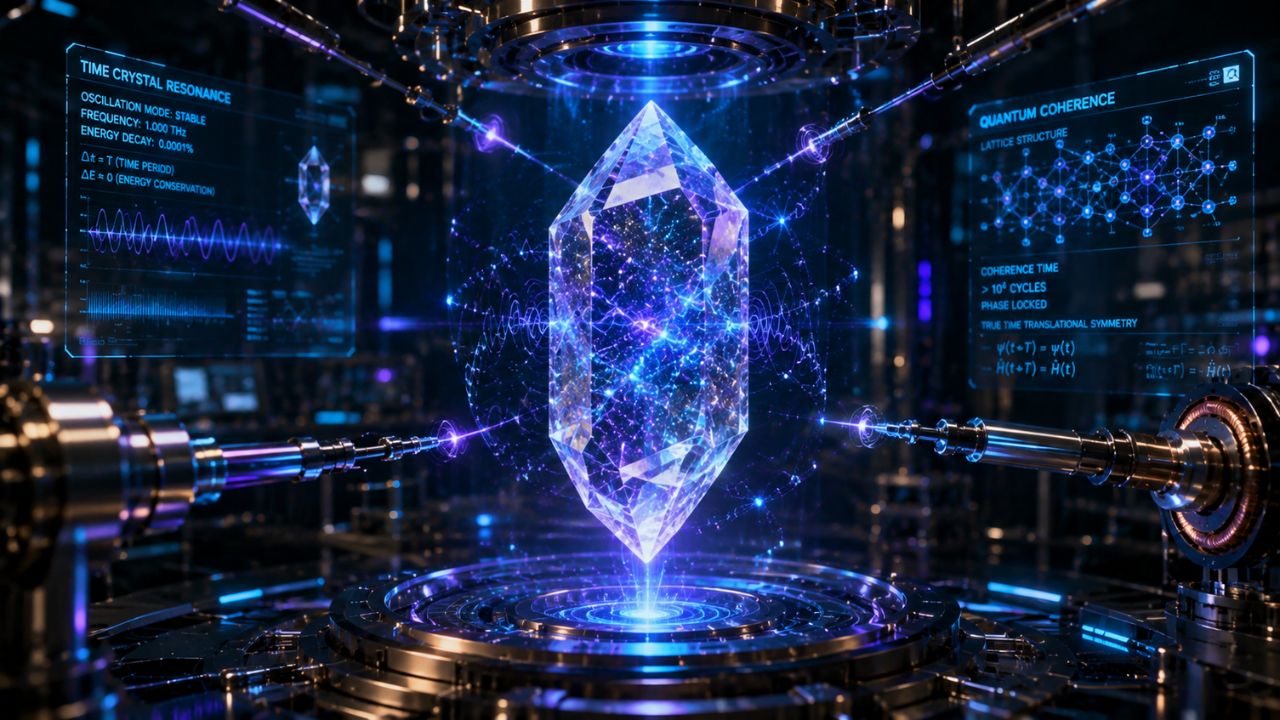
Researchers at the University of Colorado created a time crystal observable with the naked eye using liquid crystals and blue light. The material self-sustainably repeats patterns and can be used in security systems such as banknotes and official documents.
One of the greatest milestones in physics is the creation of a visible time crystal, but researchers issue an important warning: this system is not a perpetual motion machine.
According to Olhar Digital, although the material exhibits a stripe pattern that cyclically repeats in time in a self-sustaining manner, it relies on energy from an external light source to keep its molecules in motion.
The experiment conducted at the University of Colorado Boulder (CU Boulder) proves that it is possible to tangibly “crystallize time,” transforming an abstract theory into a phenomenon that can be observed even with the naked eye, without generating free energy or violating thermodynamics.
-
Helicopter Drops 180 Tons of Sand and Gravel on Swedish River to Revive Ecosystem Damaged by Decades of Exploitation

-
Brazilian Company Launches Retro Smartphone with 48 MP Camera, T9 Keyboard, and Privacy Features for Social Media-Free Use

-
Self-Taught Chinese Farmer Builds 5-Ton Submarine from Scrap, Launches It in Anhui River
-
Invisible Induction Technology Enables Wireless Power for Blenders, Coffee Makers, and Air Fryers, Reducing Countertop Cables



Time crystal: The end of the perpetual motion myth
Constant blue light directs molecules on the surface of a glass cell, allowing them to organize into a perpetual rhythm.
Therefore, the system has very specific characteristics:
- Energy consumption: The material does not produce useful work; it merely organizes the received light into a temporal pattern.
- Rhythmic stability: The movement is continuous as long as there is illumination.
- Scalability: Future studies still need to define how to maintain this order in large-scale devices.
The evolution of an idea
The concept that matter could repeat itself in time, just as salt repeats itself in space, was originally proposed in 2012 by physicist Frank Wilczek.
At the time, the idea seemed impossible and failed several initial theoretical tests. However, it served as a spark for the search for “driven” versions of matter.

Before the success at CU Boulder, demonstrations were limited to the field of quantum computing — such as Google’s use of the Sycamore processor — where the phenomenon was invisible and required indirect readings.
According to Hanqing Zhao, responsible for the visual documentation of the new experiment: “They can be observed directly under a microscope and even, under special conditions, with the naked eye.”
The mechanics of the glass cell and the “world of crystals”
The physical structure that allowed this unprecedented observation consists of an ultra-thin glass cell containing rod-shaped liquid crystals, strategically positioned between plates with dye.
Professor Ivan Smalyukh, from CU Boulder, described the fascinating simplicity of the process in an official statement: “Everything is born from nothing. Just project a light, and this whole world of time crystals emerges.”
This configuration allowed the moving stripe pattern to be tracked and confirmed as an observable form of time crystal. While ordinary crystals are fixed, this liquid and dynamic version returns to the same state at every instant, functioning like a visible molecular clock.


With the tangibility of the phenomenon, the focus now shifts to commercial utility. The team identified that the precise rhythm of these oscillations can be used to create high-fidelity security systems.
As a pattern that changes over time is vastly more difficult to copy than a static image, its use in banknotes or official documents is one of the closest goals. Thus, what began as a mathematical curiosity about the symmetry of the universe is moving towards becoming an authentication tool.

With information from Olhar Digital and videos from Smalyukh Lab




-

1 person reacted to this.