Portuguese
  Spanish


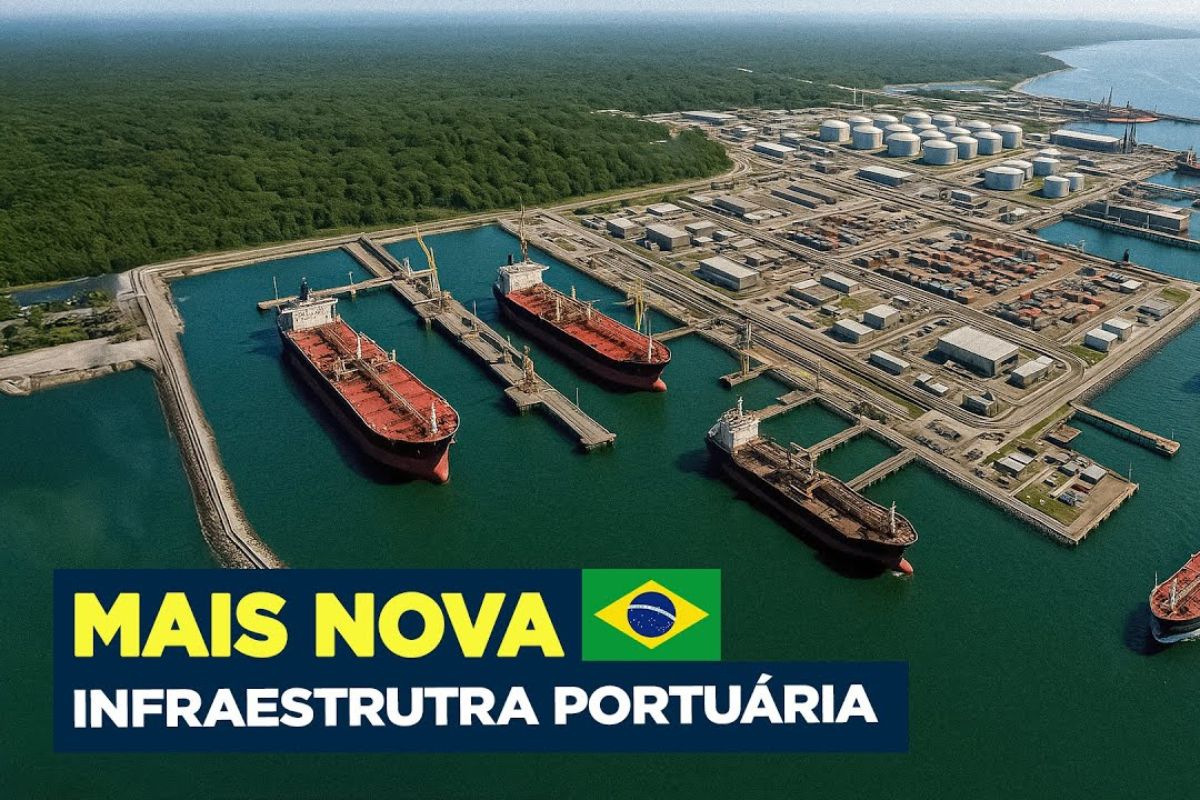


Outside the Urban Area, the New Brazilian Port Is Born with Screening for 1,200 Trucks per Day, Reception of 800 Wagons, Internal Railway to the Berth, Seven Panamax and Neopanamax Berths, and Phased Operation for Bulk, Liquids, and Containers
The new Brazilian port was designed to solve a classic bottleneck: trucks in urban queues and short docking windows. Installed outside the urban area of Paranaguá, in the Emboguaçu region, the project combines large yards, highway and railway hoppers, and an internal railway that brings the train to the berth. The design prioritizes operational safety and predictability, with dedicated screening for 1,200 trucks per day and an estimated reception of 800 wagons per day at full capacity.
With approximately 200 hectares of back area and a 21-kilometer internal railway axis with mixed gauge, the new Brazilian port connects to the existing network and the future Nova Ferroeste, increasing the train’s share of up to 70% of cargo at the terminal. At project capacity, total movement reaches 37 million tons per year, totaling solid, liquid bulk, and containers. Seven Panamax and Neopanamax berths make up the integrated dock, with enclosed belts and high-capacity shiploaders for clean and quiet operation.
Location and Operational Design
The site chosen, west of the organized port of Paranaguá, was scaled for functional back area: truck screening, warehouses, railway yards, and pipeline corridors.
-
Entrepreneur Sells Car to Launch Healthy Meal Business, Now Runs Mr. Fit with 880 Stores in 3 Countries and $40 Million Annual Revenue

-
End of an Era: Renault Plans Major Overhaul, Cutting Jobs to Compete with Chinese Rivals and Transform Engineering by 2027
-
Brazil’s Largest Grain Port Faces Delays in the Hinterlands, Missing Rail Link Costs Agribusiness Billions

-
Egg Prices Drop Due to Weak Demand as Poultry Producers Increase Purchasing Power


The orientation of the dock and accesses prioritizes maneuverability and flow segregation, reducing interference between highways, railways, and the dock.
The positioning outside the urban area removes heavy traffic from the city perimeter, reducing accident risk and emissions.
The new Brazilian port structures the train-ship connection as a single process.
The railway and highway hoppers unload into enclosed belt lines, with direct transfer to silos, tanks, or shipping.
The internal railway yard allows for formation and disassembly of trains without occupying public rail, shortening cycles and expanding the loading window onto ships.
Railway to the Berth and Truck Screening
The mixed gauge in the 21 km internal ensures compatibility with the current and future network, allowing the train to reach the berth without intermediate transshipments.
This solution reduces losses, standardizes cycle times, and eases seasonal peaks from agriculture, when rail flow needs to match the harvest.
At the highway interface, the screening of 1,200 trucks per day organizes arrival windows, electronic weighing, and segregated access to the yards, reducing idle times.
Operational beacons and OCR at gates speed up checking and reduce errors, while digital scheduling smooths demand curves during harvest days and docking windows.
Capacity by Phases and Cargo Segregation
The implementation is modular by phases, allowing operation while expanding.
In the first phase, the focus is on agricultural bulk, with hoppers, enclosed belts, and a railway backbone.
The next phase adds liquid bulk with vertical cylindrical tanks and loading arms at the dock.
In the technological stage, container yards with electric RTG and STS, OCR at gates, and predictive management systems for queues, docking, and vessel stay are introduced.
The total capacity of 37 million tons/year is distributed among solid, liquid bulk, and containers, with operational segregation that reduces window conflicts and allows 24/7 operation. Seven Panamax and Neopanamax berths ensure flexibility for different ship profiles.
Environmental Governance and Clean Operation
The new Brazilian port adopts fully enclosed belts for bulk to control dust and treatment stations for oily effluents in the liquid areas.
Containment basins and continuous monitoring of water and air structure environmental governance, with buffer zones and actions for controlled reforestation in sensitive surroundings.
Modal segregation reduces emissions per ton moved, as more cargo moves by train and fewer trucks circulate in the urban area.
This environmental logic also improves local public health, reducing noise, particulate matter, and road disputes with urban traffic.
Integration with Export Corridors
By connecting to the existing network and the future Nova Ferroeste, the new Brazilian port now anchors the West-East corridor, shortening the distance between agricultural borders and the Atlantic.
In practice, the train takes the lead in crop transportation, while the back area and screening balance the truck peaks during critical periods.
For the shipowner, the combination of railway to the berth, predictable windows, and Panamax/Neopanamax berths reduces waiting times and increases scale reliability, a central requirement for global container and bulk supply chains.
What Changes for the City, Carrier, and Industry
For the city, fewer trucks in the urban perimeter means less congestion and fewer accidents.
For the road carrier, the dedicated screening and scheduled window convert queues into productivity, with predictability in unloading.
For industry and agriculture, more windows and less variance in cycle times reduce logistics costs and operational losses.
The logic of the new Brazilian port is simple and technical: planned back area, internal railway, segregated berths, and phased operation.
At the intersection of train and ship, the gain appears on the spreadsheet and the shipping calendar.
The new Brazilian port was designed to remove trucks from queues, bring the train to the berth, and deliver predictability to the exporter, from grain to container.
Six pillars support the project: location outside the urban area, dedicated screening, rail integration, berth segregation, enclosed belts, and environmental governance.
We want to hear from you: in your opinion, which element delivers more immediate efficiency, the railway to the berth or the screening for 1,200 trucks per day?