





 Portuguese
  English
  Spanish
  3 min of reading
  0 comments



Ford Filed a Patent That Allows Collecting Driver Data, Including Conversations Inside the Vehicle, to Display Personalized Ads. Learn How This Technology May Impact Driver Privacy
Ford has just patented a system that could change the way we consume advertising in cars, but it’s generating mixed reactions among consumers. According to the patent filing, the automaker is protecting the idea of a system that uses various information sources, such as voice commands, personal preferences, and even conversations within the vehicle, to personalize ads displayed to occupants.
The patent suggests that the car could, in real time, adjust the type and format of ads based on what is happening around and inside the vehicle.
Ford System That Monitors and Adapts Ads
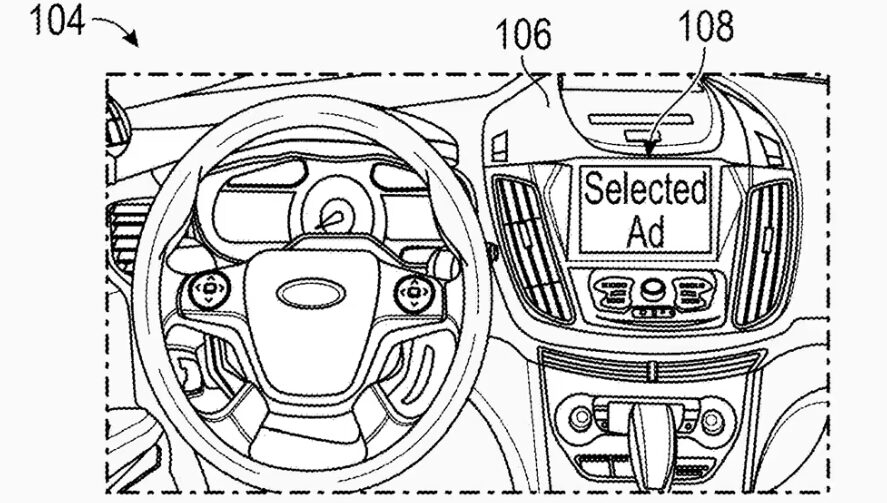
The concept described in Ford’s patent is complex and involves a combination of internal and external sensors. These sensors can detect the surrounding environment, such as weather conditions and traffic, and also monitor what happens inside the car, such as conversations and occupant preferences.
-
How does the Strada remain a leader in Brazil? Fiat bets on a 1.3 flex engine, a 130 hp turbo version, and a cargo bed of up to 1,354 liters to keep the pickup at the top of the Brazilian market.

-
BYD Atto 2 DM-i flex prepares to debut in Brazil with a plug-in hybrid engine, national assembly in Camaçari, competitive pricing, and targets Creta and T-Cross in a battle that promises to heat up the compact SUV market.

-
Harley-Davidson created an entry-level motorcycle that seems impossible for those who only know the brand’s big bikes: the X440 uses a 440 cc single-cylinder engine, delivers 27 hp, 38 Nm, a declared fuel consumption of 35 km/l, and showcases a small, rational, and much more accessible Harley in India.

-
GAC Aion UT lands in Brazil for R$ 135,990 as the most affordable electric car in the country with over 200 hp, surpasses BYD Dolphin in size, features a 360 camera, and offers up to 310 km of range to challenge Chinese rivals.


The idea is that, by identifying patterns and understanding context, the system could adjust the quantity and type of ads displayed.
For example, if the system detects that you are heading to the mall, it could display relevant ads for stores along the way.
If you prefer audio ads, the system adjusts the way they are displayed, perhaps every five minutes, depending on traffic conditions and the level of conversations in the car.
The system could also differentiate between occupants, offering visual ads to passengers and audio ads to the driver.
A Balance Between Monetization and Privacy
The system described in the patent does not ignore that occupants may not like having ads displayed while driving. The patent acknowledges that many consumers prefer not to see or hear ads in the car, but Ford seems to have thought of ways to circumvent this resistance.
The system would try to balance maximizing revenue with minimizing occupant irritation by scheduling ads at less intrusive times and ensuring relevance based on context.
By using an algorithm that assesses how users interact with ads — if they click or express dissatisfaction out loud, for example — the system would adjust the quantity and type of advertising displayed.
This means that if you show discontent, the system may reduce the ads, but if there is positive interaction, it may increase their frequency.
Not an Imminent Implementation, But…
It is important to note that the fact that Ford has filed for the patent does not mean that the system will be implemented soon.
The patent serves more as a way to protect the company’s intellectual property, ensuring that if the technology is developed in the future, Ford has rights over the idea.
In a statement to MotorTrend, Ford clarified that patent submissions are a normal part of the innovation process and do not necessarily reflect business plans or future products.
However, the system described in the patent raises questions about privacy and how far automakers may go in pursuit of new monetization methods.
In-Car Advertising: An Inevitable Trend?
With the growing number of subscription-based features, such as entertainment and navigation services, the idea of a system displaying ads in the car may not be so far from reality.
The system proposed in Ford’s patent may seem invasive, but it could also become a new way to generate revenue for automakers, especially if consumers are incentivized to accept it in exchange for discounts or benefits, such as a reduction in subscription service fees.
Regardless, the idea of being closely monitored while driving, with ads appearing based on your conversations or destination, may not please everyone. But, as the patent registration does not guarantee implementation, for now, Ford is simply protecting itself in terms of intellectual property.
However, as technology advances and personalization becomes more prevalent in consumers’ daily lives, in-car advertising may no longer be a question of “if,” but “when.”








Be the first to react!