Portuguese
  Spanish


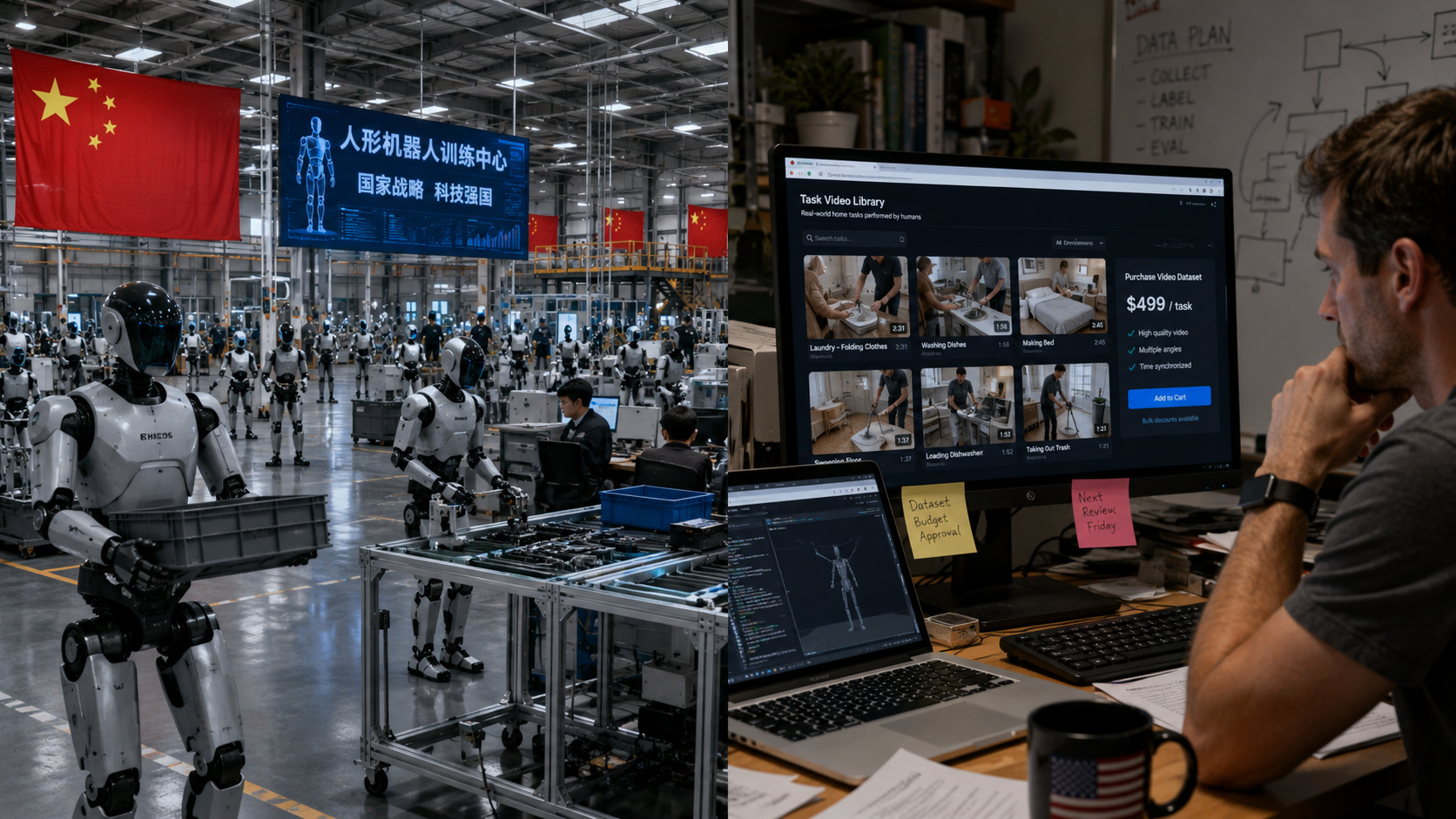

China expands humanoid robot training centers with state support, while companies in the US pay for videos of household tasks.
The race for humanoid robots has entered a more concrete and industrial phase. While in the United States, private companies have started paying workers to film everyday tasks and generate data for AI and robotics systems, China has advanced along a more centralized path, supported by local governments and organized in centers dedicated to the standardized production of data.
Instead of relying solely on scattered recordings made in homes and extra income apps, China has begun treating data scarcity as a strategic bottleneck in robotics. Rest of World reported that local governments funded 40 training centers to address this issue, at a time when so-called embedded intelligence became a national priority in the country.
Cyber workers train humanoid robots with repeated movements
At the center of this Chinese model is a new type of worker. In offices and collection centers, young people spend hours repeating simple gestures so that machines learn to execute them precisely, transforming human movements into training data for humanoid robots.
-
The Trap of Modern Technology: How Screen Overload and Digital Connections Can Impact Your Mental Health and Well-being

-
Wyoming Couple Grows Tropical Fruits Year-Round in -40°C Using Geothermal Greenhouse, Demonstrating Earth’s Heat Can Produce Oranges and Lemons in Snow Without Traditional Heating

-
Ship Returns from Brazilian Coast with Thirty Newly Discovered Life Forms
-
Nigerian Professor Invents Electricity-Free Refrigerator Using Clay Pots and Wet Sand, Extending Shelf Life of Vegetables to 27 Days; 7,000 Units Distributed in Energy-Deprived Villages





Rest of World reported the case of Kim, a 20-year-old computer science student, whose task for the week was to simulate opening a microwave door. Wearing a virtual reality headset and exoskeletons on his arms, he repeated the same gesture hundreds of times a day so that the robot beside him could copy the movement.
The report itself shows how this work has already gained its own identity. “We call ourselves cyber workers,” Kim told the publication, describing a monotonous routine but seen as part of a strategic gear for the advancement of Chinese robotics.
Humanoid robot training centers function as data factories
The physical scale of these spaces helps explain why the Chinese model draws so much attention. In the Shijingshan district of Beijing, the Beijing Humanoid Robot Data Training Center was described by the People’s Daily as the largest center of its kind in China and operates as a sort of school where robots undergo scenario-based learning before entering the market.

The center occupies two floors and replicates real production and everyday life environments, with modules ranging from coil separation and package packing to cooking and room organization.
According to the People’s Daily, the site works with 16 specialized disciplines, distributed in categories such as industrial manufacturing, smart home, elderly care, and integrated 5G scenarios.
The same publication reports that the main robot trained there is the Kuafu, standing 1.66 meters tall. So far, the robots trained there have already accumulated more than 20 operational skills, including material handling, inspection, and delivery, with success rates exceeding 95% in the tasks performed.
China uses state support to standardize data collection in robotics
The most striking feature of this model is not just the size of the facilities, but the direct presence of public power. Rest of World described these spaces as centers generally built by local governments and operated by robotics companies, in an attempt to solve the lack of structured data to train machines that need to act in the physical world.
In the case of the Shijingshan center, Rest of World reported that the facility was launched by the local government in partnership with the company Leju. The report also states that the space has more than 10,000 square meters and includes scenarios that simulate automotive assembly lines, smart homes, and elderly care environments.
The People’s Daily reinforces the logic behind this centralization. According to the publication, training done in isolation by companies tended to produce irregular and inconsistent quality data, while centralized and standardized production allows for the creation of more stable data sets, with lower cost and broader utility for the sector.
Standardized data becomes a strategic asset of embedded intelligence
The central argument of the Chinese model is simple: without organized, clean, and repeatable data, robots do not evolve quickly enough. The People’s Daily states that the center in Beijing was created precisely to tackle this bottleneck, producing scenario data that is then cleaned, labeled, and delivered to companies for the development of robotics models.
The publication also states that the center can generate millions of high-quality records per year. Furthermore, it is already part of a collection network distributed across different Chinese cities, such as Suzhou, Jinan, Hefei, and Zhengzhou, which shows that the goal is not just to train an isolated robot but to build a national data infrastructure.
In practice, this strategy brings data collection closer to the logic of industrial infrastructure. Instead of letting each company set up its own small laboratory and improvise methods, China attempts to transform data production into a shared base to fuel the next generation of physical AI systems and humanoid robots.
In the United States, private companies resort to paid everyday videos
On the other hand, the path is more fragmented and more guided by the private sector. An example of this appeared in March 2026, when DoorDash launched the Tasks app, described by TechCrunch as a new platform that pays delivery workers to perform activities aimed at improving AI and robotics systems.
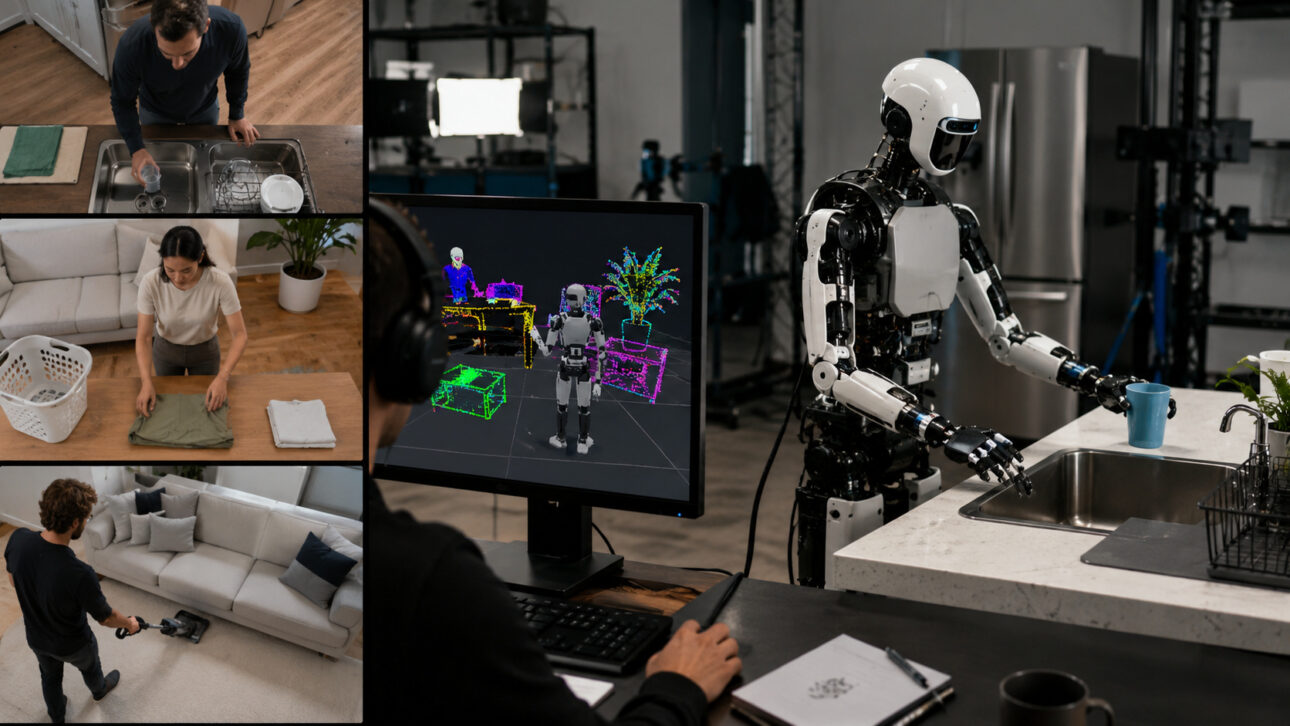
According to TechCrunch, the tasks include filming everyday actions and recording one’s own voice in another language. The company stated that this material helps AI and robotics systems to “understand the physical world,” showing how part of the data collection in the United States is being done through flexible work, distributed and contracted on demand.
This contrast helps explain the difference between the two models. While China concentrates training in controlled environments with strong local coordination, the American example documented by TechCrunch points to a more fragmented ecosystem, dependent on private platforms, task-based remuneration, and data capture in real everyday scenarios.
The dispute between China and the USA goes beyond the laboratory
What is at stake is not just the efficiency of a collection method. Rest of World highlights that researchers are still debating whether large-scale data collection will indeed be the most effective way to build truly intelligent robots, even with the rapid expansion of these centers and the political enthusiasm surrounding the sector.
Even so, the direction of the Chinese bet is clear. By funding centers, integrating local governments into the process, and organizing regional training networks, the country is trying to gain scale, consistency, and speed in a segment seen as one of the next decisive frontiers of the global technological race.
Therefore, the image of young people using exoskeletons to open microwave doors or repeat kitchen movements hundreds of times a day goes far beyond a laboratory curiosity. It reveals a state strategy to transform movement data, standardized training, and humanoid robotics into an industrial advantage before the rest of the world can consolidate an equivalent model.