






 Portuguese
  Spanish


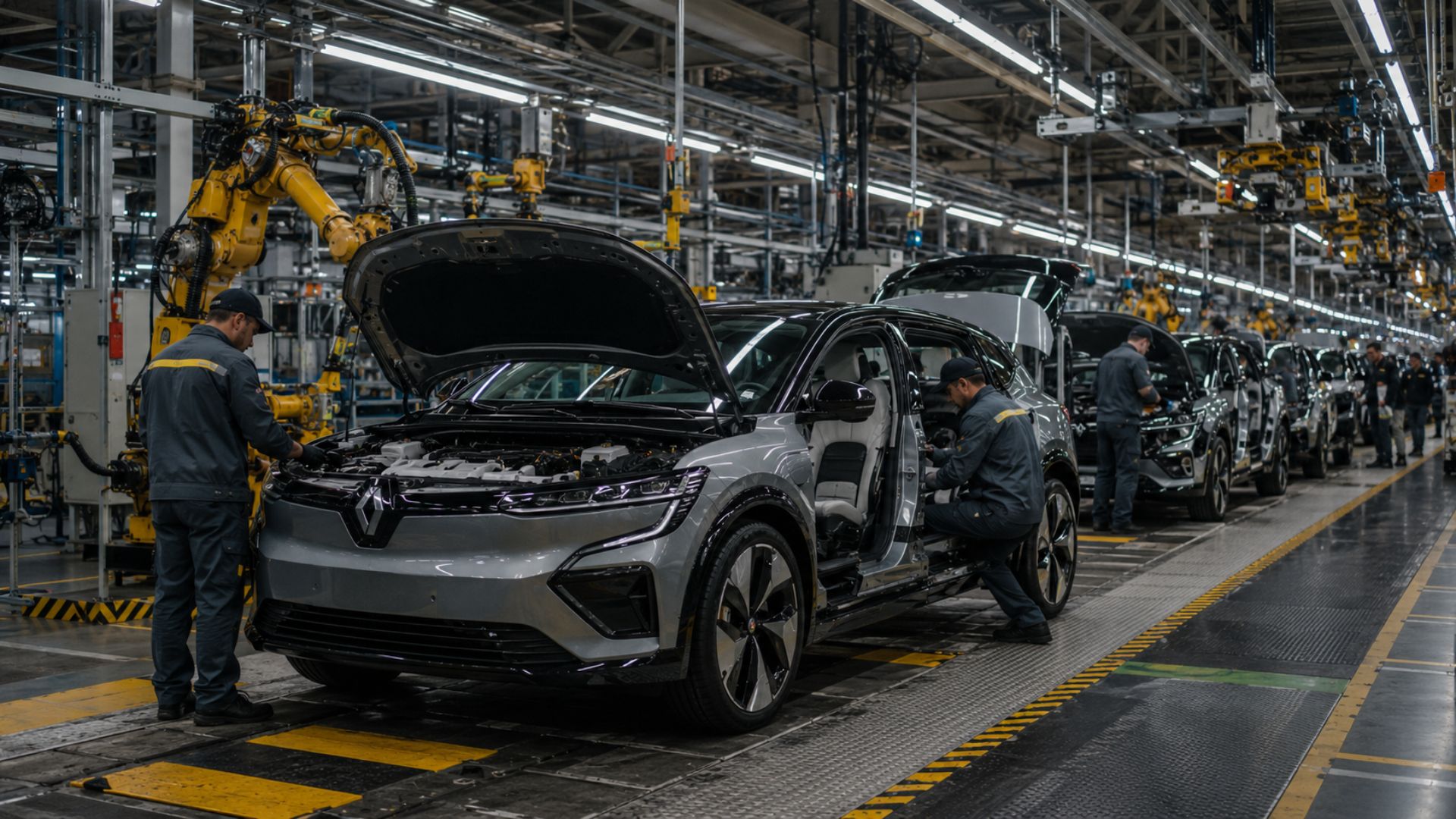

At the Automotive News Europe congress on June 10, 2026, CEO François Provost said that the Chinese threat is speed, not size. Renault made the electric Twingo in 21 months with a center in Shanghai, but the gamble comes with up to 2,400 cuts and quality doubts.
Frightened by the speed of Chinese manufacturers, Renault decided to copy this pace and made the new electric Twingo in just 21 months, with the goal of repeating the feat in 36 models over the next five years. According to Xataka Brazil, the problem, in the automaker’s view, is no longer the size of Chinese rivals, but the speed at which they launch cars. For the French group, keeping up with this pace has become a matter of survival.
According to the report, François Provost, CEO of Renault since July 2025, summarizes this challenge. On June 10, 2026, during the Automotive News Europe congress, he argued that the company needs to learn from Chinese manufacturers and keep up with their development pace. The electric Twingo, made about twice as fast as previous projects like the Renault 4 and Renault 5, became the model to follow, but the strategy has costs.
The Chinese threat that made Renault change pace
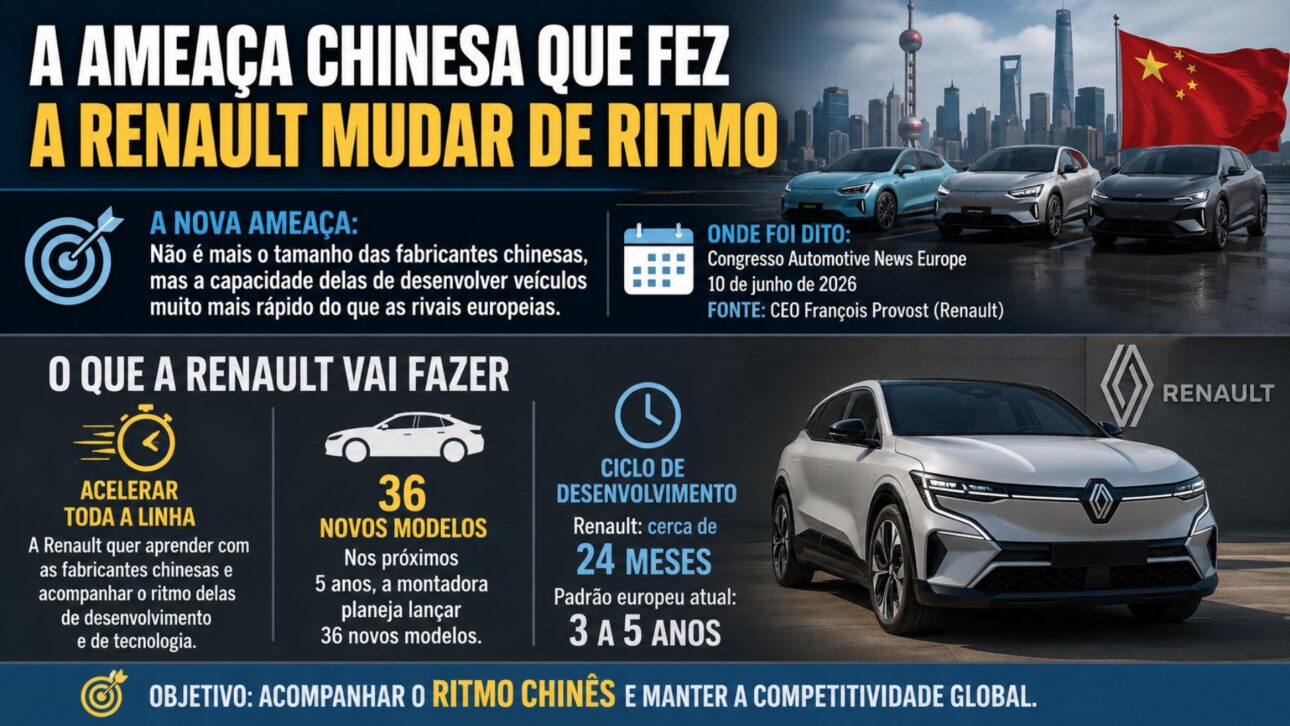
Renault’s view of competition has shifted focus. According to Xataka Brazil, at the Automotive News Europe congress on June 10, 2026, CEO François Provost summarized the challenge: the real threat is no longer the size of Chinese manufacturers, but their ability to develop vehicles much faster than European rivals. It’s a reversal from the discourse of years ago, when the fear was China’s scale.
-
$7,999 Isaac 1 Robot Aims to Tackle Household Chaos: Folds Clothes, Makes Beds, and Organizes, but Raises Privacy and Cost Concerns with Camera Reliance and Remote Human Assistance

-
Mobile Electron Accelerator Units Enable Safe Testing of Water, Materials, and Industrial Waste Treatment in Countries Without Permanent Labs

-
Brazil Invests $12 Million in Biodiversity to Develop Drug Molecules, but When Will It Reduce Dependence on Imported Pharmaceutical Ingredients?
-
3D Printing: From 1945 Sci-Fi Concept to Modern-Day Prosthetics, Homes, and Industrial Parts



Therefore, the plan is to accelerate the entire line. According to the report, Provost, who took over the group’s leadership in July 2025, believes that Renault needs to learn from Chinese manufacturers and keep up with their pace of development and technology. In the next five years, the automaker plans to launch 36 new models, all with a development cycle of about 24 months, while the European standard still tends to vary from three to five years.
The Twingo method: less bureaucracy and a center in Shanghai
The electric Twingo is the proof of concept of this turnaround. According to Xataka Brazil, the urban car was developed in just 21 months, about twice as fast as previous electric programs by Renault, such as the Renault 4 and Renault 5. To understand the leap, one must look at Shanghai, where, since 2024, the automaker has maintained the Ampere China Development Center, a center with about a hundred engineers that played a decisive role in the conception of the new Twingo, with support from local electric technology suppliers.
The battery concentrates much of the innovations. According to the report, it uses LFP chemistry, lithium iron phosphate, cheaper than traditional NMC batteries, developed in partnership with the Chinese CATL, and adopts an architecture where the cells are integrated directly into the compartment, without intermediate modules, with propulsion from a Chinese specialist, Shanghai e-Drive. Still, Renault insists that it did not outsource the project, as strategic decisions and most of the engineering remained coordinated at the Technocentre in Guyancourt, near Paris, and the reuse of the AmpR Small platform, with fewer physical prototypes, intensive use of digital tools, and a simplified line, with a single battery and a single motor, completed the formula.
The social cost of speed: up to 2,400 cuts in engineering
This transformation, however, does not happen without friction. According to Xataka Brazil, Renault confirmed that it intends to reduce its global engineering workforce by 15% to 20% over the next two years. In practice, this means 1,650 to 2,400 positions are expected to be eliminated from a total of about 11,500 engineers, spread across France, Brazil, India, Morocco, Romania, South Korea, Spain, and Turkey. Brazil, therefore, is among the affected countries.
The company tries to soften the impact and targets bureaucracy. According to the report, the automaker states that no compulsory layoffs are planned and that strategic design and development activities will continue in France, with the aim of reducing administrative levels and simplifying processes. The same logic appears in alliances, as after the withdrawal from the historic partnership with Nissan, Renault will develop two small electric cars for Ford, collaborates with Geely on industrial projects in South America and South Korea, and maintains hybrid and combustion engines through the Horse Powertrain joint venture, an area in which it believes it can still compete with the Chinese.
Fast and well: is it possible to reconcile speed and quality?
At its core, Renault’s bet runs into a difficult question. According to Xataka Brasil, is it possible to develop faster while maintaining the same level of quality? The modern automobile has become extremely complex, as a recent car already has more than 100 million lines of code, much more than a commercial airplane. The assistance systems required by European regulation GSR 2, electrical architectures, and embedded software make the validation phases more critical than ever.
The Chinese experience shows both sides. According to the report, some brands from China have proven that it is possible to launch models quickly, but they have also exposed the limits of this haste, with vehicles that needed several important updates after launch to correct flaws. What remains open is whether Renault, and the brands adopting this logic, will be able to repeat the process with each launch without turning the cars into beta versions or the customers into guinea pigs.
Pressed by the speed of Chinese manufacturers, and no longer by their size, Renault decided to change the way of making cars, delivered the electric Twingo in 21 months, and wants to repeat the feat in 36 models over the next five years.
The strategy, led by CEO François Provost, has two clear sides, as, on one hand, there is a gain in speed and cheaper technology and, on the other, the elimination of up to 2,400 engineering positions in countries including Brazil, besides the doubt about maintaining quality. In the end, the automaker’s bet will depend on proving that it is possible to be fast without treating the customer as a guinea pig.
And you, do you believe that Renault will be able to make good cars at the pace of Chinese manufacturers, or will the rush take its toll on quality and jobs? Share your opinion and exchange ideas with other readers, respecting different views on the future of the automotive industry.


