Portuguese
  Spanish


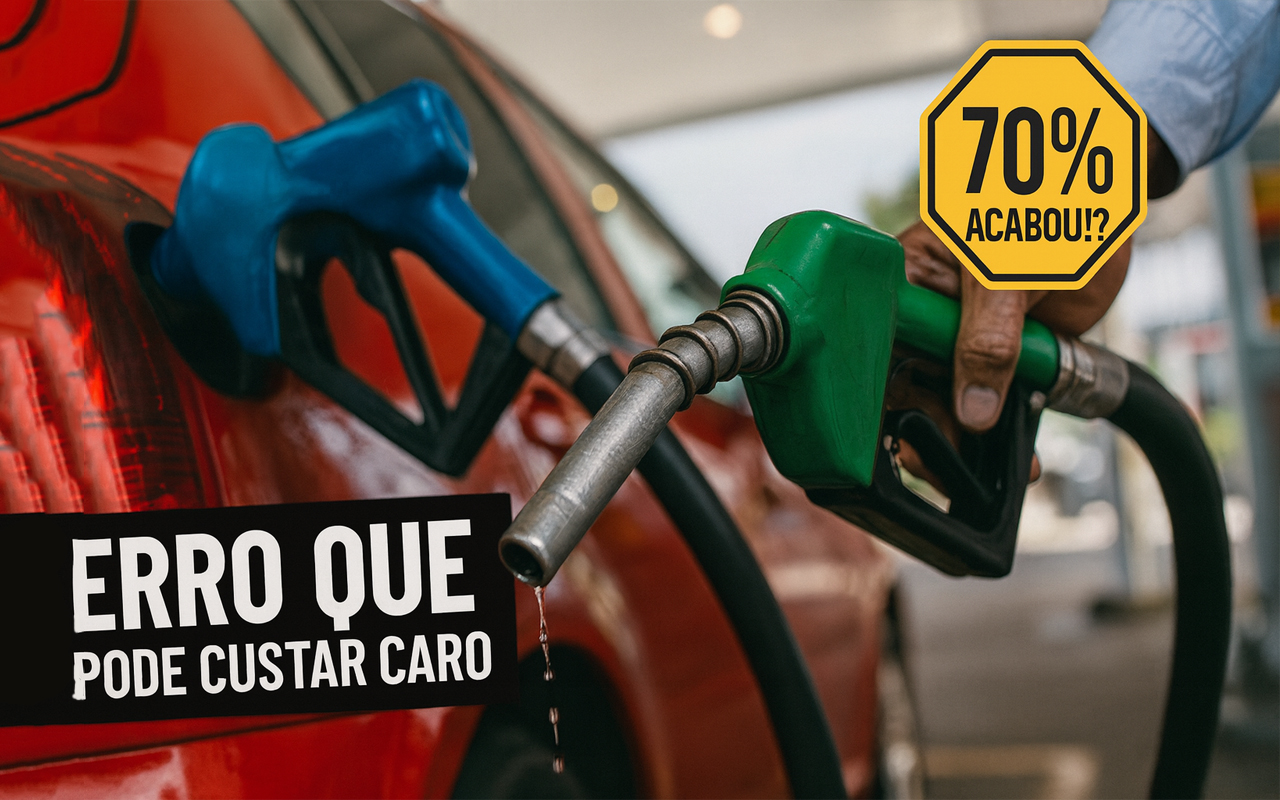


Gasoline in Brazil Will Have 30% Anhydrous Ethanol Starting August 1, 2025. Understand Why the Old “70% Rule” Became a Mistake, Learn How to Make the Right Calculation, and See How to Decide Based on Your Car’s Consumption and Local Prices.
The question “ethanol or gasoline, which is better?” gained a decisive ingredient with the adoption of E30. Since August 1, 2025, the mandatory mixture of anhydrous ethanol in gasoline increased from 27% to 30%, by decision of the CNPE. The change was officially announced by the federal government on June 25, 2025, and took effect in early August.
To maintain the quality and performance of gasoline at the pumps, the ANP adjusted the specification of gasoline C and raised the minimum octane number RON from 93 to 94, precisely because of the new ethanol content. This means a fuel that is more resistant to knocking, suitable for modern engines.
With these changes, repeating the old “70% rule” has become a mistake. The parameter arose as an approximation of the heat value of ethanol compared to gasoline, but the scenario has evolved, flexible fuel engines have become more efficient, the fuel itself has changed, and now gasoline contains more ethanol. The correct decision involves measuring the consumption of your car and comparing real prices in your city.
-
Brazil’s Lula Government Allocates $463 Million Quota for Electric Car Parts, Waives Import Tax Until December, Sparking Competition Among BYD, Automakers, and Unions as Consumers Question Impact on Prices and Local Industry

-
Thinking of Installing LED Headlights? Why Replacing Halogen Bulbs is Still Banned, the Glare Risks Authorities Worry About, and How a New Proposal Could Allow Certified, Safe Installations

-
2027 Toyota Corolla Cross Unveiled: New Design, Enhanced Fuel Efficiency, Reduced Maintenance Costs, Advanced Technology, Connected Services, and Up to 10-Year Warranty
-
Fiat Cronos Precision 2018: Affordable Sedan with Spacious Trunk and Reliable Maintenance




How to Make the Right Calculation: Your Car’s Parity + Prices in Your City
The first step to avoid mistakes is to measure the actual consumption for each fuel. The “tank-to-tank” method is simple: fill the tank until the pump shuts off for the first time, reset the trip meter, use the car as usual, refuel in the same manner, and divide the kilometers driven by the liters refueled. Repeat the process a few times to obtain a reliable average.
If the car has a trip computer, use the reading as a reference, but do not skip the measurement at the pump to validate the accuracy, as the display can vary depending on use and conditions. The important thing is to have two averages: one with ethanol and another with gasoline.
Now comes the ideal parity for your car: consumption with ethanol ÷ consumption with gasoline. Keep this number. At the gas station, calculate ethanol price ÷ gasoline price. If the price result is below the ideal parity, then ethanol is likely to be more advantageous; if it’s above, then gasoline wins. To avoid mistakes, use the weekly average prices from ANP for your city as a basis.
E30 in Effect: What Changes in Gasoline and in Your Wallet
With E30, the government and the ANP emphasize that the policy aims for technical safety, potential gain in octane, and support for a more renewable matrix. The adoption was based on studies coordinated by the MME with tests from the Mauá Institute, and the ANP adjusted the specification to preserve quality and performance. Important New Fact: gasoline C now requires a minimum RON of 94.
In the short term, the decisive factor for the driver remains the price per liter versus average consumption. To keep up with what happens in your municipality, consult the Price Survey from the ANP, updated weekly, with series by state and city. Reliable data helps to make accurate calculations.
Beyond direct savings, the change aligns with decarbonization and the role of ethanol in Brazil’s energy transition, a point emphasized by the Planalto when announcing E30. This explains why the “best choice” is not always simply the cheapest, depending on the driver’s criteria.
Does the “70% Rule” Still Apply? What Do Data and Tests Say
The rule was born as a simplification of the energy content: ethanol has a lower lower heating value than gasoline, so theoretically, it requires more volume to deliver the same energy. However, energy is not the only factor; the calibration of flexible engines and the octane values have changed, reducing the usefulness of a fixed percentage. Conclusion: do not rely on a universal number. Make your parity.
In practice, many modern engines achieve better performance with electronic adjustments that leverage the higher octane of ethanol, approaching or exceeding that “historical average” that inspired the 70%. In various market measurements, the real parity exceeds the traditional benchmark, which undermines the rule as a general guideline.
With the minimum RON of 94 in gasoline C, defined by the ANP, the direct comparison becomes even more dependent on your vehicle’s set, route, and driving style. Hence, the importance of measuring consumption and monitoring ANP prices for a precise and current decision.
Performance and Range: When to Prefer Ethanol or Gasoline
If you seek performance, many flexible engines deliver more power with ethanol, thanks to the higher octane, which allows for greater ignition advance without knocking. This is not an absolute rule, as it depends on the ECU and calibration of each model, but it is a recognized trend by specialized publications.
If the priority is range between refuels, gasoline still offers an advantage in most cases, as consumption in km/l tends to be better. However, this difference may diminish in urban areas, in mild weather, and in newer engines, due to electronic management adjustments.
With E30, regular gasoline gained a higher minimum octane, which helps with efficiency and protects against knocking in modern engines. Still, the cost per kilometer depends on the price at the pump and the real average of your car. Do the math, not the guesswork.
Final Step-by-Step to Decide at the Gas Station
First, measure the consumption with each fuel using the tank-to-tank method and, if desired, validate with the trip computer. Keep the two averages, in km/l.
Then, monitor the local prices in the weekly ANP survey and calculate: ethanol price ÷ gasoline price. Compare it with the ideal parity of your car, which is consumption with ethanol ÷ consumption with gasoline. If the price is below the parity, ethanol is likely to be worth it; if it is above, gasoline has the advantage.
But keep this in mind: If you want performance, ethanol is usually better; if you need range, gasoline tends to offer more kilometers between stops.