Portuguese
  Spanish


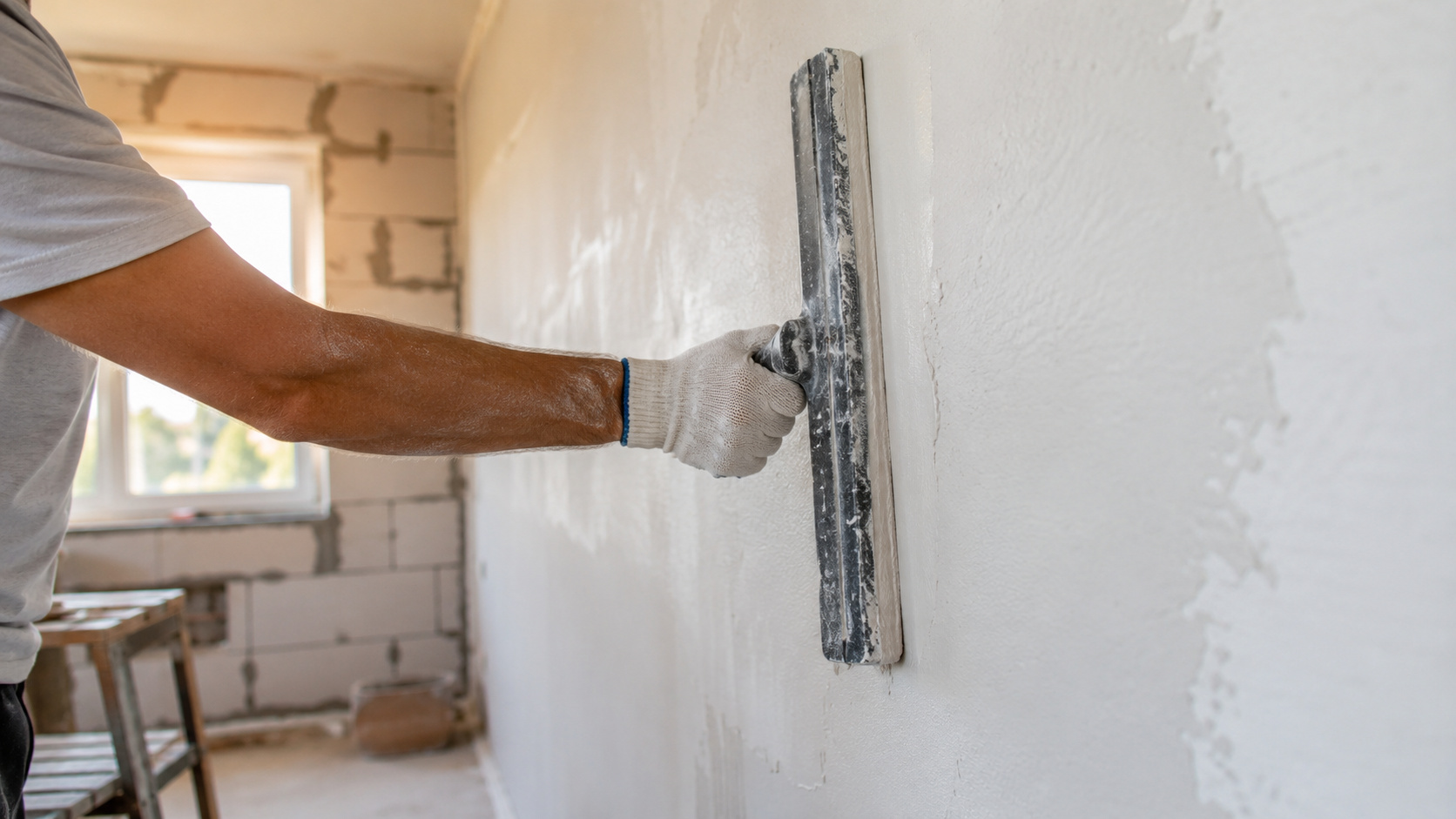

With less waste and quick application, smooth plaster stands out as an alternative to plastering in residential construction projects.
The search for more economical and efficient solutions has led many homeowners and professionals to rethink traditional finishing methods. Among the alternatives that have gained the most ground in recent years is smooth plaster, an interior coating that can replace plastering in various internal and dry situations.
Interest in the system has grown because it reduces construction stages, speeds up execution, and can lower final costs. On well-aligned internal walls, the material is applied directly onto the masonry, eliminating processes that are normally part of conventional finishing.
According to an article published by Rádio Tupi FM on June 15, specialists indicate that this movement follows a trend increasingly present in construction: reducing waste without compromising the quality of the final result.
-
28-meter, 156-ton titans traveled 20,000 km from China to the port of Santa Catarina: Portonave received 7 fully electric megacranes, part of a R$ 210 million package, to double container handling.

-
They exchanged the idea of a large house for a 35 m² warehouse, spent US$ 12,000 on the structure, and created a tiny house in Colorado with space to live and work.

-
A newly opened terminal in the middle of the Amazon has begun transporting soy and corn through Amapá, eyeing the queue of ships that is congesting the ports in the South.

-
Goodbye to old tiles: renovation technique without construction transforms bathrooms in a few hours, eliminates debris, and reduces costs with coverings using special paints, high-resistance adhesives, and modern finishes that completely renew the space.


How smooth plaster eliminates stages and speeds up construction finishing
One of the main advantages of smooth plaster is the simplification of the finishing process. While the traditional system requires several phases, plaster coating can be applied in a single layer when the wall is well-aligned.
In the conventional method, execution usually involves:
- Roughcast;
- Rendering;
- Plastering;
- Curing time;
- Putty;
- Painting.
With the new material, many of these stages no longer exist. This means less material movement, shorter waiting times, and a more organized construction site.
In practice, the professional can deliver a smooth surface ready to receive sealer and paint in a much shorter period than would be necessary using the traditional system.


New material reduces waste and may cost less than conventional systems
The savings generated by the new material are not only due to the reduction of materials used. The gain is also related to the decrease in labor and execution time.
As fewer steps are required, there is less consumption of inputs and less waste within the construction site. This directly contributes to more efficient resource management.
Some market estimates mentioned in the sector indicate values between R$ 70 and R$ 90 per square meter for plaster, while plastering may cost around R$ 95 per square meter, before the inclusion of complementary services. Prices vary depending on the region, availability of professionals, and characteristics of the construction.
For this reason, experts always recommend requesting local quotes before making a decision based solely on the initial cost.
The relationship between the price of cement and the growth of smooth plaster
The increase in construction input costs has also helped to boost interest in alternative finishing systems.
The price of cement is one of the most monitored indicators by builders and owners. When added to the costs of sand, mortar, transportation, and labor, the traditional system can represent a significant portion of the budget.
In this scenario, smooth plaster has come to be seen as a competitive solution for dry indoor environments.
Even so, experts warn that the comparison should not consider only the price of cement. The total execution cost involves several factors, including finishing, applied thickness, necessary corrections, and the value of specialized labor.

What does the ABNT standard say about the use of smooth plaster on internal walls?
The use of the new material does not occur without technical criteria. In Brazil, the application must follow parameters defined by the Brazilian Association of Technical Standards.
The ABNT NBR 16618 establishes requirements for internal wall and ceiling coatings executed with plaster. The standard addresses aspects related to surface preparation, application, performance, and appropriate conditions of use.
These guidelines emphasize that the system should be used in indoor environments protected from moisture, respecting the characteristics of the base and execution procedures.
When these recommendations are followed, the coating tends to perform well and have an excellent finish.
When is the new material really more worthwhile than plaster?
Not every wall is an ideal candidate for receiving smooth plaster. The best result occurs when the masonry is well-aligned and has few irregularities.
The system is usually advantageous in:
- Bedrooms;
- Living rooms;
- Corridors;
- Offices;
- Indoor environments protected from water.
In these situations, the new material can reduce steps, speed up the schedule, and decrease waste.
Moreover, since the application occurs directly on the regularized masonry, productivity tends to increase compared to the traditional method.
Situations where plaster remains the safest choice
Despite the advantages presented by smooth plaster, there are scenarios where plaster remains the most recommended option.
Areas subject to constant moisture, rain, or leaks require solutions with greater water resistance. For this reason, facades, laundries, and certain bathrooms usually use cementitious systems.
Another important point involves very crooked walls. When there are large alignment deviations, plaster usually offers a safer and more efficient correction.
In these cases, trying to compensate for irregularities with excessive layers of plaster can increase material consumption and compromise the coating’s performance.
Errors that can turn construction savings into losses
The cost reduction promised by the system depends directly on the quality of execution.
Among the most common errors are:
- Applying plaster on walls with leaks;
- Not checking the plumb of the masonry;
- Choosing only the cheapest budget;
- Hiring inexperienced labor;
- Execute the coating before completing the plumbing and electrical installations.
These failures can result in cracks, stains, bubbles, and even detachment of the coating over time.
Therefore, the technical evaluation of the wall should occur before the start of services.
Smooth plaster or render: which offers better long-term performance?
A frequent question involves the resistance of the two systems. Although both can deliver good results, they have different characteristics.
Smooth plaster offers a refined finish and excellent performance in dry indoor environments. Meanwhile, render has greater tolerance to moisture and is usually more suitable for external areas.
This does not mean that one is superior to the other in all situations. In fact, each solution was developed to meet specific needs within construction.
In walls that will receive hanging cabinets, televisions, or heavy objects, the fixation must reach the masonry or follow an adequate sizing to support the load.
What explains the advancement of this system in residential projects
The growth of smooth plaster reflects an important change in the construction market. Owners and builders seek alternatives capable of reducing costs, accelerating schedules, and minimizing waste without compromising the quality of the finish.
Although the direct comparison with the price of cement is not always enough to determine the best choice, the system has proven competitive in well-executed indoor environments.
When applied in suitable locations and following the technical recommendations of ABNT, the new material can represent an efficient and economical solution. In areas exposed to moisture or with large irregularities, render remains a consolidated and widely recommended alternative by industry professionals.