Portuguese
  Spanish


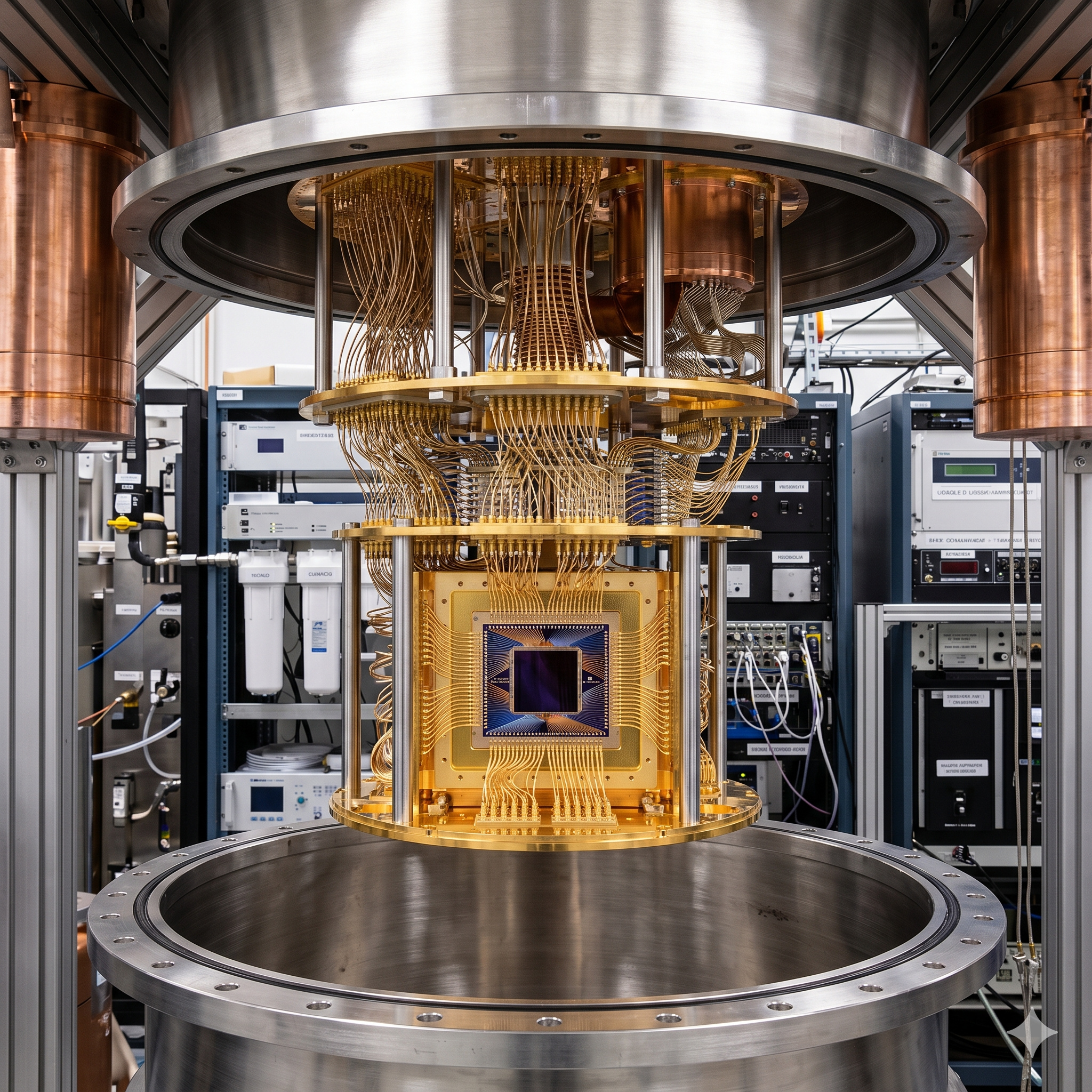

Google achieves verifiable quantum advantage with 105-qubit chip that solves calculations impossible for classical supercomputers.
According to Google Quantum AI, on October 22, 2025, the company published in the journal Nature the results of the Quantum Echoes algorithm executed on the Willow chip, a 105-qubit superconducting quantum processor operating at temperatures colder than interstellar space.
The experiment solved a quantum physics calculation about 13,000 times faster than the best classical algorithm running on one of the world’s most advanced supercomputers.
The historical differentiator was not just speed, but the verifiability of the result, something unprecedented until now.
-
Engineers Develop Fridge-Sized Machine to Produce 95-Octane Synthetic Fuel from Air and Water, Aiming to Sustain Combustion Engines Without Oil

-
Two-Armed Robot Uses AI to Reassemble Destroyed Pompeii Frescoes, Solving an “Impossible” Puzzle
-
New Law in Brazil Requires Breaks for Type 1 Diabetes Management at Work, School, and Public Exams

-
Scientists Confirm “Greening” of Antarctica: Ice on the World’s Coldest Continent Turns Green as Mosses Multiply Over Tenfold in Four Decades


Difference between 2019 quantum supremacy and 2025 verifiable quantum advantage changes the scientific standard
In 2019, Google announced what it called quantum supremacy with the Sycamore processor, by solving a problem in 200 seconds that would take thousands of years on supercomputers.


However, the result was contested by researchers and companies like IBM, who demonstrated ways to reproduce the calculation with more efficient classical algorithms.
The central problem was the lack of independent verifiability, as the calculation involved random sampling without practical application and without reliable external validation.
Quantum Echoes algorithm solves this problem by enabling reproducible and verifiable results
The Quantum Echoes algorithm introduces a fundamental advance by working with deterministic physical quantities.
It measures a type of quantum correlation called OTOC, which describes how information propagates in complex quantum systems.
Unlike previous experiments, the result can be reproduced and validated by other equivalent quantum systems, establishing a new scientific standard.
Experiment simulates quantum information propagation using sonar echo analogy
The experiment’s operation can be compared to a sonar system. The Willow chip initializes a set of qubits in an ordered state, applies a sequence of operations that scramble the system, and then introduces a small perturbation to a single qubit.
After that, the system reverses the operations, and the difference between the final and initial states reveals how the information spread, generating a “quantum echo.”

Simulating quantum systems with tens or hundreds of qubits requires classical computers to process an exponential number of states simultaneously.
For the experiment performed, estimates indicate that certain data points would take more than three years to be calculated on supercomputers like Frontier. The Willow chip executed these operations in a few minutes.
Qubits allow representing multiple states simultaneously and expand computational capacity
Unlike classical bits, which assume values 0 or 1, qubits can exist in a superposition of these states.
When entangled, they form systems whose representation grows exponentially.
A system with 105 qubits can simultaneously represent a number of states greater than 2¹⁰⁵, drastically expanding computational capacity.
Quantum error correction allows reducing failures as the number of qubits increases
Historically, increasing the number of qubits meant increasing the number of errors. However, Willow demonstrated that, with advanced error correction techniques, it is possible to reduce the failure rate as the system grows.
This breakthrough solves one of the main challenges of quantum computing. In November 2025, Quantinuum launched Helios, a quantum computer with 98 physical qubits and 48 logical qubits with error correction.
The system introduces the Python-based Guppy language, allowing developers to write hybrid programs with quantum and classical operations. Integration with Nvidia’s CUDA-Q enables real-time error correction management using GPUs.
Companies like JPMorgan, BMW, and SoftBank already use quantum computing in specific applications
Large companies participated in the initial use of Helios. JPMorgan applied the technology in financial analysis, while BMW used the system for materials research, and SoftBank explored new compounds for batteries.
These cases indicate that quantum computing has already entered the phase of practical application in specific niches.
In January 2025, Nvidia’s CEO stated that broad applications of quantum computing would still take decades. Although quantum computers cannot yet replace supercomputers in general tasks, recent advances demonstrate real utility in specific areas of science and engineering.
Next generation of quantum computers promises to scale qubit count and expand applications
Companies like IBM, Fujitsu, and research centers like RIKEN are working on systems with hundreds or thousands of qubits.
These projects aim to expand scale and reduce errors, bringing the technology closer to broader applications.
The recent advance indicates a phase shift in the technology. Quantum computing is no longer just experimental and is beginning to become an applicable tool for specific problems. Recent advances show that the technology has already surpassed important milestones.
In your view, is quantum computing close to a practical revolution or does it still depend on structural advances to reach its full potential?