






 Portuguese
  Spanish


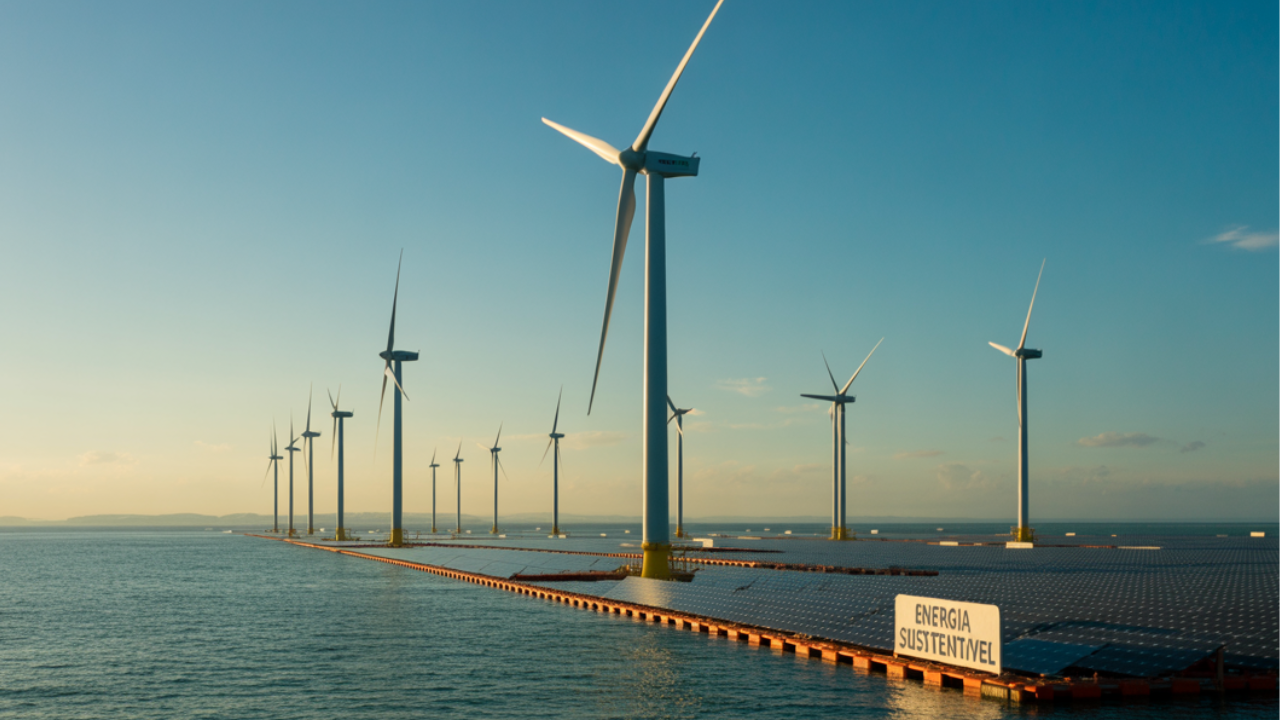

Floating Solar Park System Was Anchored in the North Sea and Promises to Increase Energy Generation by Up to Five Times, Integrating Solar Panels and Wind Turbines in a Single Maritime Area.
A historic milestone in the global energy transition has just been established by the Netherlands: the installation of the world’s first offshore solar project in an operational wind farm has begun.
The innovative proposal combines, for the first time, floating solar panels with existing wind turbines, aiming to optimize renewable energy generation in the same space in the North Sea.
The project is being developed at the Hollandse Kust Noord park, located about 22 kilometers off the Dutch coast, operated by CrossWind — a joint venture formed by Shell and Eneco.
-
Brazilian scientists are simultaneously advancing two research projects on clean hydrogen and driving solutions that could transform the energy matrix, enhance industrial competitiveness, and accelerate large-scale emission reduction targets.

-
Advancement in renewable energy: A R$ 150 million project launched by Petrobras and Finep aims to create state-of-the-art electrolyzers for green hydrogen, strengthening national research and preparing Brazil to compete in a billion-dollar energy market.
-
Illiterate or semi-literate grandmothers were trained to repair solar systems, open rural workshops, and light up homes that still depended on kerosene.
-
The world has bet on green hydrogen as the fuel of the future, but now faces the side effect: producing 1 kilogram requires about 9 liters of ultrapure water, and the largest projects on the planet are precisely in the driest regions of the Earth, where water is already scarce for people.




The solar technology, in turn, is the responsibility of Oceans of Energy, a company specializing in offshore sustainable energy solutions.
Energy Production Could Quintuple with Solar-Wind Integration
The great promise of the project is the possibility of multiplying electricity generation by up to five times by using the same maritime space with two complementary sources: solar and wind.
With this combination, it will be possible to ensure a more stable and continuous energy flow, especially during periods of low wind production.
With 1,500 floating solar panels anchored at a depth of 25 meters, the system is designed to operate in sync with the surrounding turbines.
“The reliability of the anchoring system is essential, not only for the safety and stability of the floating solar park but also to ensure it operates seamlessly with the surrounding wind turbines,” explained Jeroen van Loon, solar project manager at CrossWind.
The connection between the offshore solar system and the wind farm will be made through a special electric cable, designed exclusively for the project by the Swedish company NKT.
It will allow the transport of solar energy to one of the turbine foundations, and from there to the power grid on land.
The Hollandse Kust Noord wind farm, which became operational at the end of 2023, has an installed capacity of 759 megawatts, with an estimated annual generation of 3.3 terawatt-hours.
Now, with the addition of the solar panels, this volume is expected to increase significantly.
Oceans of Energy’s Leading History in Offshore Solar Energy
Oceans of Energy is a world pioneer in the field of offshore solar energy.
In 2019, the company was responsible for the installation of the first floating solar park in open sea, near The Hague.
The structure withstood four years of the harsh conditions of the North Sea, including more than ten severe winter storms.
“It proved to the world that offshore solar energy in high wave conditions is a reality, having operated continuously for four years in the rough North Sea – including during more than 10 categorized (winter) storms,” emphasized the company in a press release.
Founded in 2016, Oceans of Energy also conducts ecological research to study the environmental impacts of offshore structures and seek solutions that positively contribute to marine biodiversity.
Installation in Progress and Commercial Contract Signed in 2023
The contract between CrossWind and Oceans of Energy was signed in 2023, and since then the project has gone through engineering, licensing, and manufacturing phases.
The physical installation of the solar system began in April 2025, marking a new era for offshore solar projects and for the efficient combination of different sources of clean energy.





