Portuguese
  Spanish


Kahlon’s Carved House in Herzliya Blends Art, Ingenuity, and Controversy After Fifty Years, Now Threatened by Government Eviction Order
The “Hermit’s House” is a set of rooms carved into the rock. The space operates like a labyrinth, with rooms connected by tunnels and staircases, according to AP News. The exterior is clad with stones, pebbles, and recycled materials, as described by Atlas Obscura.
The Origin and Life in the Cave House
Kahlon, now 77 years old, began sleeping by the sea before he started carving the deathroadin 1973. He told New Lines that he lived in a tent after fleeing an arranged marriage.
When the police tried to evict him, he decided to build a refuge.
-
At 17, she hand-painted her first watercolor design for school uniforms; her brand grew without investors, sold 135,000 pieces, and aims for $3 million in revenue by 2026.

-
Shell Discovers Intact Early 19th-Century Wooden Shipwreck in the Gulf of Mexico at Over 1,300 Meters Deep
-
Brazilian Entrepreneur Turns Door-to-Door Jewelry Sales into a Family Business Empire with Over 70 Stores

-
$75 Million Bridge in Brazil Opens to Connect Cities, Create Jobs, and Cut Travel Time from 30 to 2 Minutes; Spanning 1.24 km, It’s Among the Country’s Largest and Ends Decades of Ferry Queues.




The dwelling grew over time. Initially, it was a simple cave, but he expanded rooms over the decades.
The space was made and filled with recycled material, Kahlon told AP News. “With the stones I extract, I make a mold and build a wall. There is no waste here, just material“, he stated.

Construction Details
The images show a multi-level property accessible by a staircase that descends from the beach.
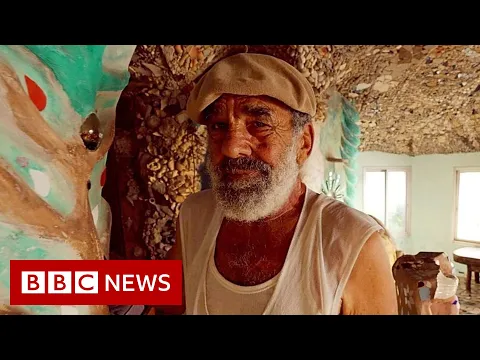
The interior walls have texture and arched ceilings. Narrow, arched doors hardly allow Kahlon, who is a short man, to pass.
Simple tools, such as an iron spear he forged himself, shovels, and trowels, were used in sculpting the space, according to New Lines Magazine.
He also carved shelves into the stone walls to store his belongings, and he has some furniture inside.
Artistic Touches of the Cave House
The interior blends pieces of colored glass, mosaics, and ceramic fragments. Kahlon made these mosaics with old tiles he collected from dumpsters in Tel Aviv, according to AP News. Some rooms feature walls, windows, and paintings in bright colors.
Despite its rustic appearance, the house has plumbing and a telephone line. Additionally, many rooms receive electricity, AP News reported.
The Risks and Losses
The sea has already destroyed the exterior of the house on two occasions. The first occurred in the early 1980s and the second in the late 1990s, when the construction of the Herzliya Marina caused beach erosion, reports Atlas Obscura.
Herzliya is about 13 kilometers north of Tel Aviv, and the house is close to the seaside neighborhood known for hotels and upscale villas.
Eviction Threat
Now, after nearly half a century, Kahlon is facing an eviction order from the Israeli government. The Ministry of Environmental Protection states that the cave has caused “significant damage to the cliff, put the public in danger, and reduced public access to the beach”, as reported by AP News.
Kahlon rejects the accusation. “I worked here for fifty years without a salary. What did I do? Kill, steal, rape? No!”, he told New Lines magazine. For the resident, the house is a museum and should be recognized, not demolished.
The man admitted that he never had official permission to build the structure. Still, he claims that local authorities connected his cave to the power grid years ago.
In 1974, he received a demolition order that was not enforced. Since then, he says he has only faced recent opposition.
Authorities maintain that they offered Kahlon alternative housing. However, he states he has no intention of leaving. “I won’t leave here. I’m ready to be buried here“, he declared to AP News. “I have nowhere to go, I have no other home.“
The Legal Battle
With the support of friends and relatives, Kahlon raised funds to hire a lawyer for the legal proceedings that will take place in court, New Lines Magazine reported.
He questions why he is being expelled now, after decades of living in the place.
The public and cultural groups are watching the dispute closely, as many value Kahlon’s creativity but also fear concrete risks to the coast and stability.
The story highlights the clash between personal heritage and public rules. Because the house emerged from the needs and ingenuity of an individual, many see it as having cultural value.
Thus, the case raises doubts about who defines what is public space and what deserves protection.
Not everyone agrees. Additionally, erosion and safety risks are arguments that authorities use to justify the action.
With information from Business Insider.