Portuguese
  Spanish


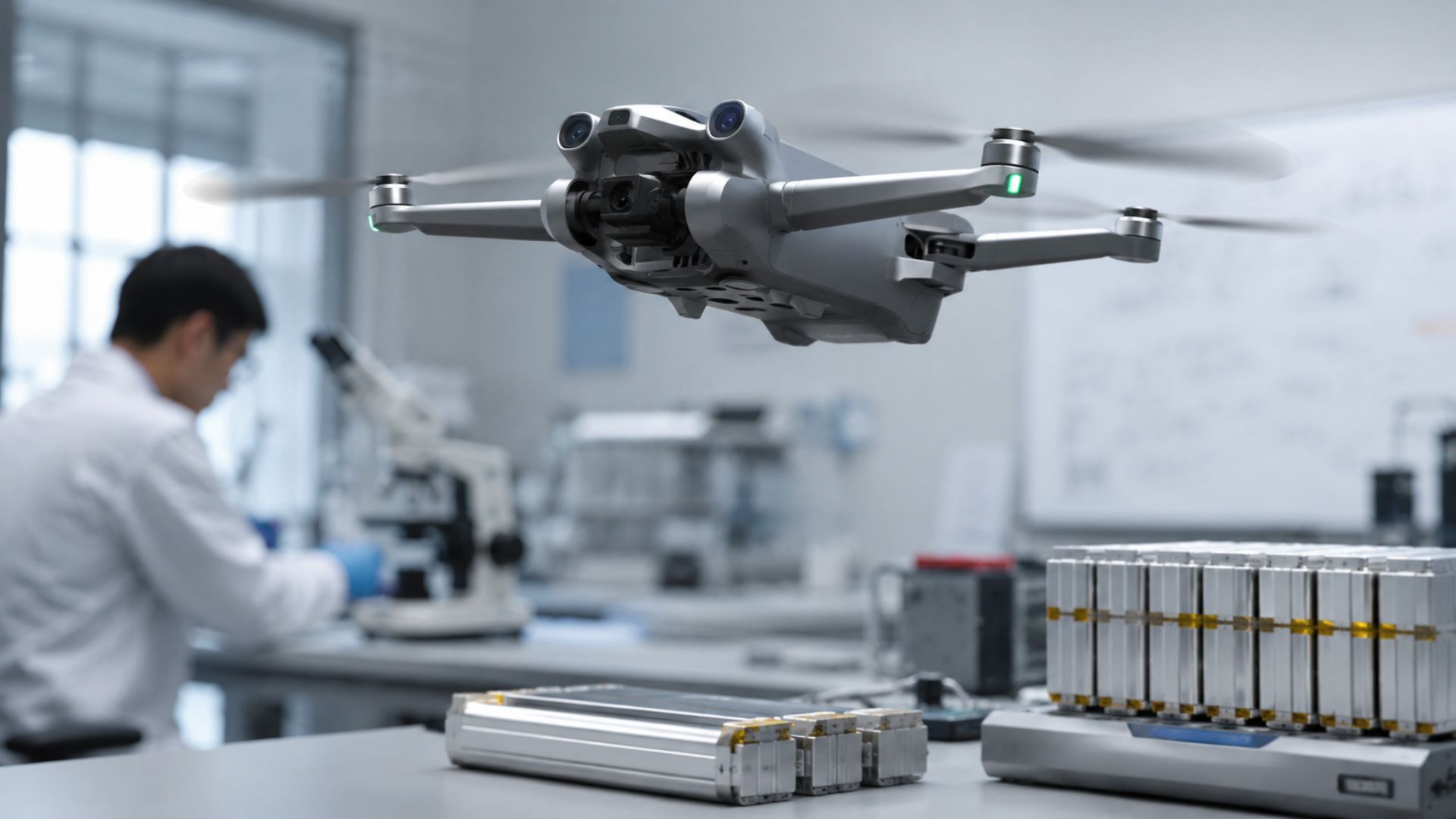

Researchers at Tsinghua University in Shenzhen, China, have developed a lithium-sulfur battery that achieves 549 Wh/kg energy efficiency, nearly double that of the lithium-ion batteries currently used in commercial drones, which average 300 Wh/kg. The component retained 82% of its original capacity after 800 charge and discharge cycles in laboratory tests, but has not yet been tested in real flight conditions.
The new battery was developed by a team of researchers from Tsinghua University, one of China’s most prestigious, based in Shenzhen. When the results were released: this week, through a publication in the newspaper China Daily. How the battery almost doubles efficiency: the researchers created a specific molecular pre-mediator for sulfur that is only activated during the electrochemical reaction, directing the transport of electric charge and preventing the energy from dissipating as heat, a problem that has historically prevented the commercial use of lithium-sulfur batteries. Why this innovation matters for the drone market: limited autonomy is the main bottleneck of current drones, and a battery that offers nearly double the energy per kilogram can transform delivery, rescue, and mapping drones into viable tools for distances and loads that are currently impossible.
The tests were conducted exclusively in the laboratory, and so far there is no report of real use of the new battery in drones or any other equipment. Therefore, it is still not possible to predict when or if the technology will be employed at a commercial level. The path from a laboratory result to a shelf product involves validation stages, industrial scaling, and safety certification that can take years.
The problem the battery solves: energy lost as heat
Lithium-sulfur batteries are not new in scientific research. The concept has existed for decades and has always been considered promising because sulfur is cheap, abundant, and can store significantly more energy per kilogram than the materials used in conventional lithium-ion batteries. The problem is that, in practice, these batteries quickly lost energy as heat during charge and discharge cycles, degrading the component in just a few hundred cycles and making it unviable for commercial use.
-
The Trap of Modern Technology: How Screen Overload and Digital Connections Can Impact Your Mental Health and Well-being

-
Wyoming Couple Grows Tropical Fruits Year-Round in -40°C Using Geothermal Greenhouse, Demonstrating Earth’s Heat Can Produce Oranges and Lemons in Snow Without Traditional Heating

-
Ship Returns from Brazilian Coast with Thirty Newly Discovered Life Forms
-
Nigerian Professor Invents Electricity-Free Refrigerator Using Clay Pots and Wet Sand, Extending Shelf Life of Vegetables to 27 Days; 7,000 Units Distributed in Energy-Deprived Villages



The innovation by Tsinghua researchers lies in the molecular pre-mediator that controls this dissipation. Instead of trying to contain the heat after it forms, the additive created by the team intervenes at the level of the electrochemical reaction, ensuring that the transport of electric charge occurs more directed from the start. The result is a battery that not only stores more energy but loses less of that energy during operation, achieving resistance up to 75% greater than conventional lithium-sulfur batteries.
549 Wh/kg versus 300 Wh/kg: what the numbers mean

The difference between 549 Wh/kg and 300 Wh/kg may seem abstract, but translated to the performance of a drone, the impact is concrete. Wh/kg (watt-hour per kilogram) is the measure of how much energy a battery stores per kilogram of weight. The higher this number, the longer the drone can fly with the same battery load, or the more weight it can carry while maintaining the same range. A battery that offers 549 Wh/kg instead of 300 Wh/kg means, in theory, almost double the range for the same battery weight.
For delivery drones that today can cover distances of 10 to 15 kilometers with a load, the new battery could extend this range to 20 to 30 kilometers. For rescue drones operating in disaster areas that need range to fly to remote locations, carry supplies, and return, the difference between 300 and 549 Wh/kg can be the difference between reaching a victim or not. And for mapping and inspection drones that need to fly over extensive areas, fewer stops for recharging mean more productivity per journey.
800 cycles with 82% capacity: tested durability
Besides energy efficiency, the battery’s durability in tests was another relevant data point. The researchers subjected the component to 800 charge and discharge cycles, and at the end of this period, the battery still maintained 82% of its original capacity. For comparison, commercial drone lithium-ion batteries typically show significant degradation after 300 to 500 cycles, requiring replacement that represents a constant operational cost for operators.
If laboratory durability holds up under real conditions, the new battery would not only fly farther but also last longer before needing replacement. For companies operating fleets of delivery drones, such as retailers and delivery services, the combination of greater range with longer lifespan would significantly reduce the cost per delivery. Fewer stops for recharging, fewer battery replacements, and more kilometers covered per component lifecycle.
Cheaper than lithium-ion: the advantage of sulfur
One aspect often overlooked in battery technology comparisons is the cost of materials. Sulfur is significantly cheaper than the materials used in lithium-ion batteries, such as cobalt and nickel, making the lithium-sulfur battery potentially more affordable on a production scale. If the technology developed at Tsinghua proves commercially viable, the unit cost of the battery could be lower than current solutions, even while offering superior performance.
This cost advantage is especially relevant for emerging markets where delivery and rescue drones operate on tight budgets. In countries like Brazil, where drone delivery services are still in the experimental phase and operational costs determine the model’s viability, cheaper and more efficient batteries could accelerate the commercial adoption of the technology. Sulfur is also abundant as a byproduct of the petrochemical industry, which facilitates the supply chain on a global scale.
Delivery and rescue drones: the applications researchers foresee
Researchers from Tsinghua pointed out specific applications for the new battery that go beyond recreational drones. Rescue drones used in risky situations, such as searching for victims in areas of natural disasters, floods, or fires, would have extended autonomy to cover greater distances and remain airborne longer, which can be decisive in operations where every minute counts and each additional kilometer of range can mean a saved life.
Product and food delivery drones were also mentioned as direct beneficiaries of the technology. With nearly double the autonomy per kilogram of battery, drones could cover longer routes or carry heavier loads without sacrificing flight time. Besides these applications, the team also plans to test the technology in reusable flow batteries, lithium-metal batteries, and in component recycling processes, indicating that the molecular innovation may have reach beyond the drone market.
From laboratory to the world: the path that still remains
The new lithium-sulfur battery reaches 549 Wh/kg, maintains 82% capacity after 800 cycles, and may cost less than current batteries. But all these results were obtained in the laboratory, and so far there is no report of real-world use of the component in drones or any other equipment outside Tsinghua’s test benches. The leap from a laboratory result to a commercial product involves validation under real conditions of temperature, vibration, humidity, and mechanical stress that the controlled research environment does not replicate.
Do you believe lithium-sulfur batteries can replace lithium-ion ones in the drones of the future? Tell us in the comments what you think of the numbers of this new battery, if you think the technology will reach stores or remain stuck in the lab, and which application makes the most sense to you: delivery, rescue, or mapping. We want to hear your opinion on the future of batteries.