






 Portuguese
  Spanish


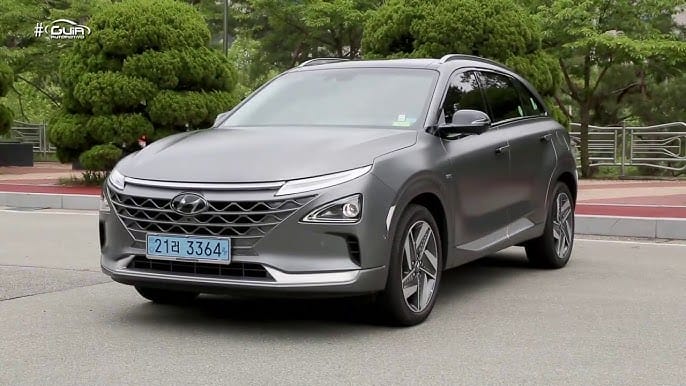
New Hydrogen-Powered Car Unveiled by Hyundai. Meet the Hyundai Nexo, Hydrogen Car Promising 600 km of Range While Purifying the Air.
The Green Mobility and Innovation Program (Mover) sets new requirements for vehicles to be safer and more economical, and primarily to pollute less. The Brazilian government’s program will build upon the advances already achieved with Inovar Auto (2012) and Rota 2030 (2018). Now, however, the idea is also to promote the production of new technologies, such as a hydrogen-powered car, for example, a solution already advocated by Hyundai.
New Hydrogen Car – Hyundai Nexo Unveiled by the Brand at the International Seminar on Renewable and Low-Carbon Hydrogen
During the International Seminar on Renewable and Low-Carbon Hydrogen, held a few months ago in Piracicaba, São Paulo, the brand unveiled the Hyundai Nexo, a hydrogen-powered car. For the first time in Brazil, the hydrogen-powered mid-size SUV promises a range of 666 km in the European WLTP cycle, and even air purification while driving.
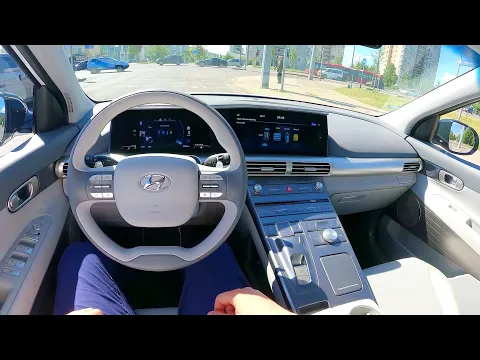

The hydrogen-powered Hyundai Nexo features fuel cell propulsion and an electric motor that together produce 183 hp. In theory, the arrival of the hydrogen-powered car may indicate domestic production by the brand in order to promote the use of the fuel of the future. Not to mention that Brazil has an extensive network of filling stations offering sugarcane-derived products, thus facilitating the use of the system.
-
Uber Black Revamps Fleet, Drops Ten Car Models and Sets Deadline for Electric BYD Dolphin

-
Chinese Giant Uses Metal Structures and Cranes to Deliver Over 700 Electric Cars to Brazil

-
Uber Faces Shareholder Scrutiny as Board Accused of Ignoring Safety, Compliance, and Harassment Warnings Amid Over 3,500 U.S. Lawsuits
-
Ferrari’s First Electric Car Divides Fans, Priced at $630,000, Amid Concerns Over Limited Editions; Brand Clarifies It’s Not Just for Future Perks


Developed in South Korea and launched in 2018, the Hyundai Nexo is powered by an electric motor that does not need to be charged at outlets, after all, it can be refueled with hydrogen (the fuel cell transforms hydrogen into electricity). In this way, there is no combustion, no pollutant emissions, and only water comes out of the exhaust.
Hyundai Strongly Invests in Alternatives to Fossil Fuels
Visually, the hydrogen-powered car features headlights at the level of the grille and sharp DRL lights at the base of the hood. The rear lights of the hydrogen Hyundai Nexo measure 4.67 meters in length, 1.86 m in width, and 2.79 m in wheelbase. The trunk has a capacity of 461 liters.
In addition to a hydrogen-powered car, Hyundai offers hydrogen solutions for other types of vehicles, including trucks, buses, trams, special equipment, vessels, power generators, and advanced air mobility. According to Airton Cousseau, president and CEO of Hyundai Motor for Central and South America, the company has always been at the forefront of hydrogen use development.
The ix35, launched in 2013, is an example of this innovation in the global market, and the Nexo is currently the model with global prominence. With the aim of propagating the use of clean hydrogen and being carbon neutral by 2045, the brand invests in solutions throughout its entire value chain, from production to final consumption.
BMW and Toyota Aim to Bring New Hydrogen-Powered Car to the Market
BMW recently confirmed that it will launch its first hydrogen-powered car (FCEV) with series production starting in 2028. The vehicle will be developed in partnership with Toyota, as the companies have been partners for 12 years in the development of this type of technology.
The model is based on the iX5 Hydrogen, which had less than 100 units produced and is being tested in various regions around the world. The Japanese brand also has its hydrogen car, the Mirai.
In the case of the iX5, there are two tanks installed under the floor. One is placed longitudinally in the center of the monocoque, and the other transversely under the rear seats. Together, these tanks hold 6 kg of hydrogen, enough to provide a range of 500 km for the model, considering the European cycle.







Be the first to react!