








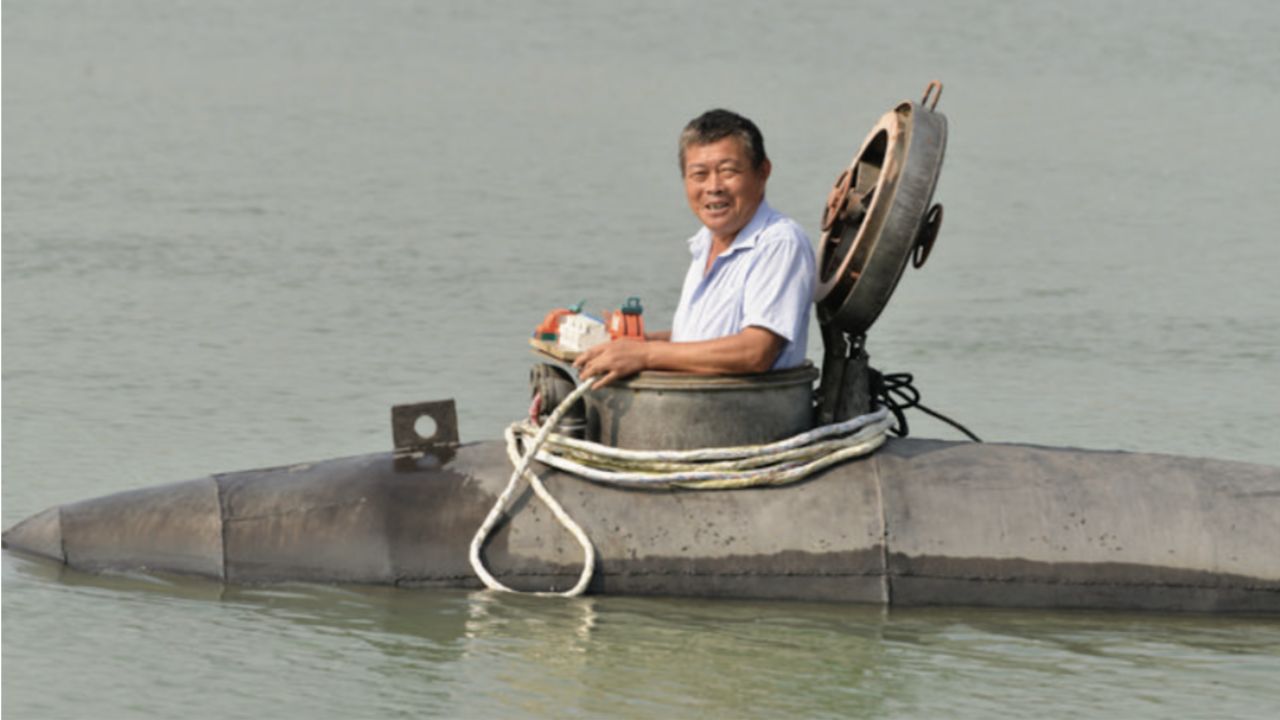
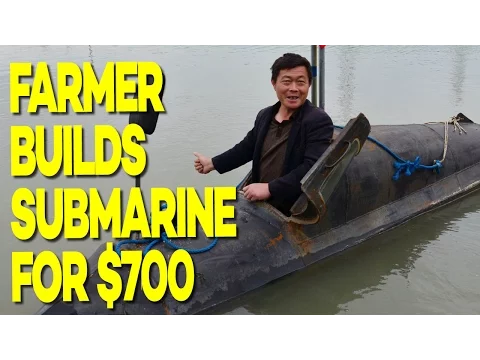
Chinese farmer builds handmade submarine Big Black Fish, a 5-ton submersible capable of diving 8 meters with two passengers in the Fengle River, Anhui.
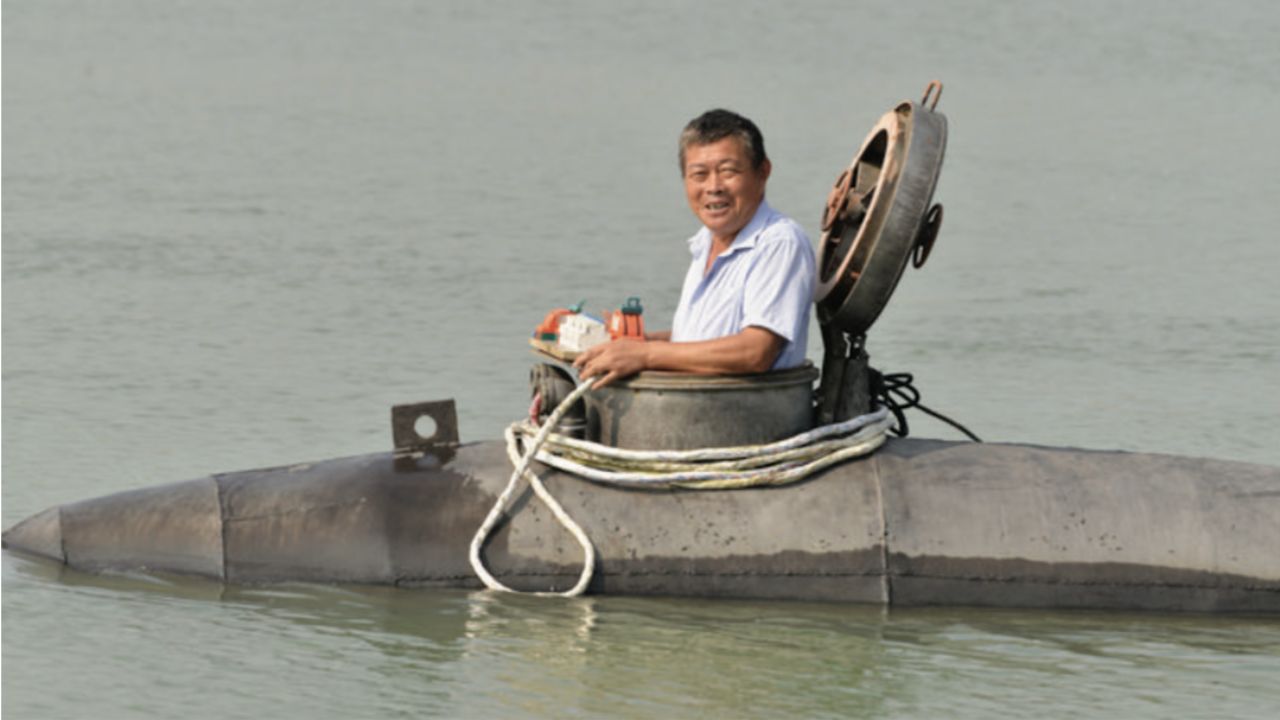
On July 2, 2025, residents of Hanshan County, in the Chinese province of Anhui, witnessed an unusual scene in the waters of a local river. A dark steel structure slowly slid across the surface, emitting a low mechanical noise, and a few seconds later disappeared under the water. It was neither a military test nor an industrial prototype. Inside the vessel was Zhang Shengwu, a 60-year-old farmer who built with his own hands a handmade submarine called Big Black Fish, after ten years of nighttime work.
Without an engineering degree, without a formal technical plan, and without family support for much of the project, Zhang decided to develop a functional submersible using steel plates, an electric motor, and common batteries. The result was a small submarine of 5 tons capable of diving up to 8 meters deep with two passengers on board. On the same day of the first public dive, the test video was posted on Douyin, the Chinese version of TikTok, and quickly spread across the country’s social networks. The name of the vehicle immediately caught attention: Big Black Fish, or “Great Black Fish.”
The childhood of Zhang Shengwu and the relationship with the rivers of the Yangtze basin
Zhang Shengwu grew up in the Yangtze River basin region, one of the most important hydrographic areas in China. The province of Anhui, in the east of the country, has a large number of rivers, canals, and river transport, especially in rural areas.
-
Brazilian Woman Transforms Ambulance into Solar-Powered Mobile Home for Remote Work and Travel Adventures

-
Oil Company Robots Discover 3,300-Year-Old Canaanite Shipwreck in the Mediterranean, Proving Ancient Mariners Navigated Open Seas by Stars Long Before Historians Thought

-
Facing high rent costs in Brazil, couple swaps apartment for life on a sailboat, reducing expenses significantly.

-
Avoiding the rental cycle, 26-year-old transforms school bus into a solar-powered mobile home for road living, spending up to $35,000 on renovations.


Throughout his life, Zhang worked in various activities related to construction and transport. He was a carpenter, welder, and worker in the river navigation sector. More than twenty years ago, he built a small sand and gravel dock in the village of Zhangdu, near the city of Ma’anshan, where he began to observe daily cargo vessels navigating the region.
In an interview with the state broadcaster CCTV, Zhang reported that this constant interaction with boats sparked his curiosity.
He stated that for years he saw wooden boats and steel ships crossing the river, but he had never witnessed a boat capable of diving. This curiosity would eventually become the starting point for the submarine project.
The idea of building a submarine came after a television program
The direct inspiration for the project appeared in 2014, when Zhang watched a television program showing a person building an experimental submarine. According to him, the segment immediately sparked a simple question: if someone else could build a submarine, why couldn’t he try to do the same?

Later that week, Zhang gathered 5,000 yuan — about 700 dollars at the time — to buy steel sheets, a used engine, and a battery. The work began discreetly. He welded the pieces at night while his wife was away taking care of his mother-in-law.
Without formal training in naval engineering, Zhang based the project on observations of boats and trial and error.
The first handmade submarine cost US$ 700 and had leaks
Six months after starting the work, Zhang completed the first prototype of a submarine. The vessel was 6 meters long, about 1.2 meters high, and approximately 2 tons in weight. The vehicle could dive only 1 meter deep and had leaks.
Even with the flaws, Zhang decided to pilot the submarine during initial tests. He described the experience as the fulfillment of a dream, although he admitted being afraid that the structure might not hold.
Despite the technical limitations, the prototype attracted enough attention to secure Zhang a national utility model patent in 2016. This type of patent, common in China, recognizes technical solutions considered new or useful.
In the same year, he registered a second patent related to a surface boat with a propulsion system that reduces wave formation.
Lack of family support and continuity of the project
Zhang’s family never showed enthusiasm for the submarine project. His wife described the initiative as expensive, risky, and without practical use. Despite the criticism, Zhang continued working.
Between 2016 and 2023, he gained practical experience, saved money, and analyzed the failures of the first prototype. This period was essential for him to start a second, more ambitious project.
The second submarine: birth of the Big Black Fish
In 2023, Zhang began building a new submarine. This project would become the Big Black Fish. The total investment reached 40,000 yuan, about 5,570 dollars, eight times more than the cost of the first prototype.
The new model had larger dimensions. The hull measured 7 meters in length and 1.8 meters in height, allowing it to accommodate two passengers side by side. To solve the stability problems that affected the first submarine, Zhang adopted a simple solution: he poured about 2 tons of concrete at the bottom of the hull, creating a permanent counterweight.
According to him, the concrete helps keep the submarine balanced during the dive.
Ballast system allows the submarine to dive and return to the surface
The Big Black Fish uses a ballast tank system, a common technology in submarines. Zhang installed two tanks — one at the bow and another at the stern. When these tanks are filled with water, the submarine loses buoyancy and dives. To ascend, the water is drained.
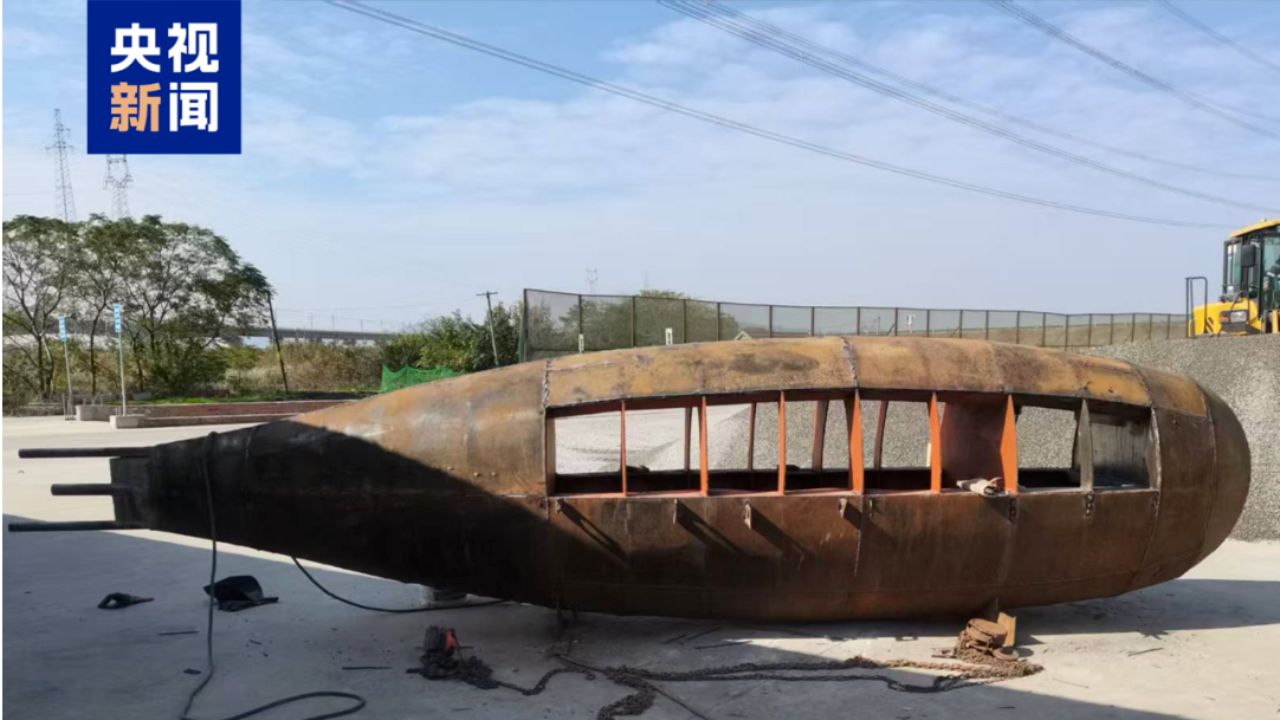
Each joint of the hull was manually welded by Zhang himself. He used silicone and industrial adhesives to improve sealing and installed circular hatches, which help better distribute water pressure.
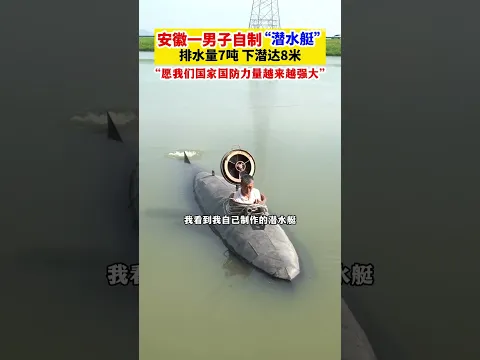
The final result was a submersible of 5 tons of steel and an approximate displacement of 7 tons, capable of diving up to 8 meters deep. The submarine can navigate at about 4 knots (approximately 7.4 km/h) and remain submerged for up to 30 minutes, using only an electric motor powered by batteries.
The vehicle also has reverse gear, which facilitates maneuvers in narrow areas.
The first public dive in the Fengle River
On July 2, 2025, Zhang took the Big Black Fish to the Fengle River, near his residence in Hanshan. Local residents gathered on the banks to watch the test. Zhang entered through the top hatch, closed the lid, and activated the ballast tanks.
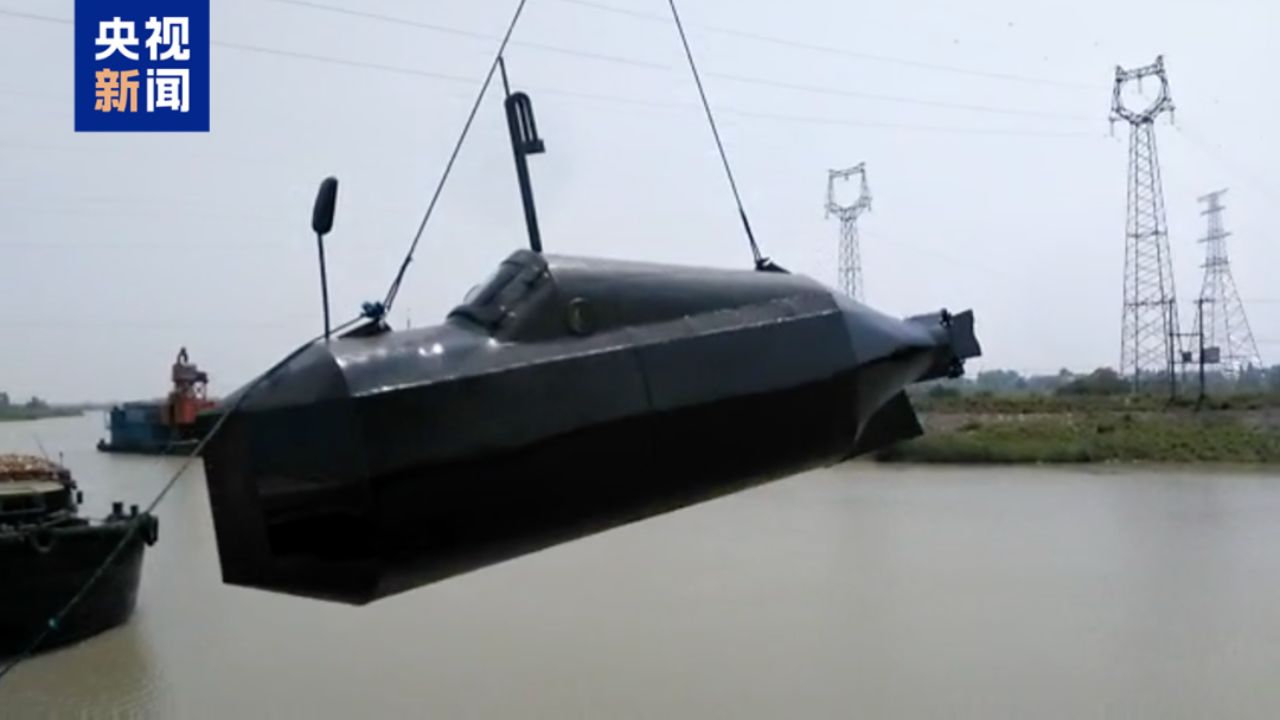
The submarine slowly sank into the murky waters of the river and disappeared for a few moments before resurfacing. To aid navigation, Zhang installed a waterproof camera attached to a pole approximately 5 meters at the bow. The system allows observation of the riverbed before starting the dive.
Inside the cockpit, there is a small panel with blue lighting and a rubber-coated non-slip joystick, used to control the direction. During the initial tests, Zhang used the submarine to retrieve a lost fishing net, belonging to a local fisherman. For the rescue, he received 3,000 yuan as a reward.
Experts warn about the risks of homemade submarines
The invention also raised concerns among experts. Professor Li Zheng, a specialist in naval architecture at Shanghai Jiao Tong University, commented on the case in an interview with CCTV.
According to him, maintaining the structural integrity of a submersible vehicle is a complex challenge. Even at a depth of 8 meters, the water pressure is already significant. Experts point out that submersibles built without technical certification, adequate pressurized hulls, or emergency systems for forced ascent can pose serious risks.
So far, no official safety inspection has been released for the Big Black Fish. Zhang claims to be aware of the risks but says he will continue to improve the project.
Rural inventors and innovation outside China’s major technological centers
Zhang’s story also attracted attention for contrasting with the more well-known image of technological China. While the country invests billions in hypersonic aircraft, artificial intelligence, and quantum computing, Zhang’s case shows an inventor working almost alone on a complex project.
According to data from the China National Intellectual Property Administration (CNIPA), the number of utility model patent applications submitted by individual inventors in rural provinces has been increasing in recent years.
Many of these projects are related to transportation, agriculture, and low-cost solutions. In Anhui, a federal program launched in 2020 offers subsidies of 5,000 yuan for rural inventors who keep their creations operational for more than six months.
The next project: an even bigger submarine
Zhang Shengwu has already stated that he intends to build a third submarine, larger and capable of deeper dives.
The details have not yet been defined, but he claims that he continues working in the same way he started the original project: without formal technical blueprints and basing the calculations mainly on accumulated experience. According to Zhang, his mind is always thinking about the next project.
Meanwhile, the Big Black Fish remains anchored in the Fengle river. The submarine does not have official certification nor does it meet traditional naval engineering standards.
Even so, it dives, returns to the surface, and continues functioning — the result of ten years of work by a farmer who decided to build a submarine after watching a television program.







Be the first to react!