






 Portuguese
  Spanish
  4 min of reading
  0 comments


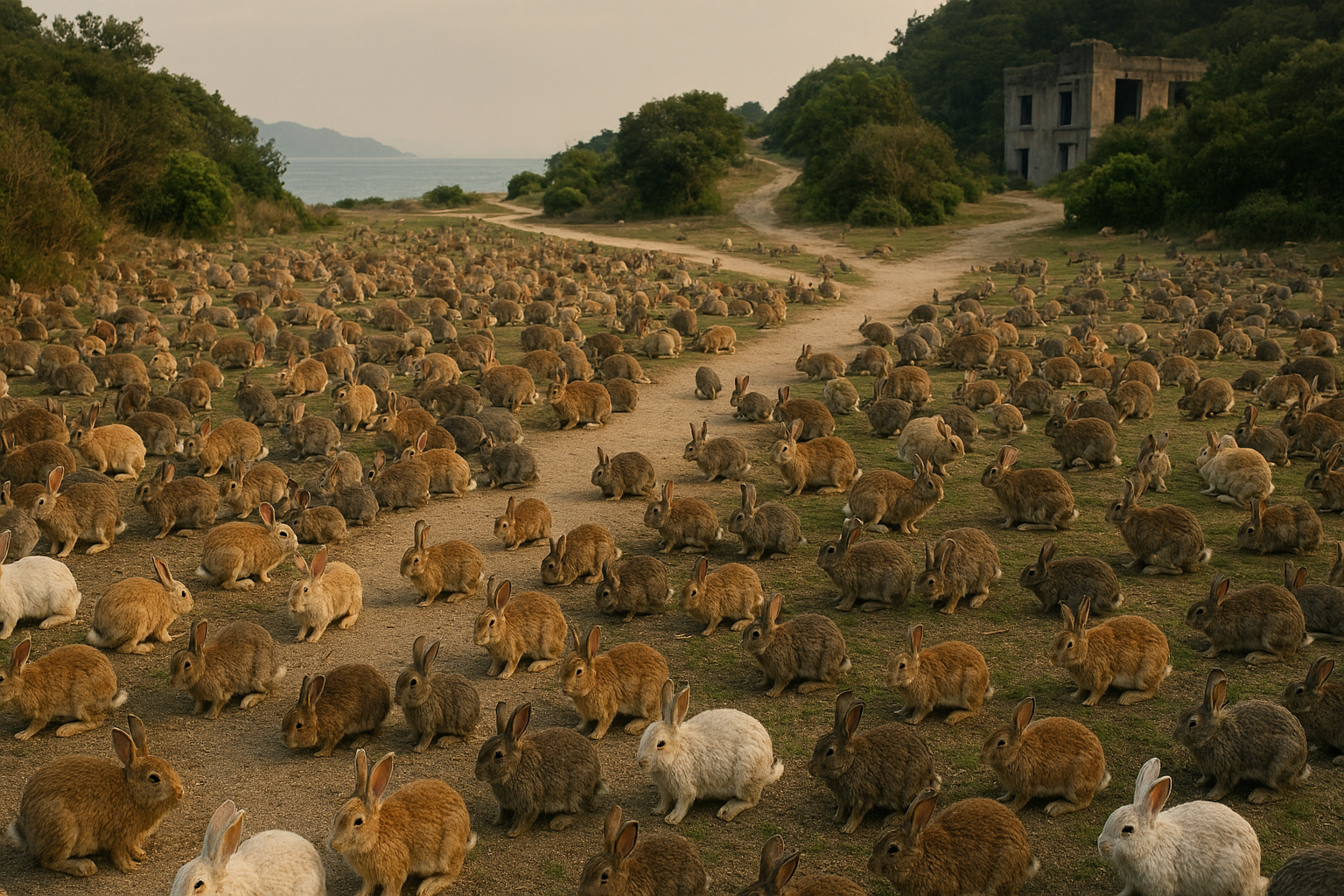
Japanese Island of Okunoshima Houses More Than 1,000 Rabbits After Human Abandonment and Lack of Predators, Creating a Real Case of Ecological Imbalance.
The small island of Okunoshima, located in the Seto Inland Sea in Japan, has become internationally known as the so-called “Rabbit Island”. What seems, at first glance, to be a curious and even charming tourist spot hides a complex environmental phenomenon, a direct result of human intervention, historical abandonment, and complete absence of natural predators. Widely accepted estimates by researchers, local authorities, and Japanese media indicate that the current population exceeds 1,000 rabbits, a number that varies throughout the year due to accelerated reproduction and natural mortality.
The Geographical Isolation That Favored the Population Explosion
Okunoshima has about 4 kilometers of perimeter, is separated from the mainland by a few minutes by ferry, and does not have permanent residents. This combination created a closed environment, ideal for observing how a species behaves when all natural control mechanisms are removed.
There are no foxes, birds of prey, large snakes, or predatory mammals on the island, which eliminates any selective pressure on the rabbits.
-
Small clay piece with 11 dots found in Guatemala may push back the history of numbers in Mesoamerica by 2,700 years and reveal that ancient civilizations were already recording identity, calendar, and counting centuries earlier than imagined.

-
Hairdresser opens a simple salon at her doorstep in Sete Lagoas, cuts the ribbon with her daughter, and draws attention on social media; emotional video goes viral, attracts over 22,000 followers, and turns a humble beginning into an inspiration for thousands of people.

-
Japanese fans transform NFL stadium into a global example of education at the 2026 World Cup; after a dramatic draw against the Netherlands, blue bags used in the celebration become a cleaning tool and the stands end up trash-free in the United States.
-
United Kingdom announces social media ban for under 16s







Without predators and with constant access to food provided by tourists, the population began to grow exponentially, a classic pattern described in studies of population ecology.
How the Rabbits Got to Okunoshima
The exact origin of the rabbits is still a subject of debate. The two most accepted hypotheses are:
– Deliberate introduction of a few rabbits after World War II
– Gradual abandonment of domesticated animals by visitors and residents of the surrounding area
What is known for sure is that the current rabbits are not part of the island’s native fauna. They are descendants of a small initial group that found ideal conditions to multiply rapidly.
Accelerated Reproduction and Out of Control Growth
Rabbits have one of the highest reproductive rates among land mammals. A single female can produce several litters a year, with multiple offspring in each.
In natural environments, this evolutionary advantage is offset by predators and resource limitation. In Okunoshima, this does not occur.

The result is a population growth that often exceeds the island’s natural carrying capacity, especially during periods of high tourist visitation, when the artificial food supply increases even further.
Environmental Impacts Caused by Overpopulation
Despite the friendly image, the presence of more than 1,000 rabbits in such a limited area generates real and measurable environmental impacts. Among the main observed effects are:
– Degradation of native vegetation, with excessive consumption of sprouts, roots, and young plants
– Soil compaction and erosion, caused by constant movement
– Reduction of plant regeneration, hindering the natural recovery of the ecosystem
– Competition for food, leading to malnutrition during periods of lower tourist traffic
Japanese biologists emphasize that the island’s current environment does not represent an ecological balance, but rather an artificial system maintained by continuous human interference.
Direct Dependence on Tourists
Another critical factor is food dependence. A large part of the rabbits obtain food directly from visitors, who provide feed, vegetables, and food leftovers. This creates a dangerous cycle: during periods of declining tourism, as occurred during the pandemic, there was a significant increase in mortality.
This dependence reinforces that the animals do not live fully autonomously, but rather are embedded in a fragile system, sustained by constant human flow.
Animal Health and Sanitary Risks
The high population density also raises the risk of diseases, parasites, and infections, common in environments with many individuals of the same species. Although there are no records of large-scale epidemics, veterinarians warn that the situation requires constant monitoring.
The absence of predators does not mean an absence of suffering. Many rabbits face injuries, untreated illnesses, and premature aging, common consequences in overpopulated communities.
An Unintentional Experiment in Ecological Imbalance
Okunoshima is frequently cited in academic articles, international reports, and environmental debates as a real example of how good intentions can cause serious ecological problems. The island functions, in practice, as an open-air laboratory on the effects of human abandonment combined with artificial feeding and lack of population control.
Japanese ecologists emphasize that, without planned intervention, the scenario is likely to repeat itself: rapid growth, partial collapse due to lack of resources, and new artificial recovery.
Tourism, Ethics, and the Intervention Dilemma
The local government faces a complex dilemma. Controlling the population through sterilization or relocation involves high costs, delicate logistics, and public resistance, as the rabbits are the main tourist attraction of the island. At the same time, failing to act maintains a cycle of permanent environmental imbalance.
Okunoshima shows that not always does an apparently harmonious environment represent a healthy ecosystem. The case has become a global reference for discussing the limits of human intervention in nature, even when motivated by tourism, curiosity, or affection for animals.
A Silent Alert About Living with Wildlife
More than a tourist curiosity, Rabbit Island is a concrete alert. It demonstrates that removing predators, introducing species outside their habitat, and artificially sustaining populations can lead to profound, lasting, and difficult-to-reverse consequences.
Okunoshima is not just an island full of rabbits. It is a real example of how ecological imbalance can arise slowly, seem harmless, and still compromise an entire natural environment.





-

-

-

-

-

-

190 people reacted to this.