Portuguese
  Spanish


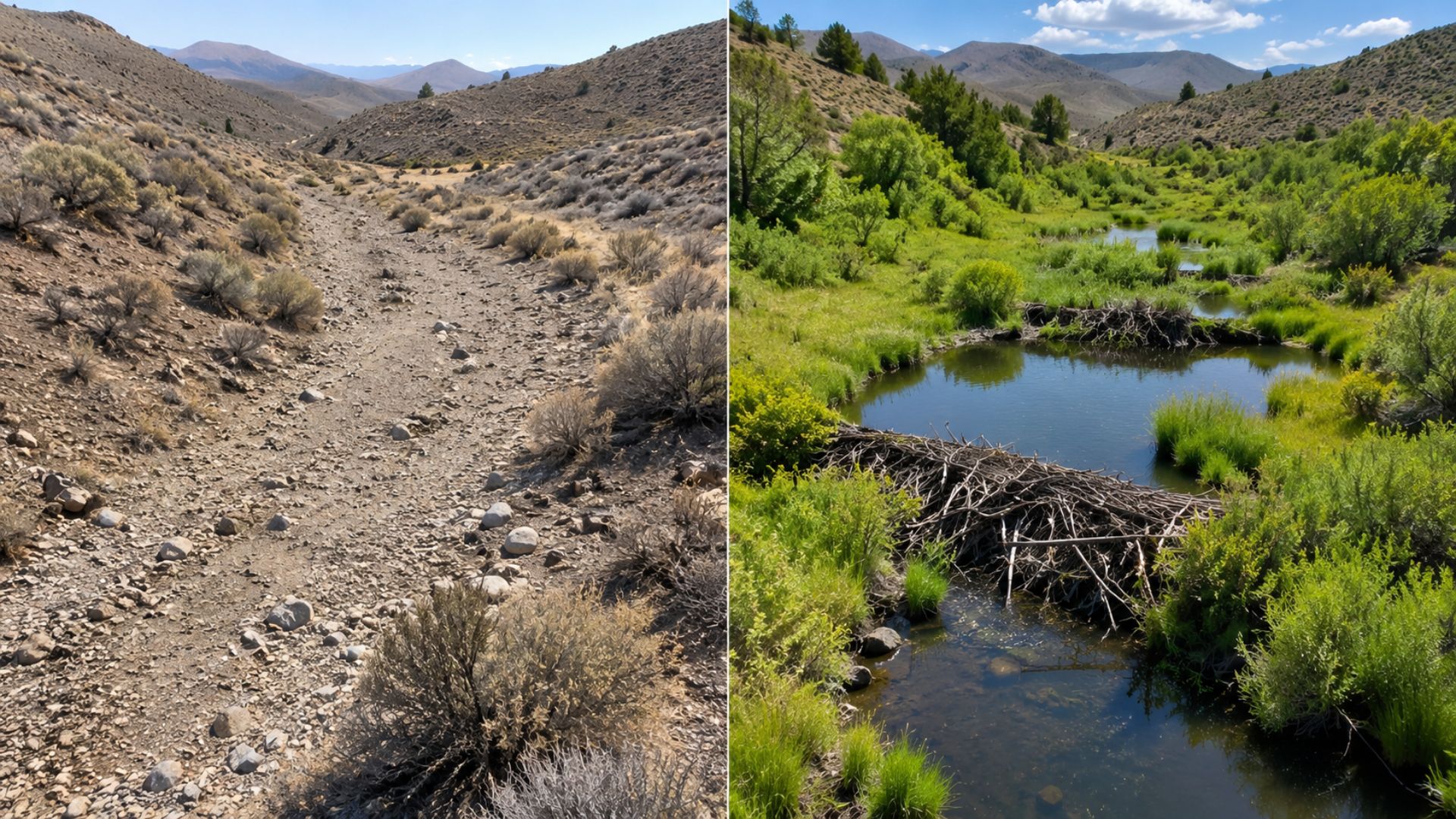

In the driest state of the United States, beavers transformed Susie Creek, in Nevada, from a dead gravel ditch in 1989 into a green oasis full of pools and willows. The dams built by the beavers stored water during brutal droughts and proved to be more efficient and cheaper than billion-dollar engineering projects.
On September 9, 1989, an official photograph from the United States Bureau of Land Management (BLM) recorded Susie Creek, in Elko County, northeastern Nevada, as a narrow strip of water cutting through an exposed gravel bed, without willows, without green vegetation, and without any sign of riparian life. Decades later, the same location turned into a green oasis of deep pools and dense willows, and the one responsible for this transformation was not any million-dollar government project, but rather the spontaneous return of beavers, attracted by simple changes in cattle management made by biologist Carol Evans from the BLM and ranch foreman Jon Griggs.
The story, documented by the United States Forest Service, the BLM, and peer-reviewed scientific studies, shows how North America’s most underestimated animal helped one of the country’s driest regions withstand severe droughts. Nevada receives less than 25 centimeters of rain per year, making it the driest state in the United States, and Susie Creek was the perfect image of this bleak scenario. The solution that changed everything, according to researchers, was almost ridiculously simple: mud, branches, and the natural instinct of beavers.
What disappeared when beavers were nearly extinct

Before the arrival of Europeans in North America, it is estimated that there were between 60 and 400 million beavers spread across the continent. The dams and ponds created by them occupied more than 770 thousand square kilometers of wetlands, forming a vast interconnected network of calm water, fertile soil, and rich habitat for fish, birds, amphibians, and countless other species.
-
Archaeologists Uncover Ancient Ruins and Artifacts in Shiloh, Potentially Shedding Light on the Biblical Ark of the Covenant

-
Havaianas Covers Brazilian Landmark with 4,500 Flip-Flops to Create Visual Spectacle of National Flag
-
Ancient Wind Tower Cools Desert Homes Using Physics, Water, and Smart Architecture Without Electricity
-
Free Coffee for World Cup Losers? Mexican Café Offers “Losers’ Coffee” to Cheer Up Disappointed Fans with Humor




The fur trade changed this scenario brutally. Starting in the 1600s, beaver fur became one of the most valuable products in the world, used in the manufacture of hats in Europe, and mass hunting decimated the population. By around 1900, there were about 100,000 beavers left in all of North America. Without the beavers’ dams to slow the water, rivers began to carve deeper channels, floodplains dried up, water tables dropped, and wetlands that stored billions of liters of water simply disappeared.
From pest to ally: the mindset shift in Nevada

One of his first tasks was to transport dynamite from Battle Mountain to blow up a beaver dam on Maggie Creek. At that time, farmers saw beavers as pests: they blocked irrigation channels and flooded pasture areas, and therefore were hunted, captured, and had their dams destroyed with explosives.
At the same time, biologist Carol Evans, a specialist in riparian ecosystems at the BLM, observed those same streams in a completely different way. Decades of overgrazing had left the banks bare, with soil collapsing and water tables falling, threatening native fish like the Lahontan cutthroat trout, Nevada’s state fish. It was Evans who proposed to Griggs a simple idea: keep cattle away from the stream banks during the hottest months of the year, giving plants a chance to grow back. The partnership between the two would change the fate of the beavers in the region.
How cattle management paved the way for the beavers


Carol Evans’ proposal did not involve expensive fences or large investments. It was just a strategic pause: let the vegetation recover during the growing season and only then allow the cattle to return, when the plants were already strong. Jon Griggs didn’t have much faith in the idea, but decided to try. Changes began quickly. In the first year, native grasses began to grow back on the banks. In the second, wildflowers and more vegetation appeared.
In the mid-1990s, around 1996, young willows finally began to sprout again. And that’s when something happened that even Evans didn’t expect so soon. Normally, it takes 8 to 12 years to restore a riparian area to the point of attracting beavers back. But by 2003, the beavers began to appear in Susie Creek and the Maggie Creek area on their own, without anyone bringing them there, attracted by the willows, their main source of food and building material.
The work of beavers and the sponge effect on the soil

They built dams that slowed the flow of water, which began to spread across the floodplain, infiltrate the soil, and recharge the underground aquifers. With more water available below the surface, plants grew stronger, roots stabilized the banks, more sediments were captured, and the floodplain soil began to rise slowly, in a cycle of recovery that maintained itself almost independently.
Jon Griggs likes to explain that most people imagine a stream as just the visible water running on the surface, but a healthy stream is much more than that: there is a huge underground sponge formed by the moist soil below the floodplain, which keeps the region hydrated for much longer. The beavers help to create this sponge by slowing down and spreading the water. A satellite study in 2006 identified 107 dams along about 32 kilometers of Maggie Creek, a number that grew to 271 dams in 2010.
The trial by fire: how the beavers overcame extreme drought
The real test came after 2012, when the region faced some of the driest periods ever recorded. Neighboring farmers had to transport water by truck to prevent cattle from dying. However, at Maggie Creek Ranch, the areas of Susie Creek where there were beaver dams continued to store water, with large deep pools intact even during extreme heat, while green vegetation continued to grow around the banks.
The contrast was immortalized in two photographs from the same spot. In September 1989, Susie Creek was a dry gravel strip, without water, plants, or animals. In September 2015, after a brutal four-year drought, the same place displayed large pools of clean water surrounded by dense willows, green grasses, and nesting birds. The difference was so great it seemed like digital manipulation, but it was real, and all thanks to the work of the beavers. Jon Griggs completely changed his mind and became one of the biggest advocates for the recovery of these animals, even leading the Nevada Cattlemen’s Association.
Science confirms: beaver dams cool the water
Scientists needed more than photos and reports. The proof came from Bridge Creek, in the state of Oregon, a region that receives about 30 centimeters of rain per year and almost none during the summer. Researchers from Utah State University monitored, between 2007 and 2014, the location of the dams and the water temperature along 34 kilometers of stream. During this period, the number of natural dams increased tenfold in the studied area.
The results, published in the peer-reviewed scientific journal PLOS One in 2017, showed that the water stored behind the dams reduced extreme temperature variations throughout the day and created small cold areas within the stream, true thermal refuges for fish. In the American West, where river warming is becoming fatal for native salmon and trout species, these cold areas have become essential. The study provided scientific backing to what the beavers were already naturally doing in Susie Creek.
Imitating beavers: low-cost artificial dams
The research went further and tested structures called beaver dam analogs, or BDAs. They mimic natural dams and are built with the same materials that the animals use: interwoven willow branches, filled with mud, sediments, and small logs. A team of just three or four people can erect one of these structures in a few hours, with simple hand tools, at a cost often less than a thousand dollars per unit.
The cost difference is striking. Conventional river restoration projects can cost tens of thousands of dollars to recover just a few meters of stream. The BDAs worked: they slowed down the water, captured sediments, raised the water table, and in some cases, even attracted real beavers, who took over the maintenance and expansion of the structures on their own. Today, agencies in states like Nevada, Idaho, Washington, and Oregon develop entire projects based on this technique, and federal agencies like the Fish and Wildlife Service have already published official beaver-based restoration guides.
Why beavers could be the answer to the water crisis
The movement is growing, but not without reservations. Some scientists warn that the installation of BDAs is happening faster than research can keep up with, and that the long-term effects still need to be better studied. Carol Evans herself observed that if the region’s vegetation had had another 5 to 10 years to recover before the beavers arrived, the ecosystem would have coped even better with them. In cities like Reno, many people still see the animals only as pests.
Even so, the economic logic is powerful. While human solutions like desalination plants, giant artificial reservoirs, and interstate water transfers cost billions of dollars and take decades to complete, a beaver builds a dam in a single night, at no cost. The lesson of Susie Creek is not that beavers are magical, but that the systems they create, with slow water, moist soil, and fertile plains, are exactly what the driest regions of the United States need to face the future.
The transformation of Susie Creek, from a dead gravel ditch in 1989 to a living strip of vegetation that withstood the worst droughts, is one of the most surprising environmental stories of the American West. It shows that sometimes the cheapest and most efficient solution to a gigantic problem already exists in nature, just waiting for an opportunity. The change in mindset, from seeing the beaver as a pest to recognizing it as an ally, can be as important as any cutting-edge technology in the fight against water scarcity.
Did you ever imagine that beavers could be more efficient than billion-dollar engineering works in combating drought? Do you think nature-based solutions like this could help dry regions of Brazil, such as the northeastern semi-arid area? Leave your comment, tell us what you think about restoring ecosystems with the help of fauna, and share the article with those interested in the environment, water resources, and climate change.