Portuguese
  Spanish


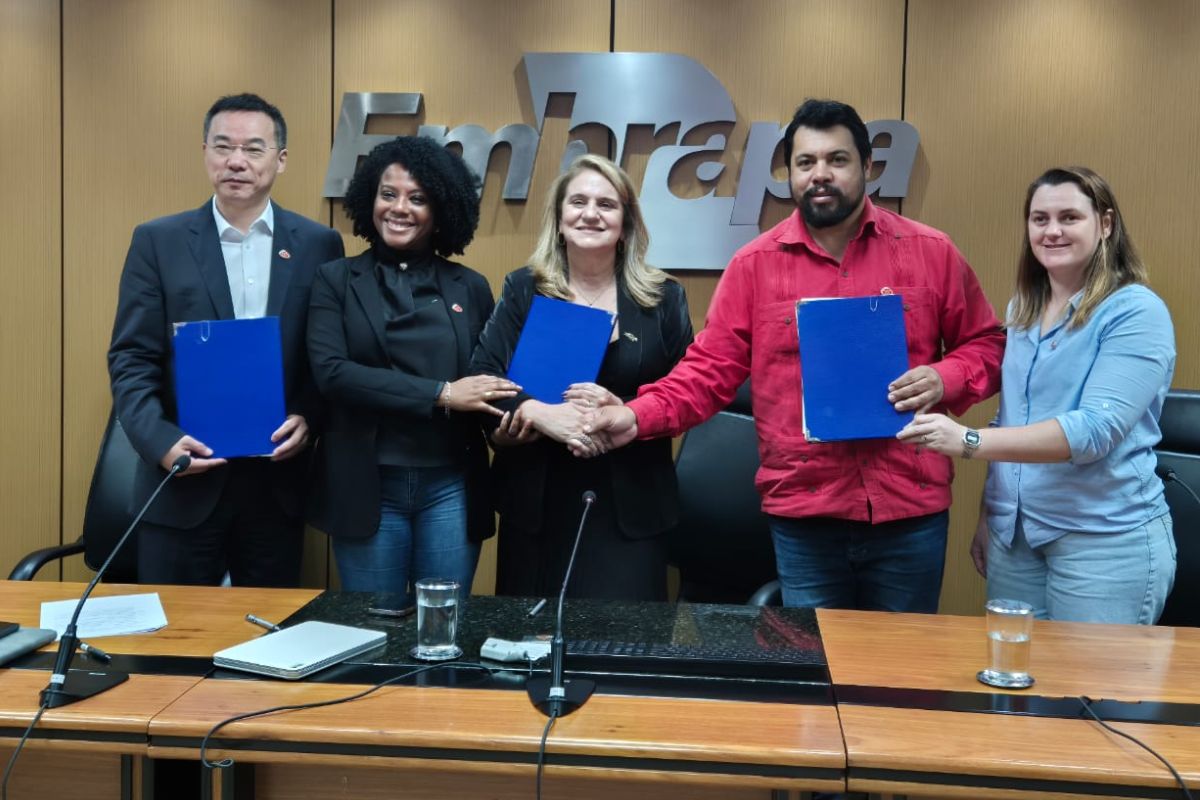

With A Focus On Digital Inclusion In Agriculture, New Smart Service Centers Strengthen Innovation, Mechanization And Continuing Education In Rural Settlements In Partnership Between Embrapa, MDA, Unicrab And Chinese Company
The digital inclusion in agriculture is taking on a new space in rural settlements as part of a cooperation agreement signed between Embrapa, Sinomach Digital Technology Corporation, MDA and Unicrab, according to a report published.
The initiative establishes smart service centers with a focus on family agriculture, with planned activities between 2025 and 2030 starting in two settlements in Londrina (PR).
The project is integrated into Semear Digital, an open innovation model funded by Fapesp and already adopted in ten digital agriculture districts presented at COP30.
-
Study of Brazil’s Tietê River Finds 25 Pesticides in Water, Including Cancer-Linked Substance Near Source

-
Young Entrepreneur Expands from 50 to 1,400 Chickens, Proving “Happy Hens” Can Be a Viable Business
-
Small Farm in Brazil’s Minas Gerais Produces 403 Liters of Milk Daily, Sets Benchmark for Rural Producers
-
Man Revives 1930s Abandoned Trout Farm, Learns from Scratch, and Earns $1.1 Million Annually Selling Fish to Michelin-Starred Restaurants



The partnership involves more than 200 cooperatives brought together by Unicrab, which has accumulated experience in adapted tractors and machinery distributed in municipalities like Maricá (RJ), Açailândia (MA), Teixeira de Freitas (BA), Mossoró (RN) and Fortaleza (CE).
The formalization of the agreement was attended by Embrapa’s president, Silvia Massruhá, MDA’s director, Vivian Libório Almeida, Chinese executive Wang Yuhang, Unicrab’s president, Diego Moreira, and technical representatives from Embrapa in both in-person and online modalities.
Smart Agricultural Service Centers As A Strategy For Rural Innovation
The creation of smart service centers stems from the need to expand access to digital technologies, connectivity and continuing education in the territories where around 500 families operate.
The agreement brings together research, machinery, and training, putting the Semear Digital approach into practice to bring farmers closer to Information and Communication Technology (ICT) tools.
The proposal reinforces digital inclusion in agriculture as a structuring element to enhance traceability, bio-inputs and productive sustainability.
According to Embrapa, the initiative allows settlements to receive technologies that contribute to sustainability certifications and to the modernization of processes that still operate on the edge of digital transformation.
Mechanization Of Sustainable Family Agriculture And Digital Inclusion In Agriculture
Sinomach Digital presented the agreement as an opportunity to deepen shared research between Brazil and China, involving the ministries of Science and Technology and Chinese universities.
The laboratory managed by the company works with artificial intelligence and digitalization in the field, reinforcing the mechanization of sustainable family agriculture in synergy with Semear Digital.
The partnership uses digital inclusion in agriculture as a way to enhance the productivity of small and medium producers, especially through 50 Chinese machines currently being tested in Brazil in partnership with UnB and the Federal Institute of Rio Grande do Norte.
According to Diego Moreira, the presence of connected machinery offers practical answers to historical bottlenecks in family agriculture, enabling advances in traceability, food security, and mechanization suitable for regional realities.
Continuous Training Of Family Farmers And Brazil-China Integration In Agriculture
Continuing education emerges as a pillar of the agreement, with special attention to youth and women in the settlements.
The implementation reinforces that digital inclusion in agriculture also represents an opportunity to enable rural succession and access to emerging technologies.
Embrapa, which has already demonstrated experiences with connected stingless beekeeping and the Amazon biome at COP30, emphasizes that the training process meets real needs of the territories.
The Brazil-China integration strengthens technical exchange and broadens the reach of the National Innovation Program for Family Agriculture and Agroecology of the MDA, which guides the development of machines, equipment, and rural credit aimed at technological advancement in the field.
In the end, those responsible for the agreement emphasize that the construction of joint innovation only sustains itself when digital inclusion in agriculture becomes an accessible tool for all involved families.