Portuguese
  Spanish


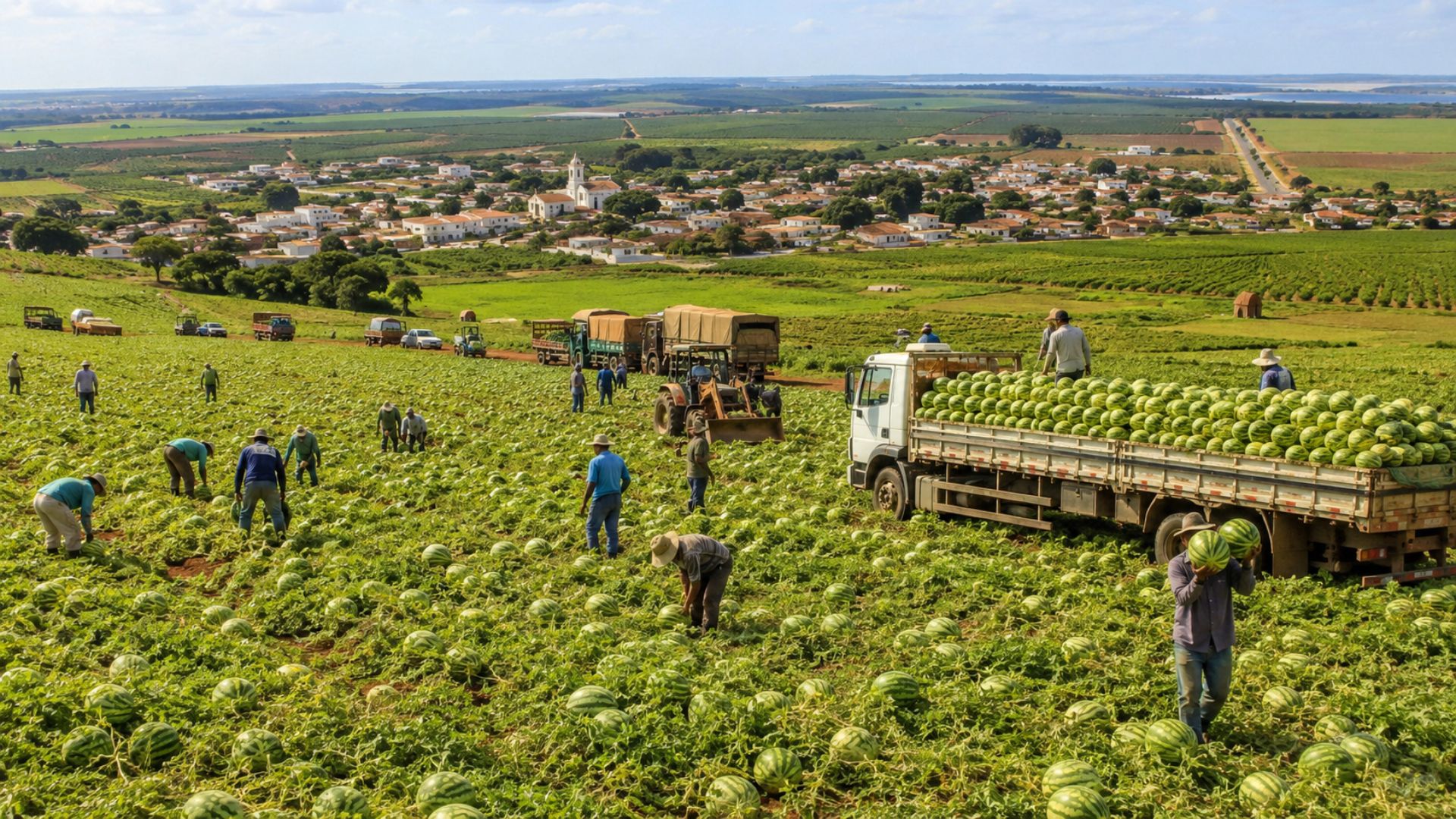


The vocation was born in 1968, when an agronomist from Emater saw in the potassium-rich soil and the water of the Uru River the ideal scenario for the fruit. Today the harvest amounts to about 16 tons per resident and supplies half of Brazil, in addition to crossing the border towards Argentina, Paraguay, and Uruguay.
With just over 14,000 inhabitants, the small town of Uruana, in the interior of Goiás, produces about 200,000 tons of watermelon per year and accounts for approximately 10% of all the fruit harvested in Brazil. This impressive performance, especially for such a small town, has earned it the national nickname of watermelon capital, a title it has proudly carried for decades.
Located in central Goiás, about 140 to 170 kilometers from Goiânia, the city has transformed the fruit into its main economic and cultural identity. However, it is important to clarify: Uruana is recognized as the watermelon capital for its fame, tradition, and the quality of what it produces, not for being the largest in absolute volume. In number of tons, there are municipalities that produce more, as we will see later, but none have the prestige that Uruana has built around the fruit.
Where the fame of watermelon capital comes from

He concluded that the region had ideal soil and climate for watermelon cultivation, in addition to the advantage of proximity to large emerging consumer markets, such as the Goiânia, Anápolis, and Brasília axis, and also the São Paulo market.
-
Study of Brazil’s Tietê River Finds 25 Pesticides in Water, Including Cancer-Linked Substance Near Source

-
Young Entrepreneur Expands from 50 to 1,400 Chickens, Proving “Happy Hens” Can Be a Viable Business
-
Small Farm in Brazil’s Minas Gerais Produces 403 Liters of Milk Daily, Sets Benchmark for Rural Producers
-
Man Revives 1930s Abandoned Trout Farm, Learns from Scratch, and Earns $1.1 Million Annually Selling Fish to Michelin-Starred Restaurants


From then on, production grew and became ingrained in the life of the city. Watermelon ceased to be just a crop to become a symbol of Uruana, to the point that the municipality is nationally hailed as its capital. Right at the entrance of the city, a watermelon-shaped monument welcomes visitors, reinforcing an identity built over more than half a century of agricultural tradition.
The Numbers That Impress

Approximately 200 to 220 thousand tons of watermelon per year, which equates to an impressive average of 16 tons of the fruit for each resident of Uruana, considering only the local population of just over 14 thousand people.
This volume places the municipality among the main production hubs in the country and accounts for about 10% of all watermelon harvested in Brazil, which produces approximately 2.24 million tons per year over an area of almost 102 thousand hectares, according to IBGE data. The fruit, by the way, is one of the most consumed in the country, especially in the summer, ensuring constant demand for the producers in Goiás.
Capital by Fame, Not by Volume


This is where a point that deserves precision comes in, to avoid common exaggerations. Despite the nickname, Uruana is not the largest producer of watermelon in Brazil in absolute volume. According to IBGE data cited by the Legislative Assembly of Goiás, the municipality of Goiás ranks as the second largest national producer, behind Baraúna, in Rio Grande do Norte.
Reports like the one from the newspaper O Povo are also clear in pointing out that there are municipalities in other regions, especially in the South of the country, with greater absolute production. What makes Uruana the watermelon capital is the national recognition, the involvement of the population, and the cultural identity built around the fruit, not necessarily the first place in the tonnage ranking. The state legislation itself formally recognizes it as the watermelon capital of Goiás.
The Secret of Productivity
Several factors explain why watermelon thrives so well in Uruana. From a natural standpoint, the region’s soil is rich in potassium, an essential nutrient for the fruit’s development, and there is good water availability, with emphasis on the Uru River, which favors continuous irrigation systems throughout the year and ensures regularity in production.
To these environmental factors, technological ones are added. Local producers invest in soil management, pest control, selected seeds, and genetic improvement research, which increases the productivity and quality of the fruit. This combination of nature and technology is what allows Uruana to maintain large-scale harvests and supply demanding markets both inside and outside Brazil.
From the Goiana farm to abroad
The watermelon from Uruana doesn’t stay only in Goiás. The production supplies various Brazilian states, such as São Paulo, Minas Gerais, Paraná, Pará, and the Federal District, and even crosses borders, being exported to Mercosur countries like Argentina, Paraguay, and Uruguay. The good road network in the region facilitates the quick flow of the harvest to distribution centers.
This reach shows how a well-structured agricultural culture can transform the economy of a small inland municipality. For Brazilian agribusiness, Uruana is an example of how the combination of regional vocation, technical assistance, and productive organization can generate income, jobs, and recognition far beyond the size of the city on the map.
The Watermelon Festival
All this productive strength reaches its peak in a celebration. The Uruana Watermelon Festival has existed for more than 40 years, traditionally takes place in September, and gathers, on average, about 80,000 visitors, a number almost six times larger than the population of the city. The festival has become a mark on the Goian cultural calendar and attracts people from various parts of the country.
The program includes musical shows, themed parades, local product fairs, exhibitions, competitions, and even watermelon-eating contests, in addition to the traditional election of the Watermelon Queen. More than just a festival, the event values family farming and regional agribusiness, reinforcing the emotional bond of the residents with the fruit that made the city famous. In recent editions, authorities like Governor Ronaldo Caiado have highlighted the economic relevance of the sector for the region.
Uruana is proof that size doesn’t matter when it comes to agricultural vocation. With just over 14,000 inhabitants, the Goian city has built, over more than fifty years, such a strong identity around the watermelon that it became known as the national capital of the fruit, even without being the largest in volume. It’s a beautiful portrait of how tradition, natural conditions, and work can put a small inland municipality on the map of Brazilian agribusiness and even in the international market.
And you, had you heard of Uruana, the watermelon capital in the heart of Goiás? Have you tried it or know someone who visits the famous Watermelon Festival? Leave your comment, tell us about your relationship with this beloved summer fruit, and share the article with those who love agribusiness, Brazilian curiosities, and, of course, a good watermelon.