Portuguese
  Spanish



NASA Researchers Identified Two Black Holes That Are Moving Toward a Merger in Our Cosmic Neighborhood. Understand the Impact of This Incredible Astronomical Discovery!
A recent study revealed an impressive discovery from NASA researchers: two supermassive black holes are on a collision course, separated by only 100 parsecs (approximately 326 light-years) — a small distance in astronomical terms.
This proximity is unusual, as most pairs of black holes detected so far are much farther away and, in many cases, obscured by dust and gas, making observation challenging. The discovery occurred in the galaxy MCG-03-34-64, located about 800 million light-years away from us.
Something Unexpected in a Mysterious Galaxy
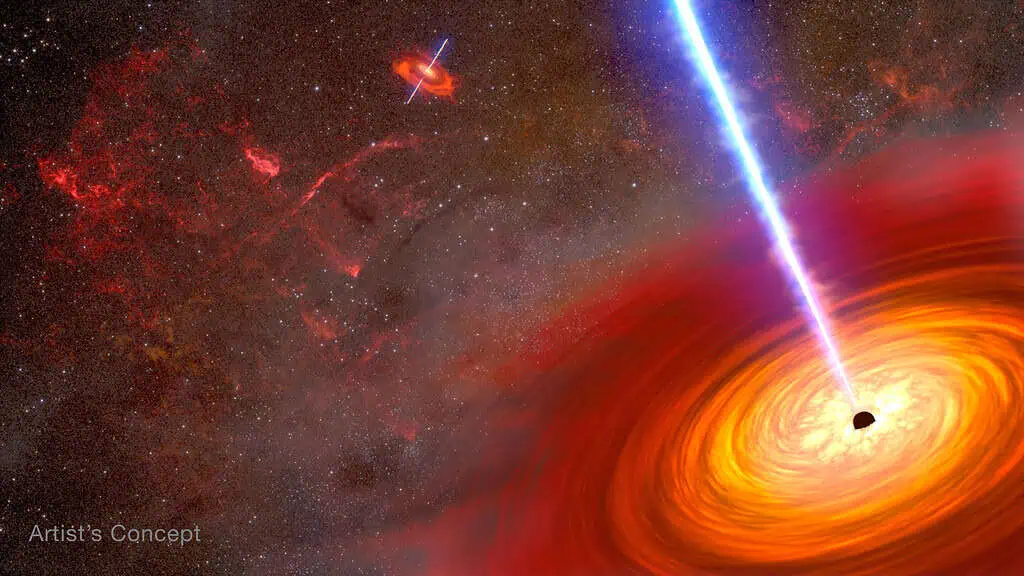
The two black holes were identified in the galaxy MCG-03-34-64, a gas-rich galaxy that is highly luminous in infrared, making it an intense source of X-rays in the local universe.
-
Excavation for Solar Park in Germany Uncovers Rare Celtic “Princely Tomb” with Elite Warrior Buried with Gold, Weapons, Etruscan Jug, and Two-Wheeled Chariot in Bad Camberg

-
NOAA Scientists Discover Mysterious, Perfectly Aligned Holes on the Mid-Atlantic Ridge Seafloor, Origin Still Unknown

-
California Startup Develops Giant “Space Sling” to Launch Vehicles at Mach 6, Reducing Fuel Use and Enabling Thousands of Satellite Deployments

-
ChatGPT Alerts FBI to Prevent Planned Murder of 8-Year-Old in Brazil’s Espírito Santo



This galaxy had already attracted scientists’ attention due to its unusual and densely absorbed X-ray spectrum, suggesting the presence of thick material surrounding its central black hole.
However, it was during routine observations with the Hubble Space Telescope (HST) that the possibility came up that there was not just one, but two active nuclei in this galaxy.
Anna Trindade Falcão, from the Harvard & Smithsonian Center for Astrophysics in Cambridge, Massachusetts, commented: “This sighting is not a common occurrence in the nearby universe and told us that something more is happening inside the galaxy“.
This discovery represents one of the closest pairs of active galactic nuclei (AGN) ever observed. To confirm and study the interactions between the two black holes, researchers used various powerful tools, such as Hubble, the Chandra X-ray Observatory, and the Very Large Array (VLA).
These instruments allowed scientists to analyze the dynamics of this system with an unprecedented level of detail.
The Merger of Galaxies and the Role of Black Holes
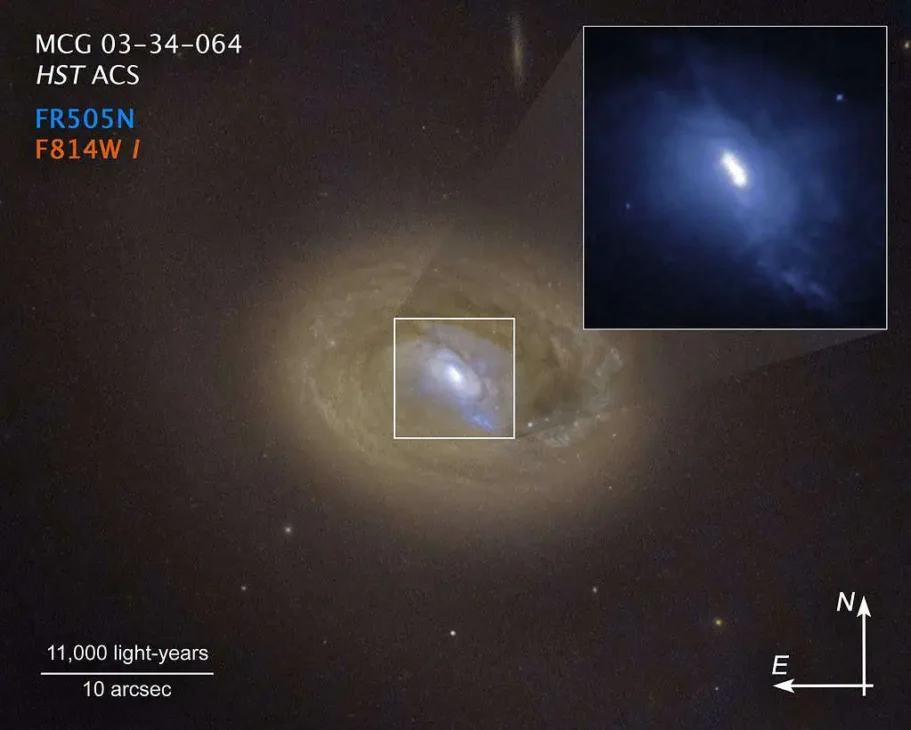
MCG-03-34-64 is part of a galactic merger, which explains the presence of two supermassive black holes. Each galaxy involved in the merger brought its own central black hole.
When galaxies merge, their black holes also get closer and eventually merge into a single black hole. This merger process directly affects the evolution of the galaxy, influencing, for example, star formation and the distribution of matter around it.
Most large galaxies, like the Milky Way, harbor supermassive black holes at their centers, with masses ranging from millions to billions of times that of our Sun. These black holes grow by absorbing gas and dust, and their growth is closely linked to the development of the galaxy they are part of.
During this process, they emit enormous amounts of energy in the form of active galactic nuclei (AGN), which can be detected by telescopes in various ways.
The discovery of two supermassive black holes in MCG-03-34-64 is a remarkable example of how galaxy mergers affect not only the fate of their components but also the role of black holes in galactic evolution.
Gravitational Waves and the Impact of the Merger
In addition to providing new insights into galaxy evolution, the discovery of these two supermassive black holes is crucial for the understanding of gravitational wave astronomy.
When these black holes merge — an event that may take about 100 million years to occur — they will send ripples through spacetime known as gravitational waves. These waves can be detected by advanced instruments, such as pulsar timing arrays, which have the potential to provide valuable information about black hole physics and the nature of the universe.
This potential merger highlights the importance of dual AGNs for gravitational wave detection. While binary systems like this were more common in the early universe, when galaxy mergers were more frequent, this discovery offers a unique opportunity for close study, which was previously rare to observe.
Identifying dual AGNs with separations of a few kiloparsecs is relatively common, but systems with subkiloparsec separations, like this one, are extremely rare.
The merger of the two supermassive black holes in MCG-03-34-64 will be a cosmic event capable of shaking the very fabric of space.
However, due to the nature of these gigantic black holes, the gravitational waves generated will have wavelengths much larger than those detectable by the Laser Interferometer Gravitational-Wave Observatory (LIGO), which previously detected waves from smaller black holes.
The Future of Gravitational Wave Detection According to NASA Researchers
To detect the gravitational waves from supermassive black holes, scientists are already developing the next generation of detectors, such as LISA (Laser Interferometer Space Antenna).
This innovative project, led by the European Space Agency (ESA) in partnership with NASA researchers, will use three space-based detectors, separated by millions of miles, to capture these longer wavelength waves from deep space.
The launch of the LISA mission is planned for the mid-2030s, which promises to open new frontiers in the detection of supermassive black hole mergers and in understanding the universe.