






 Portuguese
  Spanish


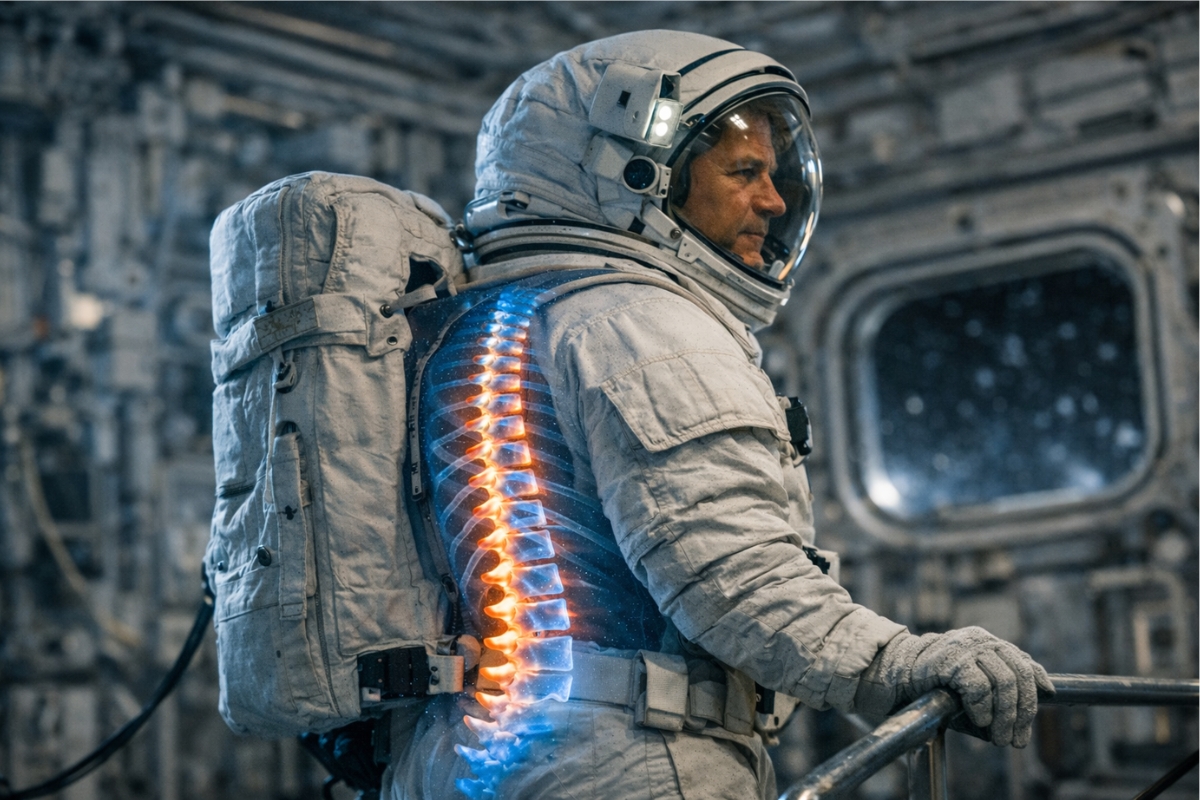


The return of Artemis II showed how few days beyond Earth’s protection already affect body and immunity. The mission’s data now help define the medical and technological limits to take humans to the Moon and then to Mars.
It was not just a weakened heart: after 10 days in deep space, the astronauts of the Artemis II mission returned with their spines expanded by 5 to 7 centimeters, atrophied muscles, balance changes, and exposure to radiation never before measured so precisely in a crewed flight.
On the night of April 10, 2026, at 8:07 PM Brasília time, the Orion capsule sliced through the Pacific at 30 km/h after a reentry at Mach 33, 33 times the speed of sound, and the four astronauts of the Artemis II mission touched Earth for the first time in almost ten days.
Christina Koch was the first to exit the hatch, followed by Victor Glover, Jeremy Hansen, and Reid Wiseman. None of them went straight home.
-
Artist’s 15-Meter Lighthouse in the Mojave Desert, 160 km from the Sea, Intrigues Visitors with 19 km Range After Years of Bureaucracy

-
Bluetti AC70 Solar-Powered Station: Powers Fridge and Wi-Fi During Blackouts, Delivers 1,000W, 3,000 Charge Cycles, Priced at $900

-
Enormous Black Hole Phoenix A* Challenges Scientific Understanding with Mass of 100 Billion Suns, Surpassing Famous TON 618 in One of the Largest Known Galaxy Clusters
-
Say Goodbye to Storing Wine in a Regular Fridge: Midea’s Climate-Controlled Cellar Holds 34 Bottles, Maintains 5-18°C, and Uses Only Half a kWh Daily


The rescue, operated by the U.S. Navy, initiated a marathon of physical and medical tests to assess the impacts of microgravity on the human body and validate the safety of future lunar walks.
The mission had taken the crew 406,771 kilometers from Earth, the farthest point any human has ever reached, surpassing the record held by the Apollo 13 crew since 1970.
What 10 days without gravity do to the human body
Deep space does not kill quickly. It transforms the body silently, systematically, and, in some aspects, still surprisingly for science.
Jessica Scott, a physiologist at the Memorial Sloan Kettering Cancer Center, who worked on developing exercise equipment for NASA, compares ten days in space to ten days of absolute bed rest.
“You would feel very weak and your muscles would start to lose volume very quickly,” Scott said. The heart, she emphasizes, is especially vulnerable in this process.
The analogy with bed rest is not rhetorical. In microgravity, the postural muscles, those of the lower back, calves, and abdomen, simply stop working because there is no weight to support.
The muscle mass of astronauts can be reduced by up to 20%, and they can lose up to 2% of bone density after about 30 days in space, because their bodies no longer need skeletal support in the microgravity environment.
For a 10-day mission like Artemis II, the losses are smaller but measurable and clinically relevant.

The heart that shrinks and the blood that rises
Without gravity pushing blood downwards, the cardiovascular system redistributes fluids upwards. The vessels in the chest and head become overloaded, while the legs “empty”.
The heart, upon sensing this excess circulating fluid, interprets it as excess blood volume and starts pumping less, literally shrinking and losing some of its muscle mass.
Changes in the cardiovascular system can lead to blood clots, cardiac arrhythmias, and low blood pressure. The severity of the consequences depends on the duration of the trip, increasing for longer missions.
Upon return, this readjustment is immediate and abrupt: the body needs to pump against gravity again, but the heart is temporarily smaller and the vessels in the legs are “forgotten” in their role.
That’s why no astronaut can drive in the first few days after returning. Intense physical rehabilitation lasts from 2 to 4 weeks, during which NASA does not allow astronauts to drive their own vehicles or engage in intense physical activities until they undergo an evaluation phase.
The spine that grows, and the inner ear that fails
One of the most counterintuitive effects of microgravity is growth. Without the constant gravitational compression on the intervertebral discs, astronauts’ spines expand.
The four members of Artemis II returned between 5 and 7 centimeters taller than when they boarded, and this sudden expansion brings significant muscle pain during the readjustment phase.
The vestibular system, the balance mechanism of the inner ear, is another critical area. “The inner ear is a delicate thing, and we know it is affected by space flight, making it difficult for the crew to move around for a few days after return,” said Steve Platts, chief scientist of NASA’s Human Research Program.
“It recovers in three to five days, but for those initial days on the lunar surface, we need to know exactly how they will respond.”


The radiation that no previous mission measured with such precision
Artemis II went beyond low Earth orbit, leaving the protection of Earth’s magnetic field. In this environment, the radiation is of another type: galactic cosmic rays and energetic solar particles that penetrate the body and damage cells deeply.
Each astronaut carried a personal dosimeter, six active sensors called Hybrid Electronic Radiation Assessors were positioned throughout the cabin, and an updated German M-42 EXT monitor, with six times the resolution of its Artemis I predecessor, measured exposure to heavy ions, considered among the biologically most dangerous forms of cosmic radiation.
The data collected is unprecedented. No crewed mission since Apollo had monitored deep space radiation exposure with such precision.
And the results, still under analysis, will determine the time limits that a human can spend beyond Earth’s magnetosphere without irreversible damage.
The “avatars” that traveled to the Moon with the crew
The most innovative experiment of the mission was not in the controls of the Orion capsule. Inside the spacecraft, while it orbited the far side of the Moon in early April 2026, a set of devices no larger than USB flash drives was silently conducting science.
Each contained living bone marrow cells, cultivated from blood samples collected from the four astronauts, maintained in fluid that mimicked the internal conditions of the human body.
The experiment is called AVATAR, A Virtual Astronaut Tissue Analog Response. The logic is straightforward: instead of waiting for the astronauts to return and check if their bodies changed, their cells made the same journey and were monitored in real time.
Wiseman, Glover, Koch, and Hansen sent microscopic versions of themselves to the Moon before going in person.
Now that the organ chips have returned from the Artemis flight, researchers will examine how spaceflight affected the bone marrow chips through single-cell RNA sequencing, a powerful technique that measures how thousands of genes change within individual cells. The results will take months.
But if they confirm that the custom tissue models reliably detect radiation-induced changes, the next step is to send larger sets of chips on longer missions.

What Mars requires, and what we still don’t have
Artemis II was a 10-day flight around the Moon. A mission to Mars will take between 7 and 9 months one way, and the astronauts will need to work on the surface upon arrival, with no recovery period in a terrestrial environment.
If a medical event like the one suffered by astronaut Michael Fincke in January 2026, who was unable to speak for 20 minutes aboard the International Space Station, were to occur on a mission to Mars, the return to Earth could take years. There is no possible rescue 225 million kilometers away.
The data from Artemis II is the first real piece of this medical puzzle. The bone marrow of the four astronauts traveled to deep space for the first time in history, and now scientists have, for the first time, direct cellular evidence of what radiation does to the human immune system beyond Earth’s magnetic protection.
Throughout the mission, Wiseman, Glover, Koch, and Hansen traveled a total of 1,117,638 kilometers. The lunar flyby took them farther than any human has ever gone, surpassing the previous distance record set by the Apollo 13 astronauts in 1970.
The next mission, Artemis III, scheduled for 2027, will take two astronauts to the lunar surface. What the bodies of Reid Wiseman, Victor Glover, Christina Koch, and Jeremy Hansen reveal in the coming weeks will dictate exactly what will be necessary for this landing, and eventually the journey to Mars, to be safely possible.







Which begs the question, why hasn’t nasa got this information from the 17 astronauts that already set foot on the moon and the ones who stayed in the command module and just orbited the moon. Surely these latest 4 would have experienced the same symptoms.