Portuguese
  Spanish


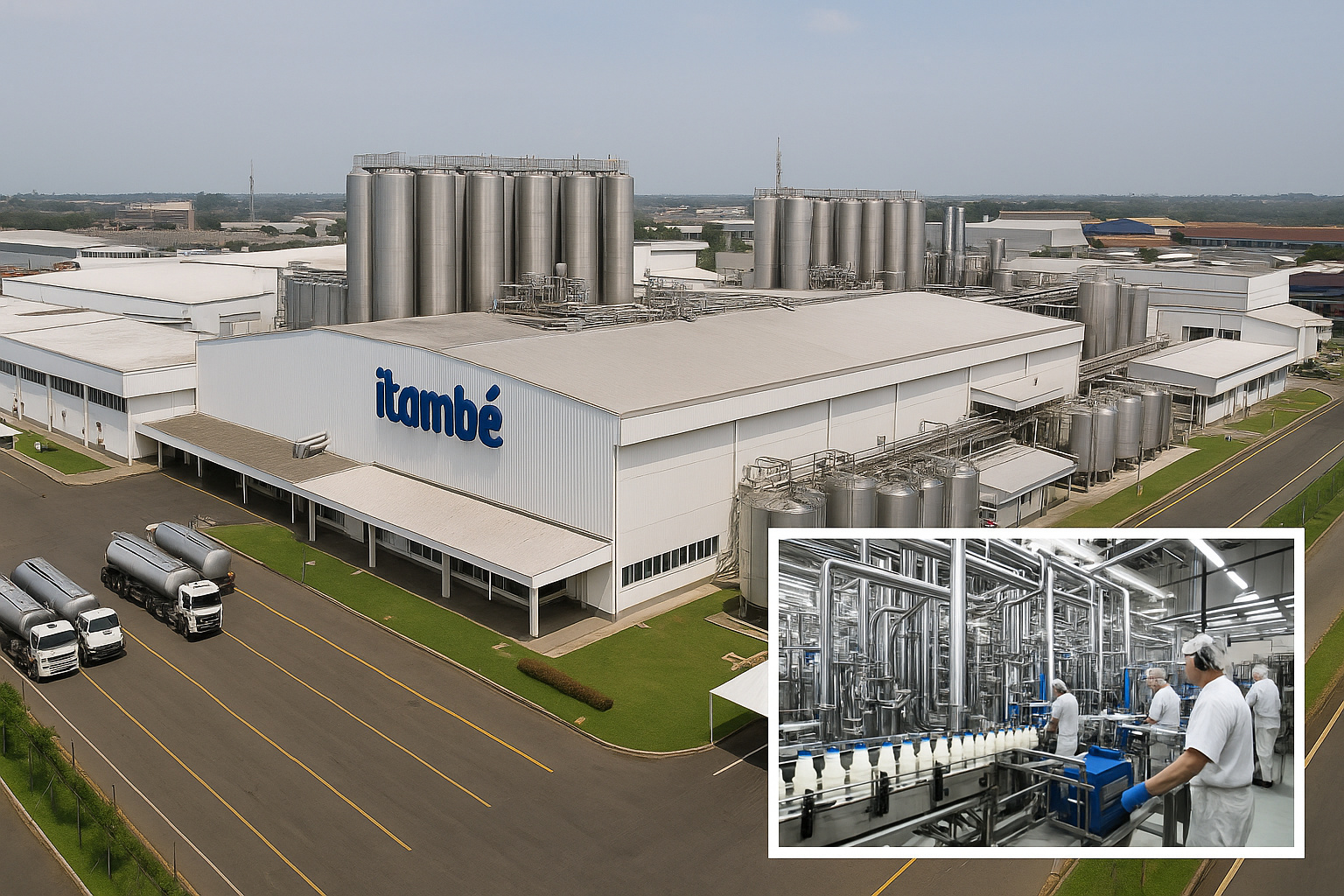


With 100,000 m² and 90 million liters processed each month, the largest dairy in Brazil belongs to Itambé, not Nestlé. Based in Minas, the factory has turned Sete Lagoas into a national reference in milk production.
When it comes to the dairy industry in Brazil, the name most remembered is Nestlé. But the true giant of the sector is in the hands of a national company with almost a century of history.
Located in Sete Lagoas, Minas Gerais, the Itambé industrial complex is considered the largest dairy in Latin America, with a structure that rivals the largest food plants in the world.
With 100,000 square meters of built area and capacity to process up to 3.5 million liters of milk per day, equivalent to 90 million liters per month, the site is a machine that never stops.
There, the raw milk arriving from thousands of dairy farms in Minas is transformed into powdered milk, condensed milk, UHT milk, cream, and other derivatives that supply the entire national territory — and also abroad.
The Strength of Itambé in the National Scene
Founded in 1949, Itambé Alimentos started as a Minas cooperative and grew alongside the advancement of dairy farming in Brazil. Today, it belongs to the CCPR/Itambé group, one of the largest cooperatives of milk producers in the country, and maintains a joint venture with the multinational Lactalis, a world leader in dairy products.
-
France Revamps 530 Social Housing Units with Large Balconies and Glass Facades Without Demolishing Existing Buildings

-
10-Year-Old Max Makes History with Paris Fashion Show, Launches Own Brand, Hires Staff, and Sets World Record as Youngest Runway Designer

-
Bolivian Female Construction Workers Form Association to Combat Discrimination and 38% Pay Gap in the Industry
-
Near Amsterdam, residents buy land and discover they must also build streets, manage drainage, handle waste, and grow food on half their plot.




The Sete Lagoas unit, inaugurated in 1971, represents the heart of this operation.
There, around 1,500 employees work continuously, divided among receiving, pasteurization, production, packaging, and shipping sectors. According to the company, over 60% of the processed milk in Minas Gerais passes directly or indirectly through its production lines.


Minas, which was already the largest milk producer in Brazil, has become, thanks to the presence of Itambé, the national capital of milk, responsible for more than 25% of Brazilian production according to IBGE.
Industrial Scale and Cutting-Edge Technology
The Itambé factory operates like a self-sufficient city. The structure houses microbiological laboratories, storage silos with a capacity of over 8 million liters, wastewater treatment stations, and fully automated packaging lines.
The equipment was imported from countries such as Germany and Switzerland, and operates under digital control, ensuring accuracy and food safety in real time.
Sensors monitor the temperature, pH, and electrical conductivity of each batch of milk, allowing for tracking of the entire process — from the moment the tanker truck arrives to the final packaged product.
This automation places the Sete Lagoas complex on the same technological level as European factories. The processed milk there supplies all regions of Brazil, and part of it is shipped to markets in South America, Africa, and the Middle East.
Impressive Production: 3.5 Million Liters Per Day
According to official data from the company and publications like Globo Rural and O Tempo, the daily capacity of the plant reaches 3.5 million liters of raw milk, processed in different industrial lines.
Of this volume, a significant part is allocated to the production of whole and skim milk powder, a high-value product with great demand in the international market.
The remainder is divided among the lines of UHT milk, cream, butter, yogurts, and condensed milk — items that are among the bestsellers in the country. Thus, Itambé has become one of the main Brazilian exporters of dairy products, directly contributing to the surplus of the sector’s trade balance.
Sustainability and Circular Economy
The large-scale operation has not neglected its environmental commitment.
The Sete Lagoas complex is a reference in water reuse and clean energy, having a recovery system that returns part of the water used in the pasteurization process for irrigation and industrial cleaning.
Solid and organic waste is repurposed for biogas generation, reducing electricity use. Additionally, Itambé supports technical assistance and sustainability projects with partner farmers, promoting good environmental practices and genetic improvements in the Minas dairy herd.
The Economic Impact on the Region
The presence of Itambé in Sete Lagoas has completely transformed the local economy. The city, once known for mining and small industries, has become a national dairy hub, attracting cooperatives, transport companies, packaging, and food technology.
It is estimated that, besides direct jobs, the complex generates over 10,000 indirect jobs, strengthening the countryside of Minas and boosting the rural production chain. The municipal GDP has grown above the state average in the last two decades, and the name Sete Lagoas has become synonymous with quality and excellence in milk production.
The Rivalry with Nestlé and Brazilian Leadership
Although Nestlé remains the largest company in the sector in terms of revenue and global reach, no isolated unit of the Swiss company in Brazil comes close to the physical scale of Itambé in Sete Lagoas.
The Minas plant is, in fact, the largest individual dairy factory in the country, surpassing even the capacities of Araxá and Ituiutaba units of Nestlé itself.
While the multinational distributes its production across various plants, Itambé focused strength and technology in a single location, granting it operational efficiency and reduced logistical costs.
This explains why many experts consider the Minas unit a model of industrial centralization.
Over 70 Years of History and Continuous Expansion
From a small regional cooperative to a continental powerhouse, Itambé continues to expand its horizons. In recent years, the company has invested hundreds of millions of reais in modernization, automation of lines, and increased storage capacity.
Even with competition from multinationals, it remains among the absolute leaders of the Brazilian milk and dairy market, supported by a network of over 30,000 cooperated rural producers.
The secret to success, according to company executives, is the closeness to the field — the foundation that ensures quality and traceability for every liter produced.
A Giant that Represents Brazil that Works
With 100,000 m² of industrial area, 3.5 million liters of milk processed per day, more than 20 importing countries, and seventy years of tradition, Itambé is not just a Minas brand — it is a symbol of a productive, cooperative, and technological Brazil.
Its factory in Sete Lagoas is an example of how the national industry can compete on a global scale, maintaining roots in the countryside and having an impact throughout the country.
While many associate innovation only with multinationals, it is in Minas Gerais that the heart of the largest dairy in Brazil beats — and it does not belong to Nestlé.