Portuguese
  Spanish


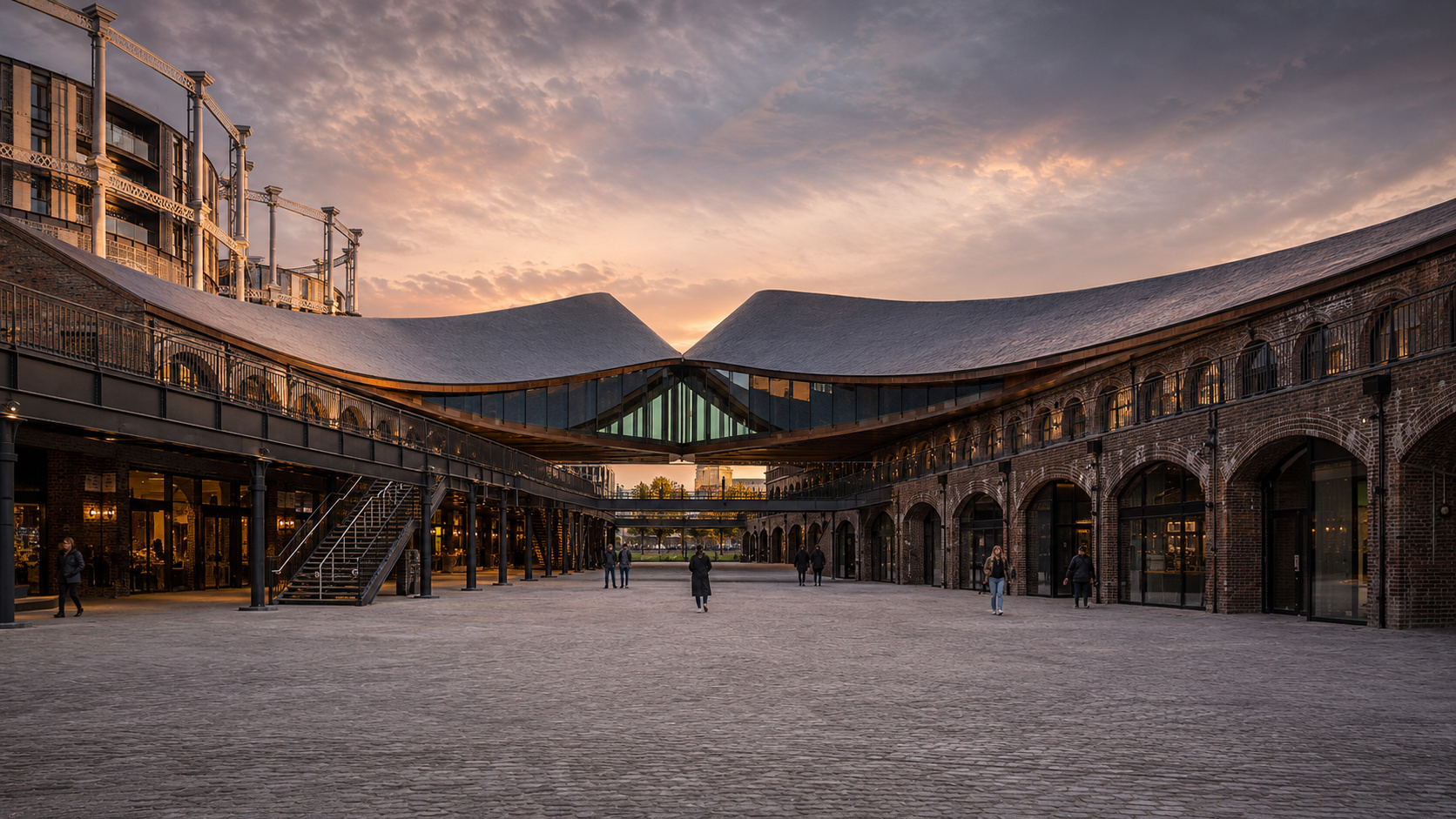

In King’s Cross, old coal warehouses have become a public and commercial destination with curved roofs that meet at the top, preserving Victorian buildings and showing how architecture can breathe new life into railway structures without erasing the history of the place
Instead of demolishing old coal warehouses, London bent their roofs until they met in the center. The renovation in King’s Cross transformed Victorian buildings into a public and commercial space, keeping the railway memory of the region alive.
The information was released by Heatherwick Studio, the architecture and design studio responsible for the project. The complex known as Coal Drops Yard repurposed two old warehouses linked to coal transportation and created a new area at the top, between the buildings.
The impact lies in the contrast. Where there were once structures used to move coal by railway, there is now a place for circulation, shops, cafes, and socializing. The project shows that old buildings can gain new functions without losing what makes them special.
-
Facing high rent, couple transforms parents’ garage into a fully functional apartment, creating a complete home at a fraction of the market cost.

-
10-Year-Old Max Makes History with Paris Fashion Show, Launches Own Brand, Hires Staff, and Sets World Record as Youngest Runway Designer

-
MIT Scientists Develop Method to Transform CO₂ into a Construction Ally, Boosting Cement Strength by 13% in 24 Hours for More Sustainable Infrastructure

-
Canadian City Builds 8 Tiny Homes in 72 Hours for Homeless Youth, Plans 40 Affordable Houses for Female-Led Families Amid Housing Crisis





How old coal warehouses became part of a new London
The coal warehouses were part of the railway history of King’s Cross. They were structures built to receive and move coal, at a time when this material played an important role in supplying the city.


Over the years, the original use lost strength. Even so, the buildings continued to carry historical value. Instead of treating these constructions as a problem, the renovation used the warehouses as a base for a new urban space.
This decision changes the way we look at old areas of the city. An abandoned warehouse may seem useless, but architecture shows that it can transform into a meeting point, commerce, and public circulation.
In King’s Cross, the memory of coal and the railway was not hidden. It became part of the experience for those who pass through the area.
Why the roofs that meet in the center became the main highlight
The most striking detail of the renovation is in the roofs. Instead of creating a modern box over the warehouses, the project made the roofs rise and curve until they meet in the center.
This solution created the image of the kissing roofs. The expression is simple, visual, and easy to understand. It helps the public perceive the work without needing to know technical architectural terms.
The meeting of the roofs also created a new floor at the top. This suspended space focused attention on the ensemble and transformed the upper part of the warehouses into the protagonist of the renovation.
The result draws attention because it combines a practical idea with a strong image. The roof protects, organizes the space, and still creates a visual brand for Coal Drops Yard.
How the renovation united Victorian buildings without erasing their original appearance
Renovating old buildings requires care. Any poorly executed change can destroy the place’s identity. At Coal Drops Yard, the proposal was to preserve the presence of the Victorian structures and insert a new roof as a link between them.
Heatherwick Studio, the architecture and design studio responsible for the project, detailed the transformation of the two warehouses into a public and commercial destination. The work opened the area to people, connected the spaces between the buildings, and maintained the historical character of the ensemble.

This helps explain why the renovation became so talked about. The new part does not try to pretend it is old. At the same time, it also does not hide the original buildings.
The strength of the project lies in this balance. The old remains visible, and the new appears as a seam that gives another function to the place.
What is urban reuse and why it matters for cities full of old warehouses
Urban reuse is a way to make use of existing buildings. Instead of tearing everything down, the city adapts old buildings for new functions. This can happen in warehouses, stations, depots, factories, and railway areas.
In the case of London, the old coal warehouses gained new life without losing their connection to the past. The renovation shows that an old building does not need to remain stagnant or become a ruin.
This type of solution also aligns with the Brazilian reality. Many cities have industrial areas, warehouses, and old railway structures without a clear use. In many cases, these spaces remain forgotten for years.
The example of King’s Cross shows that preserving doesn’t have to mean leaving things stagnant. With a good adaptation, an old building can become part of urban life again.
Why the project attracts attention even for those who don’t understand architecture
The renovation attracts attention because the idea is easy to visualize. Two old coal warehouses, roofs that curve, meeting in the center, and a new suspended floor. All this creates a strong scene for the viewer.
There is also a symbolic value. Coal represents an old phase of the city. The new use shows another phase, more focused on the flow of people, commerce, and social interaction.
The project doesn’t rely solely on beauty. It demonstrates an important urban decision: to utilize existing structures and transform an old area into an active place.

Therefore, the Coal Drops Yard is more than a beautiful renovation. It became an example of how heritage, commerce, and public space can occupy the same place without erasing history.
What this curious renovation of King’s Cross reveals about the future of old buildings
The transformation of the coal warehouses in London shows that old buildings can have a second life. The project preserved the railway memory, valued the Victorian structures, and created a new space from what already existed.
The most striking point remains the meeting of the roofs in the center. This choice gave the renovation its own identity and showed that a modern intervention can respect the past without being bound by it.
In rapidly growing cities, demolition often seems like the simplest path. But the case of King’s Cross shows another possibility: to reuse, adapt, and transform forgotten constructions into useful places for the population.
Do you think old railway and industrial warehouses in Brazil should become public and commercial spaces, or do our cities still prefer to demolish histories that could be repurposed?