Portuguese
  Spanish


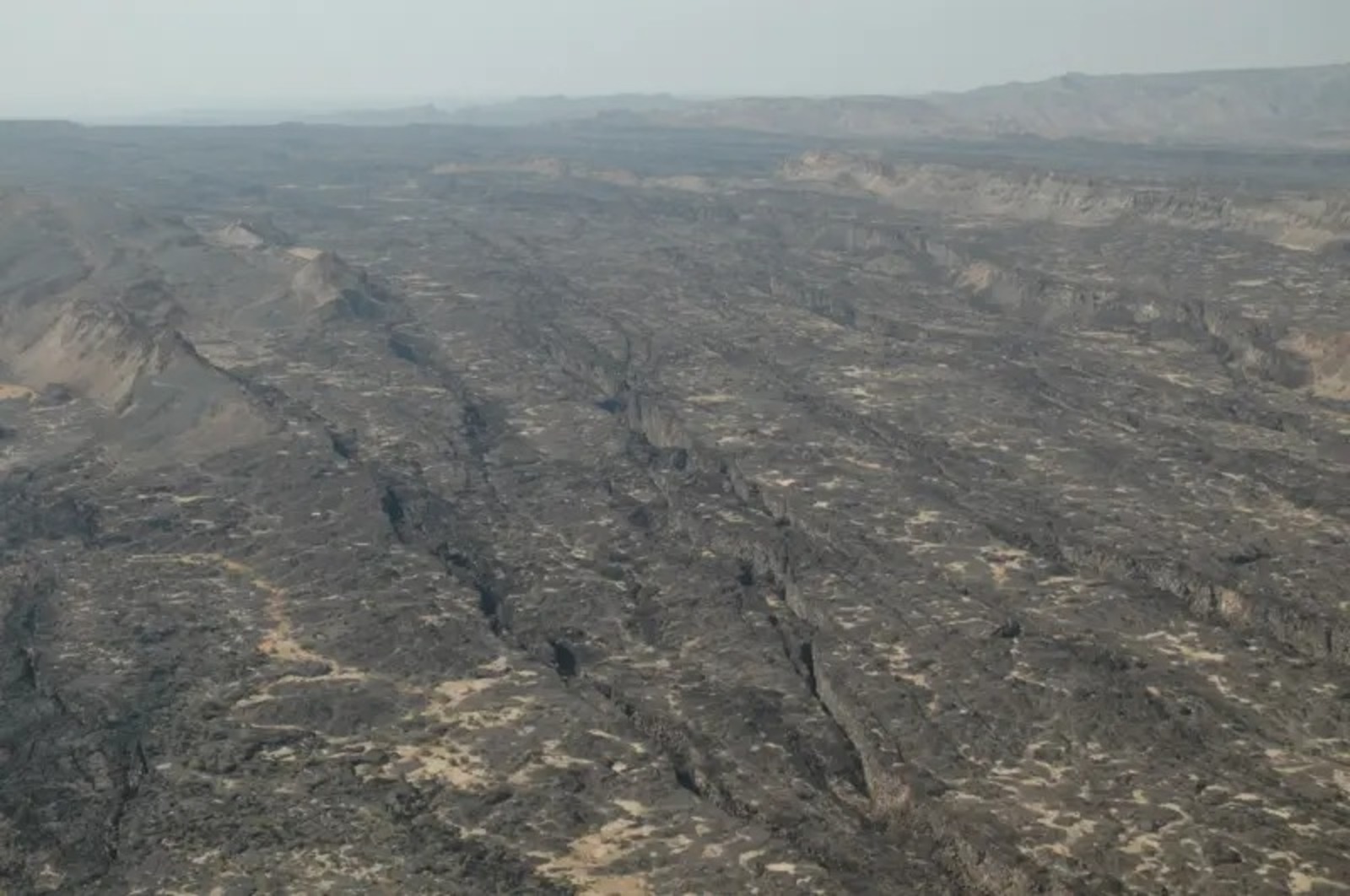


Fault Cutting Through Ethiopia, Tanzania, Kenya, and Uganda Advances Slowly, While Tectonic Pressures and Subsurface Magma Suggest Possible Future Creation of New Maritime Route
Recent research has again highlighted a massive fault advancing through the eastern portion of Africa, as the movement of tectonic plates intensifies an ancient process that could split the continent and create a new passage for saline water.
This opening already affects areas of Ethiopia, Tanzania, Kenya, and Uganda, thus attracting special attention from researchers observing the Afar region, where three large tectonic structures meet and exert distinct pressures.
The Dynamics of Plates in Eastern Africa
Initial studies analyzed magma in the Ethiopian plateau; furthermore, they indicated that the model could apply to volcanism phenomena present throughout Eastern Africa, reinforcing that the movement of the mantle pushes blocks in opposite directions.
-
Tesla injected an additional $250 million into the German factory, doubled the battery cell target, and opened its own production line for startups.

-
No more TV stuck on the wall: Samsung The Freestyle+, the new projector with over 400 lumens projects on walls, floors, and ceilings, bringing cinema to any corner of the house.

-
A Japanese governor single-handedly stalled the construction of the world’s fastest train for nine years, and only now has he agreed to allow a tunnel excavated at a depth of 1,400 meters.
-
Almost 1 billion euros, two gigafactories, and a million-dollar public investment, Chinese company aims to turn Spanish city into Europe’s new battery hub.


In this scenario, three larger plates press against the Victoriana, a smaller structure that reacts to this force. As the fault expands at this meeting point, part of the Somali plate tends to move towards the Indian Ocean.
Geoscientist Cynthia Ebinger explained that there is a small subterranean volcano in Ethiopia that prevents the entry of a large body of saline water, as it acts as a natural barrier to the direct expansion of the Red Sea in that direction.
The Emergence of a New Continent: How the Process Resembles Ancient Separations
The observed advancement represents the consequence of forces acting for many years beneath the African crust.
The plates of Eastern Africa and Central Africa are being pulled apart, creating tensions that will result in a definitive division similar to previous continental separations.
Geologist Carolina Pagli stated that two recent studies show a broad geological process.
According to her, the formation of this new body of water occurs on timescales of millions of years and also involves the constant rise of magma.
The progressive movement of the plates continues to reshape the landscape, even though it advances slowly and causes small variations perceived by researchers over time.
New Continent: Future Implications Observed by Scientists
Even with slow advancement, specialists emphasize that the fissure is likely to increase because the mantle maintains continuous pressure.
This finding appears in the analyzed models, which record signs of progressive opening in different sections of the affected region.
Researchers highlight that the detachment of the Somali plate can occur without abrupt events, so monitoring annual variations is essential.
This vigilance helps to understand how the landscape reorganizes in the face of constant internal pressures.
Recurring mappings confirm the gradual displacement, even if it seems minimal to those observing the surface daily.
Comparisons with the ancient separation between South America and Africa serve merely as a temporal reference; moreover, they illustrate how long-duration processes can shape new environments as the Earth’s interior redistributes energy.
Although no predictions of rapid changes exist, researchers believe that monitoring the behavior of magma provides important clues.
It indicates when tensions increase and therefore when the fault may accelerate in a somewhat more evident manner.
These observations are still developing and present a picture that may change with new data.
Scientists follow the evolution because each small alteration helps reconstruct the local geological history, creating useful records to understand transformations that progress over eras.
With information from Correio do Estado.