Portuguese
  Spanish




Direct imaging of a planet is a rare event, especially in nearby systems and around Sun-like stars.
If confirmed, this object would be one of the closest directly observed exoplanets to Earth.
Nancy Grace Roman Telescope could be decisive in confirming the object’s existence in the coming years
Researchers have identified a new observation window for August 2026, when the object may return to a favorable position for detection.
-
AI Video Generator Automatically Creates Subtitles and Animated Captions

-
São Paulo Unveils Latin America’s Largest Underground Reservoir, Holding 900 Million Liters, in the Greater São Paulo Area

-
Chinese Teen Wins Gold in Germany for Invention Turning Air Moisture into Underground Irrigation in Drought-Stricken Areas

-
Desertification Threatens Brazil’s Caatinga: 85% of Semi-Arid Region Affected, 30 Million at Risk, and Efforts Underway to Restore 10 Million Hectares by 2045




Furthermore, the future Nancy Grace Roman Space Telescope, with more advanced coronagraphic technology, will be able to confirm the object’s existence with greater precision.
Now we want to know: is the object detected by James Webb really a planet or just a phenomenon not yet understood?
The initial detection, followed by its disappearance and simulations, keeps the case open.
In your view, are we facing a new planet near Earth or a phenomenon that still challenges the understanding of modern astronomy?
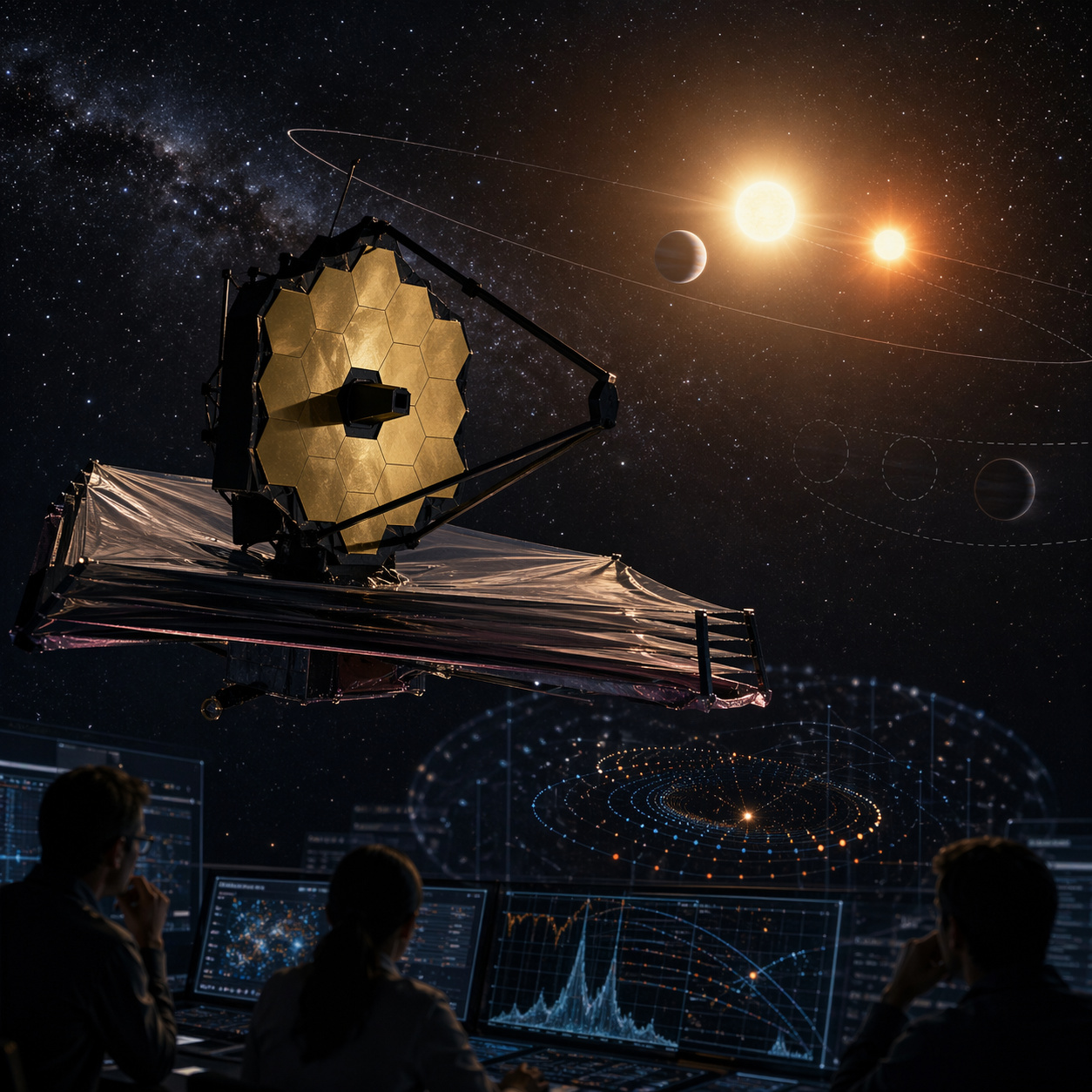
Object detected by James Webb near Alpha Centauri disappears in new observations and puzzles scientists after 1 million simulations.
According to researchers from the California Institute of Technology (Caltech) and NASA’s Jet Propulsion Laboratory (JPL), in August 2024 the James Webb Space Telescope recorded an extremely faint object in the vicinity of Alpha Centauri A, the most Sun-like star in Earth’s closest star system, located about 4.37 light-years away. The object appeared only once. In new observations carried out in February and April 2025, it was not detected again, leading researchers to classify the phenomenon as one of the most intriguing in recent astronomy.
Alpha Centauri System brings together three stars and focuses decades of search for exoplanets close to Earth
Alpha Centauri is a triple star system composed of Alpha Centauri A, Alpha Centauri B, and Proxima Centauri.
Alpha Centauri A and B form a binary system that orbits in a cycle of approximately 79 years and is visible to the naked eye as one of the brightest points in the night sky in the Southern Hemisphere.


Proxima Centauri, a red dwarf located at a greater distance from the main pair, is the closest star to Earth besides the Sun and already has confirmed planets, including Proxima b.
Despite this, the search for planets around Alpha Centauri A has always been considered the main scientific objective, due to this star’s similarity to the Sun.
James Webb’s coronography technique allows blocking starlight and revealing extremely faint objects
To detect the object, researchers used James Webb’s MIRI instrument, equipped with a coronographic mask capable of blocking the star’s intense light.
This method creates an “artificial eclipse”, allowing much fainter objects around the star to become visible in the infrared.
Even with this technology, observation is extremely complex, as it involves optical interference, instrumental noise, and the influence of the companion star Alpha Centauri B.
Object S1 was detected about 2 astronomical units from Alpha Centauri A with extremely low brightness
After image processing, a point of light named S1 emerged. It was located approximately 1.5 arcseconds from the star, which corresponds to about 2 astronomical units, a distance equivalent to twice the separation between Earth and the Sun.

The object’s brightness was about 10,000 times fainter than that of the star, consistent with a possible gas giant planet.
Disappearance of the object in new observations led scientists to run 1 million orbital simulations
The biggest challenge arose in subsequent observations, when the object was no longer detected. To understand the phenomenon, the team led by PhD student Aniket Sanghi performed about 1 million computational simulations of possible orbits.
The results indicated that, in about half of the stable scenarios, the object could have approached the star at points in its orbit where it would become invisible to the telescope.
Previous data from the Very Large Telescope may indicate that the object had already been seen in 2019
An important piece in the analysis was the inclusion of data obtained in 2019 by the Very Large Telescope in Chile. On that occasion, a candidate object called C1 was identified in the same system, but not confirmed.
When researchers considered the possibility of S1 and C1 being the same object in different orbital positions, the models began to show consistency.
Based on simulations and the detected brightness, the object could be a gas giant planet with a mass similar to Saturn’s.
The estimated orbit has an eccentricity of about 0.4, varying between 1 and 2 astronomical units around the star, with an orbital period between 2 and 3 Earth years.
The estimated temperature varies between 200 and 250 Kelvin, which explains its detection only in the infrared.

Alpha Centauri A’s habitable zone raises theoretical hypothesis of potentially habitable moons
The region where the object was detected coincides with the star’s habitable zone. Although a gas giant cannot harbor life as we know it, there is a theoretical hypothesis that natural moons around this type of planet could have suitable conditions for liquid water.
This possibility remains speculative and unconfirmed. Of the thousands of exoplanets already discovered, most have been identified by indirect methods.
Direct imaging of a planet is a rare event, especially in nearby systems and around Sun-like stars.
If confirmed, this object would be one of the closest directly observed exoplanets to Earth.
Nancy Grace Roman Telescope could be decisive in confirming the object’s existence in the coming years
Researchers have identified a new observation window for August 2026, when the object may return to a favorable position for detection.
Furthermore, the future Nancy Grace Roman Space Telescope, with more advanced coronagraphic technology, will be able to confirm the object’s existence with greater precision.
Now we want to know: is the object detected by James Webb really a planet or just a phenomenon not yet understood?
The initial detection, followed by its disappearance and simulations, keeps the case open.
In your view, are we facing a new planet near Earth or a phenomenon that still challenges the understanding of modern astronomy?