






 Portuguese
  Spanish


On Saturday, July 11, 2026, the Japanese space agency (JAXA) tested for the first time the RV-X, its reusable rocket. In less than a minute, the vehicle ascended, moved horizontally, and landed upright—a step to reduce launch costs and compete in the space market with the United States.
Japan has just taken a decisive step in the space race. According to iG, the country’s space agency, JAXA, conducted on Saturday, July 11, 2026, the first flight test of its reusable rocket, the RV-X, which took off, maneuvered in the air, and landed upright at the Noshiro Testing Center in the northeast of the country.
According to iG, the entire demonstration lasted less than a minute. The rocket reached about 11 meters in height, traveled approximately 16 meters horizontally, and maintained a vertical position before touching the ground exactly as the agency expected it to happen.
The less than a minute flight that paved the way
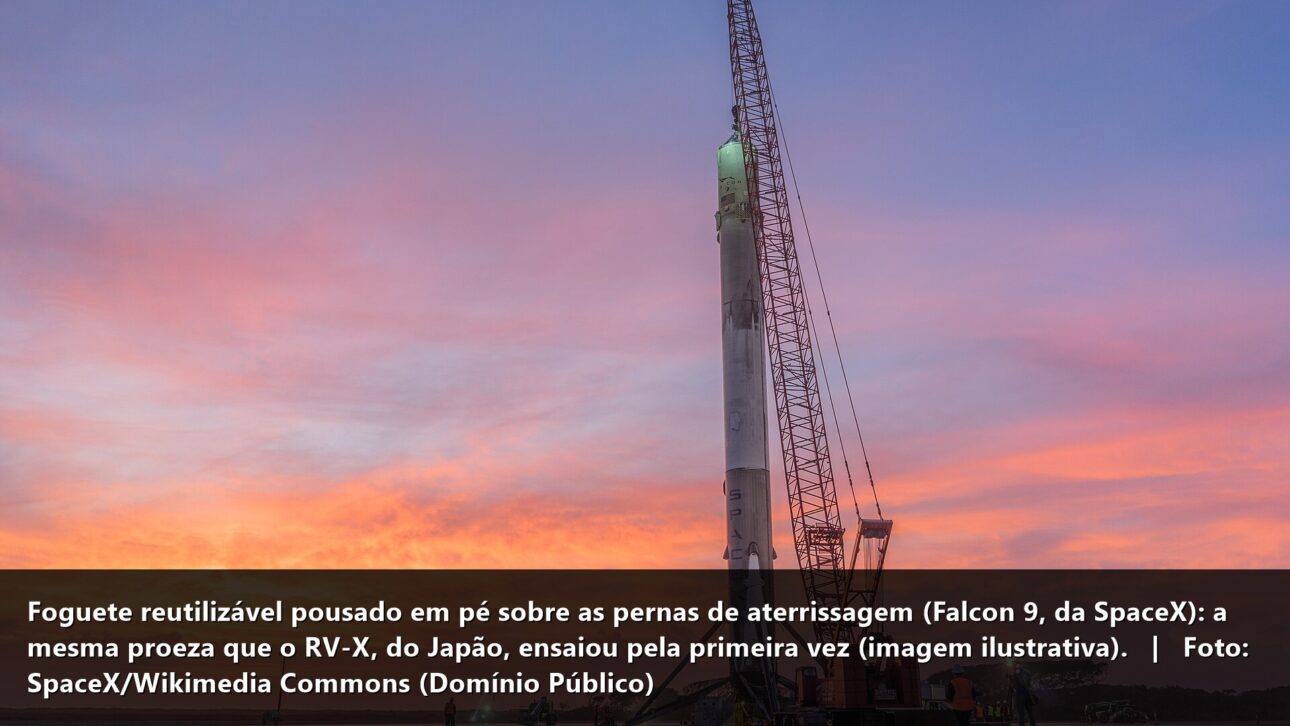
/ RV-X Rocket
The test marks Japan’s debut in a type of technology dominated, until now, by few. Conducted by JAXA, the experiment at the Noshiro Testing Center showed the RV-X taking off, maintaining controlled flight, moving horizontally, and returning to the ground vertically—the exact sequence that defines a successful landing of a reusable rocket.
-
An excavator operator at a mine in Canada hit something strange in 2011 and, after years of preparation, revealed an armored dinosaur with intact skin and armor, 110 million years old and nearly 1,300 kg, now the best preserved in the world.

-
Most powerful land crane on the planet: Mammoet SK6000 lifts 6,000 tons, raises 3,000-ton parts to 220 meters, and carries 4,200 tons of counterweight to unlock mega projects in the offshore wind, nuclear, and oil and gas industries.

-
Two students from SENAI-RS developed AI to help identify rare ocular cancer in children. They were the only Brazilian project in the world finals of Infomatrix in Romania and secured 2nd place with neural networks that promise more accuracy in early diagnosis.

-
Couple replaces the kitchen floor in a Yorkshire village, finds under the 18th-century boards an earthenware mug stuffed with 266 gold coins from 1610 to 1727 and takes the “buried retirement” to auction: final hammer of £754,000, triple the estimate.



For the agency, the result couldn’t have been better. According to Takashi Ito, responsible for JAXA’s reusable rocket project, the flight went as planned. More than the modest height, what matters at this stage is proving that the vehicle can ascend, stabilize, and land in a controlled manner—the foundation of everything that comes next.
What is a reusable rocket and why it changes the game
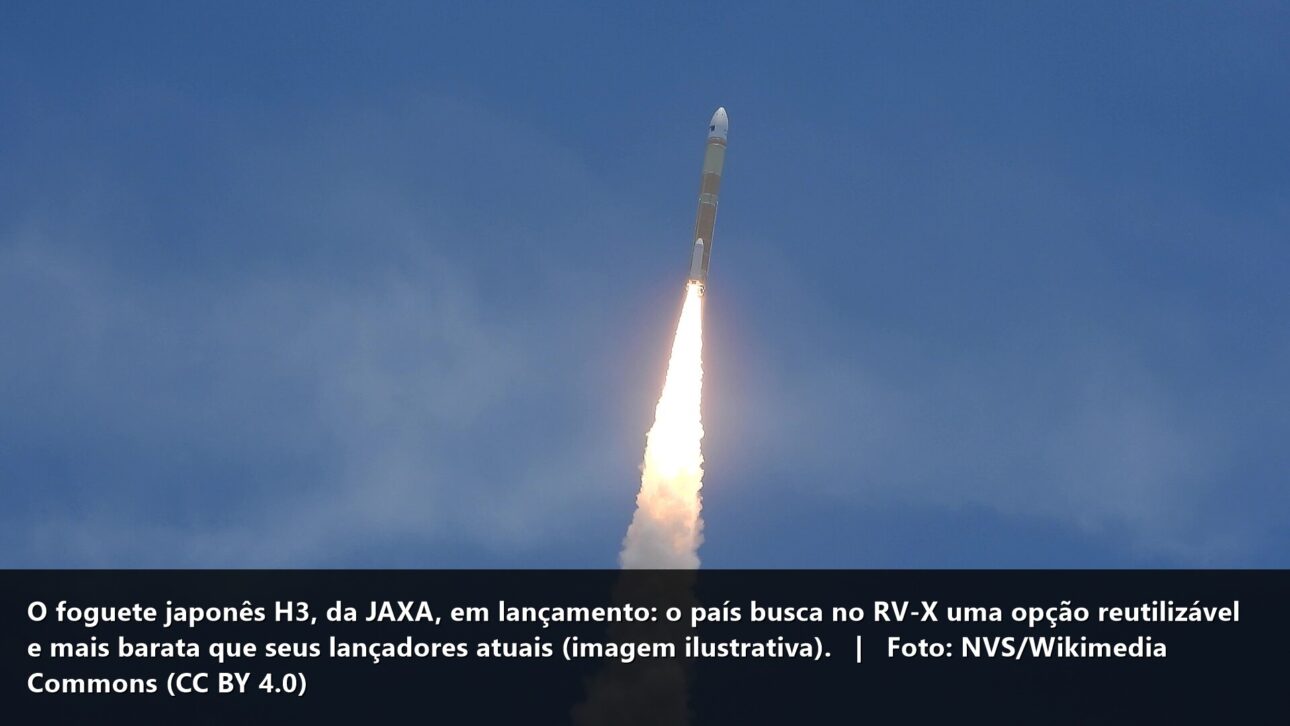
/ RV-X Rocket
The idea behind the project is simple to understand and difficult to execute. JAXA wants to create an operational model similar to that of airplanes, where the same vehicle performs multiple flights, instead of being discarded after a single mission, as happens with traditional rockets. Reusing the structure is what promises to cut costs.
This is precisely where the relevance of the test lies. Each space launch costs a fortune, and a large part of that cost is in the rocket itself, lost with each trip. Recovering and reusing the launcher transforms the economics of missions and is the reason why Japan is betting so heavily on this technology to expand its participation in the space market.
The technical specifications of the RV-X
The RV-X is developed in partnership with Mitsubishi Heavy Industries and has relatively compact dimensions for a rocket: 1.8 meters in diameter and 7.3 meters in length, with an engine designed to withstand multiple tests and four cushioning structures that assist during landing. Every detail was designed to withstand repeated use.
The robustness has already been proven behind the scenes. According to Takashi Ito, the vehicle’s engine has already undergone 165 functioning tests, and JAXA plans to conduct new experimental flights at much higher altitudes, reaching about 100 meters. The project also fuels Japanese studies of navigation, control, and landing to ensure the safe return of the rockets.
Japan, SpaceX, and the race for space costs
The Japanese movement has a clear target: to catch up with those who started ahead. Today, the United States is the only country that operates reusable rockets on a large scale, mainly through SpaceX, by Elon Musk. Without its own response, Japan risks falling behind in the race for commercial launches.
The country already has the H3 as its main current rocket, created to cost less than the old H-2A, but it is still seeking cheaper solutions. Therefore, the RV-X is part of the CALLISTO project, a partnership between JAXA, the French space agency (CNES), and the German Aerospace Center (DLR) — an international alliance to prevent technology from being concentrated in a single country.
Why reuse has become the key to the space market
Reuse has ceased to be a technical detail and has become the center of the global space strategy. When a rocket lands intact and can fly again, the cost per mission plummets. It was this logic that allowed SpaceX to multiply its launches and lower prices. Mastering controlled landing is, today, the entry password to compete in space.
The flight of the RV-X, although short, signals that Japan intends to play this game. If the next tests, planned for higher altitudes, confirm the performance, the country will have taken a concrete step towards cheaper and more frequent launches and the race that was almost an American monopoly will gain a new and strong Asian competitor.
And you, do you think Japan will catch up with SpaceX?
A rocket that ascends, maneuvers, and lands upright on its own in less than a minute: the RV-X test shows that the space race is becoming increasingly fierce and cheaper.
Do you believe that Japan can catch up with SpaceX in reusable rocket technology, or is the American advantage already too great? And which country do you bet will dominate launches in the next decade? Leave your opinion in the comments.


