Portuguese
  Spanish


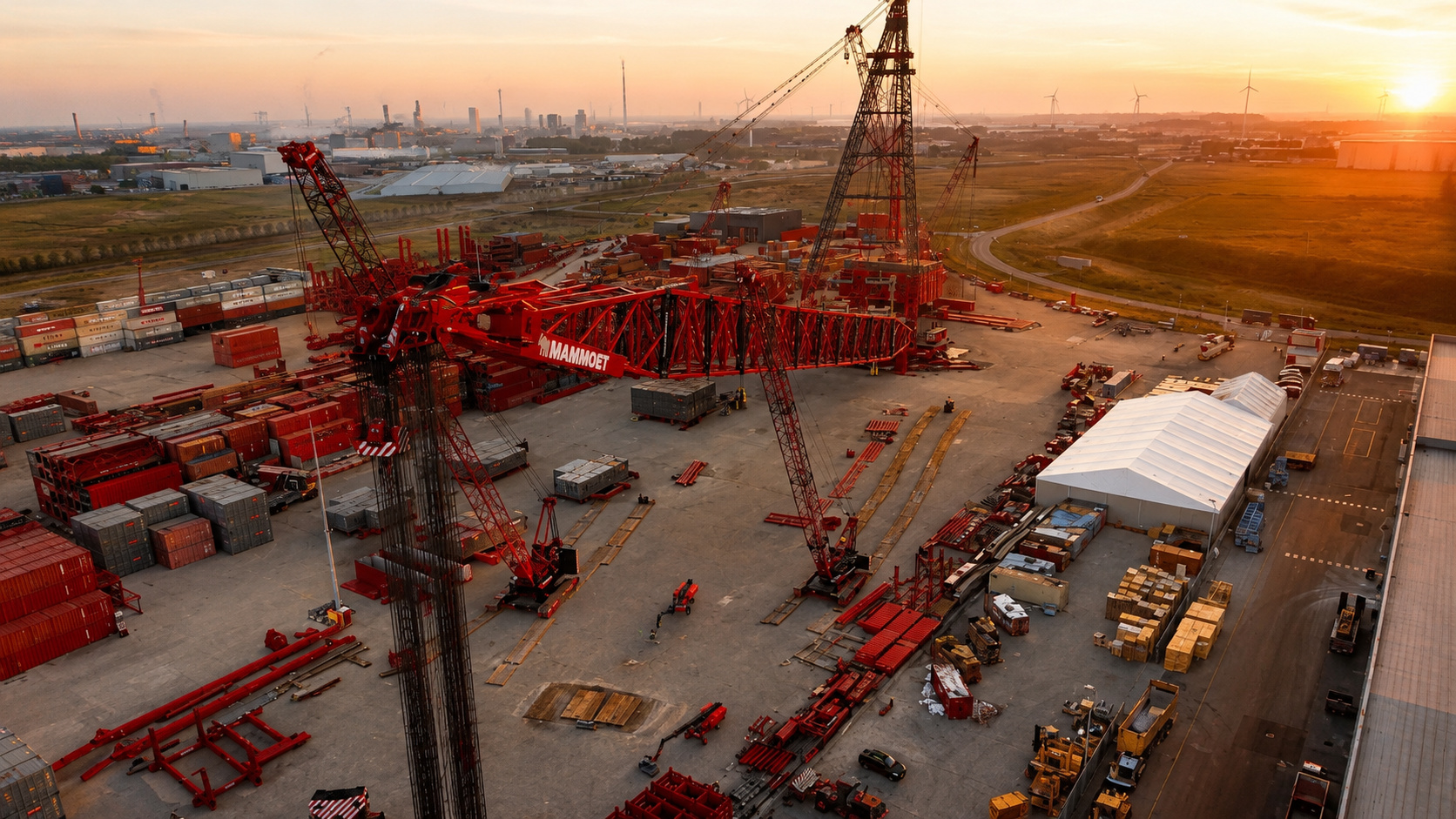

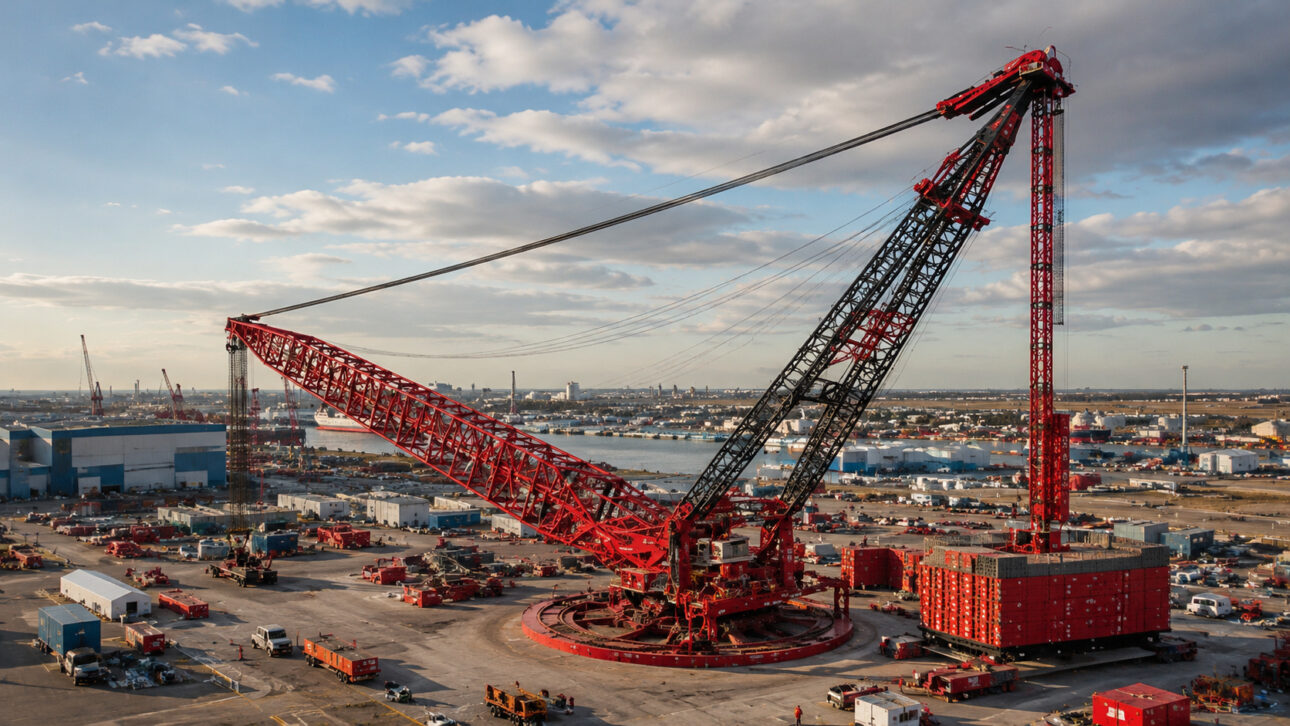
SK6000, from Mammoet, lifts up to 6,000 tons, operates with electric power and was created to accelerate offshore wind, nuclear, and oil and gas projects.
Mammoet introduced the SK6000 as the world’s strongest land crane. According to the company’s official statement, the machine has a maximum capacity of 6,000 tons, can lift components of up to 3,000 tons to 220 meters high, and was designed to operate in giant energy and infrastructure projects.
The equipment was created to meet a concrete change in the heavy industry. Mammoet states that offshore wind turbines, industrial modules, floating foundations, and nuclear components have grown so much in weight and height that part of the planned projects already required a new generation of lifting to come off the drawing board.
SK6000 was created to unlock increasingly larger energy and infrastructure projects
According to Mammoet, the advancement of offshore wind energy is among the main reasons for the emergence of the SK6000.
-
Two students from SENAI-RS developed AI to help identify rare ocular cancer in children. They were the only Brazilian project in the world finals of Infomatrix in Romania and secured 2nd place with neural networks that promise more accuracy in early diagnosis.

-
Couple replaces the kitchen floor in a Yorkshire village, finds under the 18th-century boards an earthenware mug stuffed with 266 gold coins from 1610 to 1727 and takes the “buried retirement” to auction: final hammer of £754,000, triple the estimate.

-
Archaeologists lift a giant stone in 3,500-year-old ruins in a country neighboring Brazil and discover a ritual treasure buried 3,800 years ago, with human figures, shells, beads, and symbols of a city that connected the Pacific, Andes, and Amazon.

-
Couple sees their home’s sidewalk sink, starts digging and discovers under the 1890 property a 2.7-meter-high brick tunnel even older than the house itself, a secret passage from around 1840 sealed and forgotten for nearly 180 years.


The company states that the accelerated growth of towers, monopiles, jackets, and floating foundations created execution bottlenecks, and that the new crane was developed precisely to allow parks currently in planning to be built in the future.


The company also positions the equipment for oil and gas and the nuclear sector. In offshore and petrochemical projects, the focus is on reducing the integration time of giant modules; in the nuclear sector, the promise is to shorten fieldwork by allowing larger components to be assembled in a controlled environment and lifted already complete.
This change goes beyond brute strength. The central value of the SK6000 is in enabling modular construction in larger pieces, with more stages done off-site and fewer connections, tests, and assembly at height in the final project area.
Capacity of 6,000 tons and lifting of 3,000 tons to 220 meters change the scale of heavy engineering
The equipment’s numbers help explain why it has garnered so much attention. Mammoet reports that the SK6000 has a maximum capacity of 6,000 tons, while the fixed jib configuration allows lifting 3,000 tons at 220 meters height, something specifically aimed at the new demands of offshore wind energy.
On the equipment’s technical page, the company also states that the main mast reaches 171 meters and that, with the fixed jib accessory, the total lifting height can reach 274 meters.
This places the crane in an operational range designed for components that already exceed the capacity of many large conventional systems.
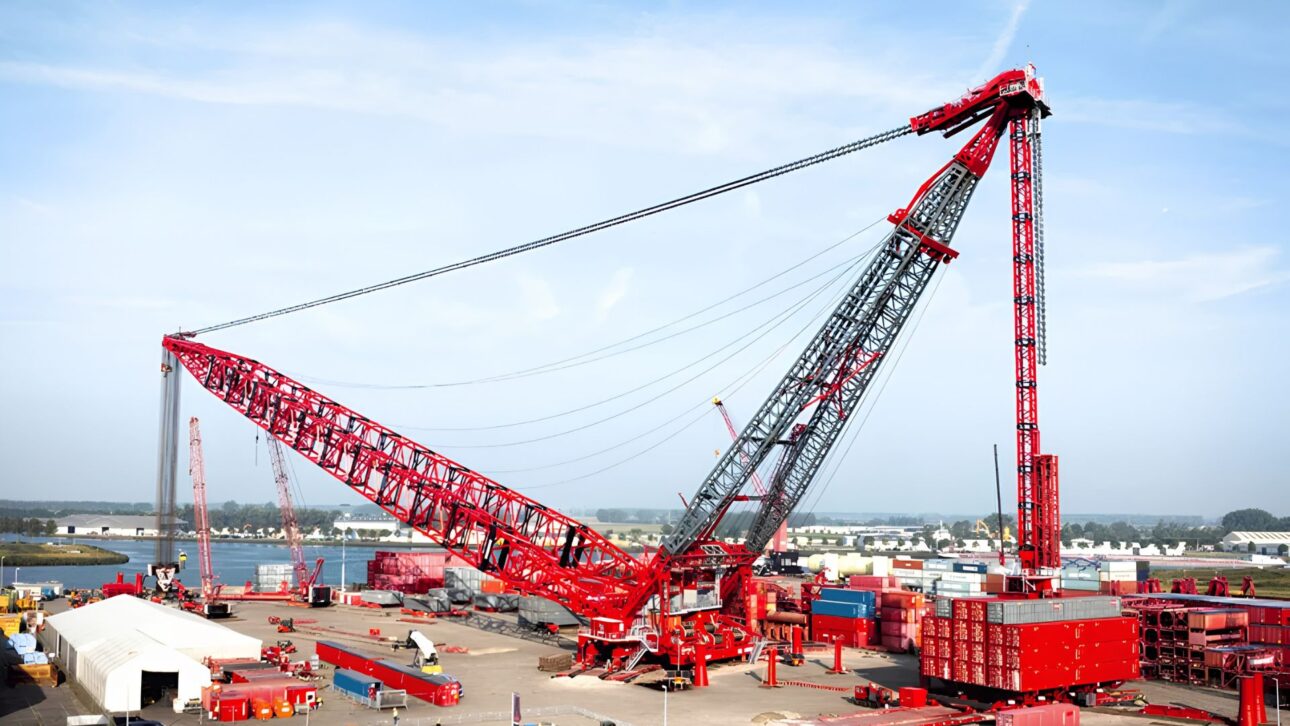
Mammoet itself presents the SK6000 as a platform created to cut the number of operations, reduce reconfigurations, and decrease work at height. In other words, the machine was not only designed to lift more but to allow the entire project to be planned differently.
Central counterweight of 4,200 tons helped reduce the occupied area on the site
Lifting such heavy loads requires solving the basic problem of balance. According to Mammoet, the SK6000 uses 4,200 tons of ballast and operates with a maximum ground pressure of 30 tons per square meter, a combination necessary to maintain stability under extreme loads.

One of the most important solutions of the project was the use of centralized ballast. Mammoet claims that this design eliminates the need to install a complete circular track and frees up up to 45% of space on the site, allowing other operations to continue around the equipment.
This arrangement also helps explain why the crane was presented as an evolution of the SK line. In the company’s view, the centralization of the ballast reduces ground preparation, maintains a smaller operational footprint, and increases flexibility for projects in space-constrained locations.
Machine was designed to lift giant modules and accelerate schedules
According to Mammoet, the biggest advantage of the SK6000 appears when clients stop manufacturing small parts on-site and start building much larger modules off-site.
These blocks can be prepared in parallel, transported ready, and lifted with fewer connection and integration steps on-site.
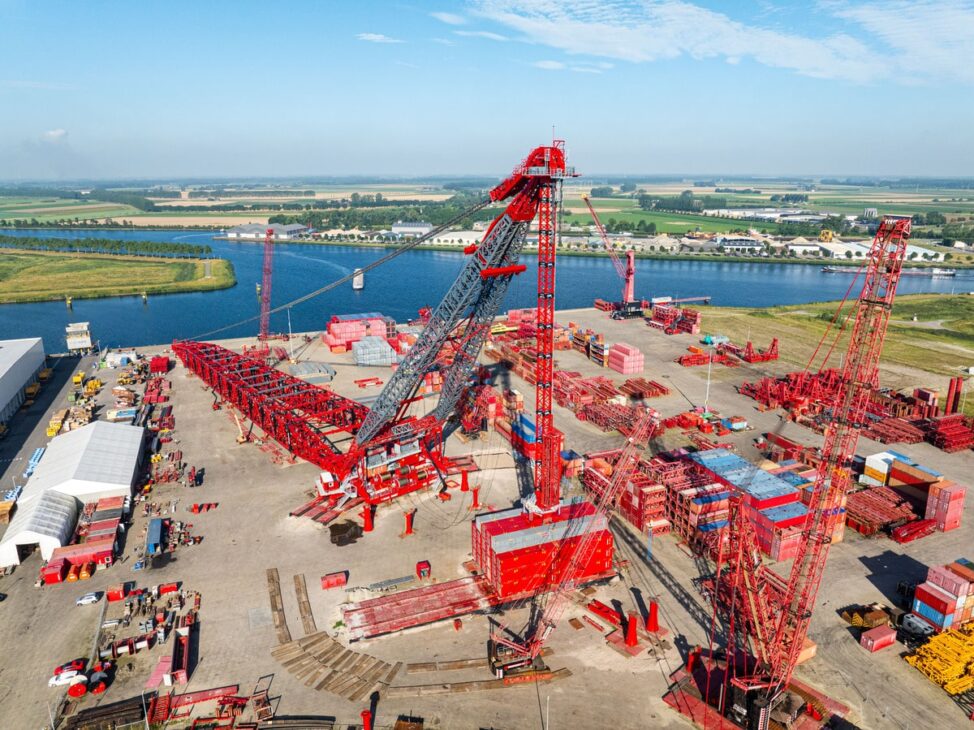
The company claims that this shortens the phases of logistics, integration, and mobilization, reduces the time until operational start, and improves safety by moving part of the assembly to more controlled environments. This argument appears in materials aimed at both wind energy and offshore and industrial applications.
In practice, the SK6000 was designed for engineering where the project speed depends less on fragmented on-site assembly and more on the ability to join giant pieces with fewer lifts, fewer interferences, and less construction time.
Tests supervised by Lloyd’s Register took the equipment to 125% overload
Before being released for operation, the SK6000 underwent a formal testing program supervised by Lloyd’s Register.
According to Mammoet, the process certified the safe operation of the equipment according to its specification and validated the load charts in different configurations.
The company reported that the crane was subjected to functional, structural, and stability tests, and that all components proved to withstand 125% overload. The tests covered all configurations of the main mast, from the smallest, at 127 meters, to the largest, at 171 meters.
At the most extreme point, Mammoet claims that the test reached 520,000 ton-meters of load moment, a value that the company describes as well above the nominal moment of the SK350, the previous model in the line that until then held the title of the company’s strongest land crane.
Fully electric operation put the SK6000 on the path to zero local emission lifting
Another central point of the project was electrification. According to Mammoet, the SK6000 has already been tested in fully electric operation and can now work with zero emissions on-site, using power from the grid, batteries, or hydrogen generators, depending on the available infrastructure.
In the tests, the company used two 600 kWh Battery Boxes connected in series to deliver 1,200 kWh. Mammoet claims that this solution showed that the use of batteries has minimal impact on operational routine and also reduces operational noise, which improves communication and safety on site.
The company also highlighted that the battery sets capable of operating the equipment are already available in standard 20-foot container formats. This reinforces the proposal of a giant crane that, despite its scale, was designed to travel and operate with more flexibility than traditional machines of this size.
Containers, global mobilization, and quick assembly became the project’s focus
Despite its gigantism, the SK6000 was conceived with a focus on international mobilization. Mammoet claims that the crane uses containerization techniques, can be transported in shipping containers, and was designed for quick on-site assembly, which increases its utility in projects spread across different regions of the world.
After the completion of the tests, the company reported that the equipment would be dismantled, containerized, and prepared for shipment to the first project.
The official statement shows that the development phase had already been completed and that the machine moved from the engineering promise stage to being a ready-to-deploy commercial asset.
This combination of extreme capacity, central ballast, electric operation, and container transport helps explain why the SK6000 became a symbol of a new era in heavy construction. As turbines, industrial modules, and foundations grow, the infrastructure of the future increasingly depends on machines capable of lifting parts that until recently seemed unfeasible on solid ground.