Portuguese
  Spanish


Ritual offering found in Peñico reignites the debate on the Caral tradition, with wooden, bone objects, beads, and shells linked to an ancient city that connected the coast, Andes, and Amazon.
In archaeology, a displaced stone can change the reading of thousands of years.
In Peru, researchers studying Peñico, an ancient urban center associated with the Caral tradition, identified a 3,800-year-old ritual offering hidden under a large stone, in an area where excavations had already revealed public buildings, ceremonial spaces, and traces of integration between communities from the coast, the Andean highlands, and the Amazon jungle.
The most recent discovery was announced on July 6, 2026 by the Caral Archaeological Zone, a unit of the Ministry of Culture of Peru.
-
Couple sees their home’s sidewalk sink, starts digging and discovers under the 1890 property a 2.7-meter-high brick tunnel even older than the house itself, a secret passage from around 1840 sealed and forgotten for nearly 180 years.

-
Chicago transforms colossal quarry into an “underground bathtub” of nearly 13 billion liters, sees the reservoir fill up six times in 2026 alone, and digs the hole to nearly 38 billion liters to create one of the largest water and sewage vaults in the U.S.

-
A couple who grew up surrounded by factory waste transforms ash and silica sludge into cement-free blocks, builds houses in up to 30 days, keeps interiors cooler in India’s heat, and claims to have already helped build homes for 450 families.
-
The oldest crime of humanity is 100,000 years old: a Homo sapiens was stabbed in the face with a stone blade in a cave in Israel, survived the blow, and became the oldest record of violence between people.


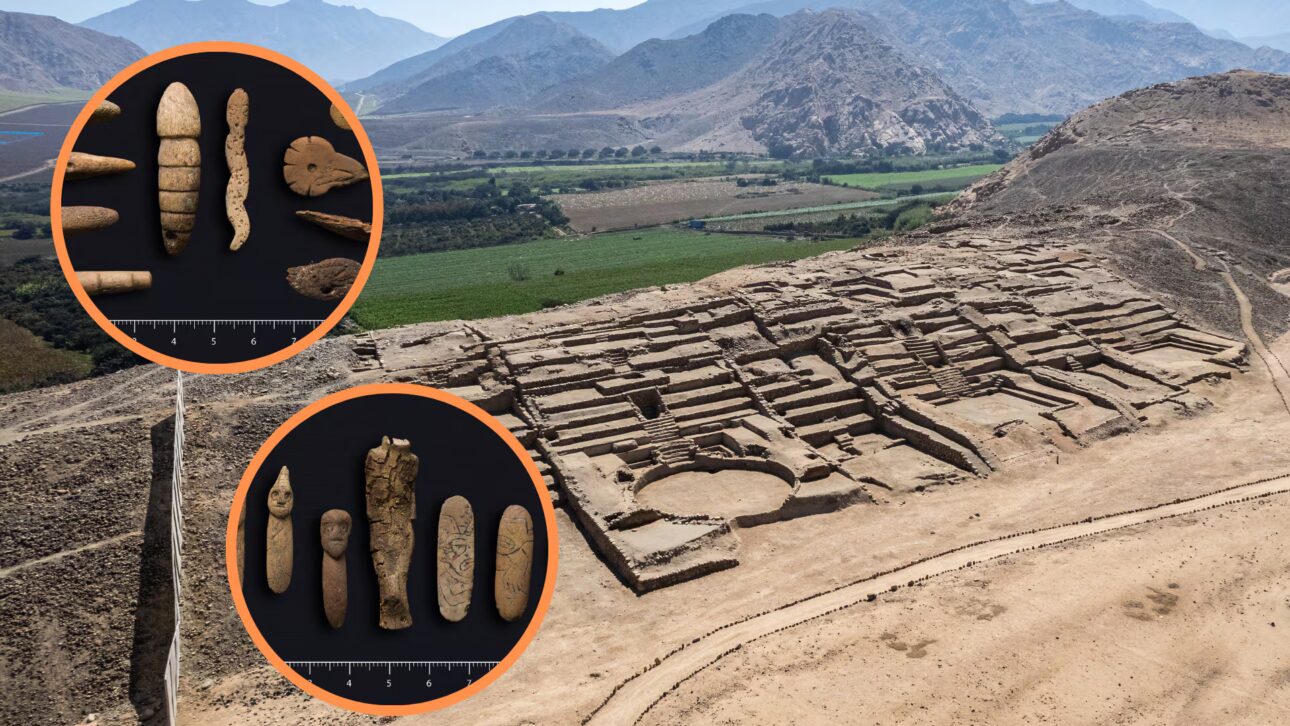
According to the institution, the offering was found at the Peñico archaeological site, in the province of Huaura, Lima region, and includes 43 wooden and bone pieces, as well as beads, chrysocolla fragments, and elements made with shells.
The set was in a small space bounded by rounded stones in a semicircular shape and covered by a large stone.
According to the Caral Archaeological Zone, the structure that held the earth filling and ritual objects measures 22 centimeters in length and was associated with the construction of a new platform in the Main Public Building, in subsector B1-B3 of Peñico.
The finding reinforces the interpretation that Peñico was not just an ancient settlement, but a center of power, rituality, and circulation of goods in the Supe valley after the decline of the main nuclei of the Caral Civilization.
This interpretation is attributed by researchers to the continuity of cultural, technical, and symbolic practices identified in the material found itself.
Peñico, the ancient city in the Supe valley
Peñico was presented to the public on July 3, 2025, after eight years of research conducted by the Caral Archaeological Zone.
The urban center was described by the Ministry of Culture of Peru as the “City of Social Integration” of the populations of the Supe valley, with estimated occupation between 1800 and 1500 B.C.
The site is located about 600 meters above sea level, on a geological terrace parallel to the Supe river, surrounded by mountains reaching 1,000 meters in altitude.
The location is considered strategic by researchers because it favored protection against floods and landslides, as well as allowing interaction between coastal areas, the mountains, and Andean-Amazonian territories.
Until the public presentation of the site, archaeologists had identified 18 constructions in Peñico, including larger and smaller public buildings, ceremonial temples, and residential complexes.
Drone images released by the researchers showed the urban center with a circular structure in a terrace area, surrounded by remnants of stone and clay constructions.
The proximity to the Sacred City of Caral-Supe is one of the central points of the research.
Caral is recognized as one of the oldest urban civilizations in the Americas and developed in the same valley about 5,000 years ago, in a period contemporary to ancient societies of Egypt, India, Sumer, and China, according to researchers cited by Reuters.
Unlike these civilizations of the Old World, Caral developed in isolation, without contact with other major civilizational centers.
This fact makes the Supe valley relevant for studies on urbanization, social organization, religion, architecture, and exchange networks in the Americas.
3,800-Year-Old Offering
The offering disclosed in 2026 consisted of 43 pieces crafted in wood and bone.
Some of them feature engraved designs, while others show evidence of exposure to fire, according to the Caral Archaeological Zone.
Among the objects, researchers identified representations of mythical characters, anthropomorphic figures, a possible female representation, possible authorities, birds, snakes, tadpoles, geometric motifs, and abstract forms.
Some pieces have cavities that, according to the institution, were intended for the inlay of minerals or semi-precious stones.
The set also includes three beads and three fragments of chrysocolla, two fragments of land gastropod shell beads, nine eye representations made with mollusk shells, and eight smaller objects still under investigation.
These pieces, according to the researchers, help to understand ceremonial practices related to the consecration of architectural spaces.
The fact that the offering was deposited during the initial stages of construction of a platform indicates, according to the Caral Archaeological Zone, that the act was part of a planned ceremony.
The institution states that the similarities in materials, incision techniques, and iconographic patterns point to the continuity of cultural traditions originating in the Supe Valley.
This interpretation links the finding to the period following the weakening of the first major urban centers of the Caral Civilization.
The Sacred City of Caral-Supe is 12.93 kilometers from Peñico, according to the Caral Archaeological Zone, a distance that helps situate the new center within the same cultural landscape.
Pututus and Symbols of the Caral Tradition
One of the most cited spaces in Peñico’s research is the so-called Ceremonial Hall of the Pututus, associated with the Major Public Building B1-B3.
A pututu is a trumpet made from a seashell and used in Andean societies to convene meetings, announce important events, and mark ritual practices.
In the building identified as B2, researchers observed sculptural reliefs with drawings of pututus.
According to the Ministry of Culture of Peru, this instrument had social and symbolic functions, as its sound could be heard over long distances and was also considered a ritual offering to deities.
In other areas of the site, archaeologists found raw clay sculptures with human and animal representations, ceremonial objects, stone artifacts, and necklaces made with beads of different materials.
Among the materials mentioned are Spondylus, Argopecten purpuratus, Felicioliva peruviana, rhodochrosite, chrysocolla, animal bone, and clay.
These remains help explain why Peñico is interpreted as a site of integration.
The presence of shells, minerals, pigments, and other materials suggests the circulation of goods between distinct areas, although researchers still rely on additional analyses to detail routes, trade volumes, and specific uses of each object.
Ruth Shady Solís, an archaeologist who directs the Caral Archaeological Zone, stated that Peñico occupied a strategic position for trade and exchange between coastal, highland, and jungle societies.
The statement was given to Reuters during the site’s presentation.


Continuity of the Caral Civilization
The scientific importance of Peñico is linked to the question of what happened after the decline of the first urban centers of Caral.
For researchers, the site shows that practices, symbols, and forms of organization did not disappear all at once but were preserved and transformed in new contexts.
Archaeologist Marco Machacuay, a researcher from the Ministry of Culture, stated in a press conference that the importance of Peñico lies in representing a continuity of the Caral society.
The statement was recorded by Reuters during the coverage of the site’s presentation in July 2025.
The Caral Archaeological Zone reports that Peñico was founded around 1800 B.C. and occupies an archaeological area of 19.44 hectares.
The period coincides with the phase following the loss of prestige of the ancient urban centers of the Caral Civilization, including the Sacred City of Caral-Supe.
The researchers’ hypothesis is that Peñico maintained networks of social and economic interaction already consolidated in the Supe valley.
It is also possible, according to the Ministry of Culture of Peru, that the prestige of the urban center was linked to the extraction and circulation of hematite, a mineral used to produce red pigment and associated with symbolic value in Andean cosmology.
Technology in the archaeology of Peñico
Although the discovery is archaeological, part of the current interest comes from the tools used to study, record, and present the site.
Drone images allowed for observation of Peñico’s spatial organization from above, while museography resources and digital reconstructions help visitors visualize spaces that today appear as ruins.
The Ministry of Culture states that Peñico has an information and interpretation center, with infographics, models, dioramas, and digital recreations to present the social history and cultural values recovered at the site.
In an interview with Xinhua, Yoshio Cano, head of the Museography Unit of the Caral Archaeological Zone, stated that the team reconstructed in 3D the Hall of Pututus and the associated building to bring the public closer to how these spaces would have been experienced in Peñico society.
This use of digital reconstruction does not replace excavation, material analysis, or the conservation of objects, but it broadens the form of scientific communication.
For the general reader, technology helps transform walls, platforms, and fragments into a more comprehensible reading of the ancient city.
The opening of Peñico to the public also brings the site closer to other locations managed by the Caral Archaeological Zone, such as the Sacred City of Caral, the fishing city of Áspero, and the agro-fishing city of Vichama.
The visitation was announced in 2025 by the Ministry of Culture of Peru, with schedules, signage, reception area, and interpretive center.