Portuguese
  Spanish


According to the Industry News Agency and FIERGS, SENAI-RS students Andrei Vinícius Krug and Yuri Mendes Beck created Visual Detect, AI with neural networks to assist early diagnosis of childhood retinoblastoma, the only Brazilian project in the world final of the Infomatrix World Finals 2026, in Bucharest, Romania international.
SENAI-RS students Andrei Vinícius Krug and Yuri Mendes Beck won second place in the Software Development category at the Infomatrix World Final 2026, in Bucharest, Romania, with the Visual Detect project, aimed at assisting in the early diagnosis of childhood retinoblastoma.
The competition took place between May 14 and 18, 2026, according to FIERGS, and brought together more than 2,000 young people from 40 countries. The students from the Technical Course in Systems Development represented SENAI-RS from São Leopoldo and were the only Brazilian project in the world final, according to the participants’ report.
Brazilian project used AI to target a rare eye cancer
Visual Detect was developed to assist in the early identification of childhood retinoblastoma, a rare type of eye cancer that affects the retina. The students’ proposal uses artificial intelligence and neural networks to support the analysis of signs related to the disease.
-
Couple replaces the kitchen floor in a Yorkshire village, finds under the 18th-century boards an earthenware mug stuffed with 266 gold coins from 1610 to 1727 and takes the “buried retirement” to auction: final hammer of £754,000, triple the estimate.

-
Archaeologists lift a giant stone in 3,500-year-old ruins in a country neighboring Brazil and discover a ritual treasure buried 3,800 years ago, with human figures, shells, beads, and symbols of a city that connected the Pacific, Andes, and Amazon.

-
Couple sees their home’s sidewalk sink, starts digging and discovers under the 1890 property a 2.7-meter-high brick tunnel even older than the house itself, a secret passage from around 1840 sealed and forgotten for nearly 180 years.
-
Chicago transforms colossal quarry into an “underground bathtub” of nearly 13 billion liters, sees the reservoir fill up six times in 2026 alone, and digs the hole to nearly 38 billion liters to create one of the largest water and sewage vaults in the U.S.



The source informs that the technology seeks to increase accuracy and agility in identifying the problem. The central point is the use of AI as a support tool, not as a substitute for medical evaluation or clinical diagnosis made by health professionals.
Duo represented SENAI-RS in Bucharest
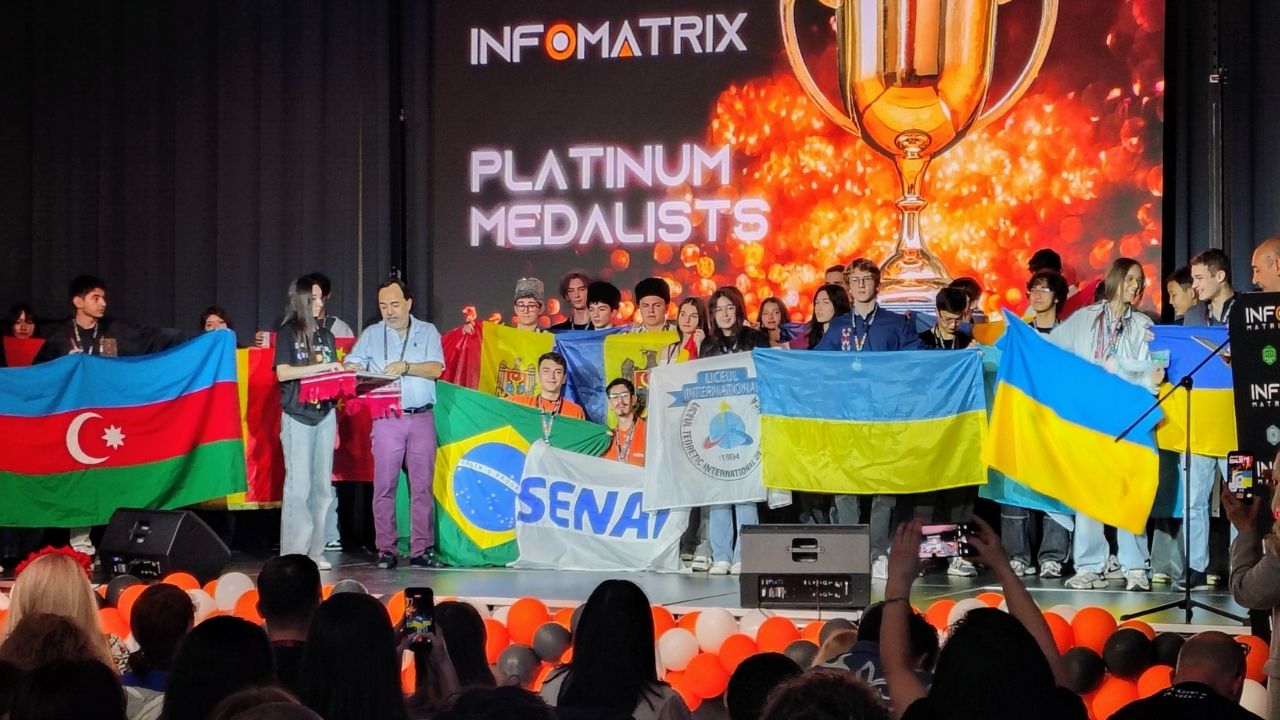
Andrei Vinícius Krug and Yuri Mendes Beck traveled accompanied by instructor Alexandre Silveira de Paula. The work also had guidance from instructor Cassio Klen de Azevedo and co-guidance from Fernando Silveira de Aguiar, according to FIERGS.
The participation placed SENAI-RS from São Leopoldo in an international competition of technology, robotics, and innovation. The Infomatrix World Final brings together elementary, high school, and university students, expanding contact between projects from different countries and technical areas.
Only Brazilian project in the world final
Yuri Mendes Beck told FIERGS that representing Brazil was a source of pride, highlighting that Visual Detect was the only Brazilian project in the World Finals. He also mentioned the international networking with representatives and leaders from other delegations.
This fact reinforces the weight of the achievement. In a competition with more than 2,000 young people from 40 countries, the project by SENAI-RS students managed to reach the world final and win a silver medal in the software category.
Research had been developed for about a year
According to FIERGS, the group had been working on Visual Detect for approximately a year. Before the international stage, the project had already gone through three other fairs and won the top prize in two of them.
Among the previous results are Infomatrix Brazil 2025 and Fenecit 2025. The spot in the international tournament was secured after the duo won the Platinum award at Infomatrix Brazil 2025, in September of the previous year.
Neural networks were applied to early diagnosis
The choice of neural networks places the project within an expanding area: the use of AI to recognize patterns in data and images. In the case of Visual Detect, the proposal is to assist in the identification of childhood retinoblastoma more quickly.
The source does not detail the database used, the accuracy level of the model, or clinical results in patients. Therefore, the correct reading is to treat the project as a technology in development, with the potential to support the screening and investigation process.
Next stage involves investors and field tests
After the result in Romania, the group intends to seek investors and start testing the technology in the field. This stage will be important to evaluate how Visual Detect can work outside the environment of fairs, prototypes, and academic presentations.
Progressing to practical tests requires validation, technical monitoring, and dialogue with health areas. The international medal shows recognition of the project, but the path to real use depends on additional evaluation and development steps.
International experience also broadened the students’ repertoire
Andrei Vinícius Krug highlighted to FIERGS the contact with people from other countries and cultures during the trip. He stated that he learned to communicate differently and realized that scientific research produced in Brazil can overcome language barriers.
This point shows that the competition was not just a showcase of technology. For SENAI-RS students, the experience involved technical presentation, cultural adaptation, exchange of ideas, and exposure to projects from different countries.
Technical education appears as a bridge for innovation in health
The case of Visual Detect shows how technical education can connect to complex health problems. Two systems development students started from neural networks and AI to propose a tool aimed at a rare childhood cancer.
This type of initiative also reinforces the role of institutions like SENAI-RS and FIERGS in training young people for applied technology areas. When student projects approach real challenges, the classroom starts to function as an innovation laboratory.
Result places Brazil in an international technology showcase
The achievement of second place at the Infomatrix World Final 2026 does not automatically transform Visual Detect into a ready medical solution, but it places Brazilian student research in a global innovation showcase. The recognition came in a competitive category with participation from dozens of countries.
The challenge now is to transform international recognition into technical development, testing, and partnerships. Do you think AI projects created by Brazilian students should receive more investment to advance in areas like health, education, and early diagnosis? Leave your opinion in the comments.