Portuguese
  Spanish


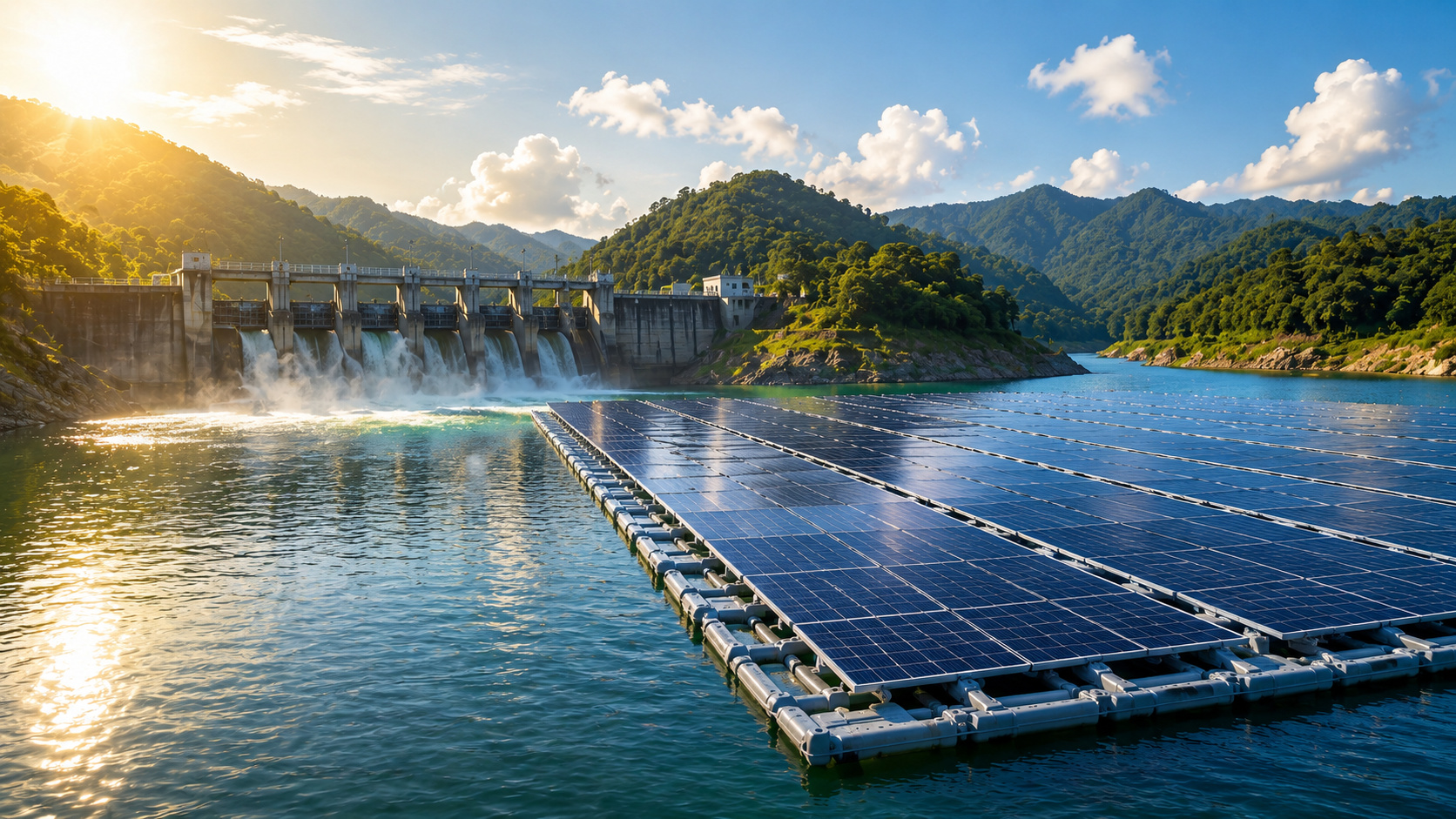

With floating solar plants installed over hydroelectric reservoirs, the Philippines combine renewable generation, reduction of water evaporation, increased energy efficiency, and intelligent use of the country’s existing infrastructure.
According to PV Magazine, the company NKS Solar One — a joint venture between Blueleaf Energy Philippines and NKS Energy Utilities, with a US$ 1.5 billion investment from the Australian group Macquarie — is building two floating solar parks in the Philippines: 162 MW on Lake Caliraya and 88 MW on Lake Lumot, both in the province of Laguna, southeast of Manila. Together, the two projects total 250 MW of capacity with commercial operation expected in the second quarter of 2026. What distinguishes NKS Solar One from any conventional solar park is not just the location over water.
It is the set of simultaneous benefits that the floating panels produce for the same reservoirs that support them: reduction of up to 70% in the water evaporation rate, suppression of algae blooms that degrade water quality, cooling of the panels by proximity to the water which increases generation efficiency, and production of clean energy without occupying any hectare of land in a country that, with 115 million inhabitants and 7,100 islands, has land available as one of the most contested resources.
The NREL — United States National Renewable Energy Laboratory — identified 584 floating solar installations around the world with a total capacity of 10 GW in September 2024. In less than a decade, the technology has gone from experiment to industry.
-
Brazil Aims to Become a Global Exporter of Green Hydrogen, the Clean Fuel Set to Generate Billions

-
Brazil to Hold First Offshore Wind Energy Auction, Aiming to Become the Country’s New Hydropower
-
Brazil to Hold First Auction for Batteries to Store Solar and Wind Energy from the Northeast
-
Brazilian scientists are simultaneously advancing two research projects on clean hydrogen and driving solutions that could transform the energy matrix, enhance industrial competitiveness, and accelerate large-scale emission reduction targets.



Why hydroelectric reservoirs lose water — and how the panels help
The evaporation of reservoirs is one of the least discussed losses of natural resources in hydroelectric generation — and one of the most relevant in tropical regions like Brazil and the Philippines, where temperature and intense solar radiation combine to evaporate significant volumes of water throughout the year.
In tropical reservoirs, evaporation loss can represent between 5% and 15% of the total volume of water available for generation annually. In drought years, when reservoir levels are already compromised, this additional loss has a direct impact on generation capacity. The Itaipu reservoir, for example, has a surface area of approximately 1,350 km² — an area where annual evaporation can represent billions of liters of water that will never pass through the turbines.
Floating panels solve this problem by blocking direct solar radiation that heats the water’s surface. According to data from Power Prognosis, partial coverage of a reservoir with panels reduces water temperature and evaporation rate by up to 70% in covered areas. This not only conserves water for hydroelectric generation but also improves the reservoir’s reliability during periods of water scarcity — exactly when generation is most critical.
Water Cooling That Increases Panel Efficiency
One of the physical advantages of floating solar that rarely appears in technical summaries — but has a measurable impact on energy production — is the cooling effect that the water surface exerts on the panels installed above it.
Photovoltaic panels lose efficiency as temperature rises. A panel operating at 65°C produces approximately 12% to 20% less energy than the same panel operating at 25°C — a thermal degradation that directly affects any installation in a tropical environment exposed to direct sunlight. In land-based parks during the Filipino or Brazilian summer, this loss of efficiency is routine and unavoidable.
Floating panels operate in a permanently cooler environment because the water surface beneath them continuously evaporates, absorbing heat through evaporation and maintaining the local microclimate cooler than on land. The additional efficiency estimated for floating installations compared to equivalent land-based installations ranges between 5% and 15%, depending on ambient temperature and wind speed over the lake surface. In terms of annual production, this difference can represent tens of gigawatt-hours additional without any extra capital cost.
NKS Solar One: The $1.5 Billion Project and the First Major FPV in the Philippines
NKS Solar One is the first major floating solar project in the Philippines — and one of the most complex in the Asian region as it involves two lakes in different municipalities connected to a single transmission substation.
Lake Caliraya will host the larger of the two parks, with 162 MW capacity. Lake Lumot will receive 88 MW. The two projects total 220 MWp of maximum output capacity, according to Rafael Macabiog, project manager at Blueleaf. The grid connection will be made via a 6 km 230 kV transmission line to the Lumban substation of NGCP — the national transmission company of the Philippines. The total project cost is estimated at PHP 15 billion, equivalent to approximately $260 million just for NKS Solar One, part of the total $1.5 billion portfolio that Blueleaf is investing in the Philippines.
The project received certification as an Energy Project of National Significance by the Filipino government — a classification that speeds up regulatory approvals and simplifies the licensing process. China Energy Engineering Corporation International signed an EPC contract for the Lake Caliraya project, while Xian Electric will be responsible for the substation. The expected production is approximately 200 million kWh per year for the Caliraya component alone, enough to supply more than 165,000 Filipino households with average consumption.
What Algae Suppression Has to Do with Energy Cost
One of the benefits of floating solar that appears only in the most detailed technical studies — rarely in project announcements — is the suppression of algae blooms in reservoirs covered by the panels.
Algal blooms in reservoirs are a growing problem in tropical regions, where elevated water temperatures combined with nutrients from agricultural runoff create ideal conditions for the accelerated growth of cyanobacteria and other algae. The impact goes beyond environmental: intense blooms contaminate water with toxins, drastically increase treatment costs for human supply, and can reduce dissolved oxygen in the reservoir to the point of killing fish on a commercial scale.
Floating panels block the solar radiation that fuels algae growth, creating shaded areas where blooms cannot establish. The suppression of algae reduces water treatment costs for reservoirs serving riverside populations, improves the quality of water available to the hydroelectric plant itself — because excess algae damage turbines and filtration systems — and preserves the aquatic ecosystem that the local fishing community depends on.
The 1,300 Brazilian reservoirs and the unexplored potential
Brazil has 1,300 hydroelectric reservoirs with a total surface area representing one of the world’s largest potentials for floating solar — and this potential remains practically unexplored.
Conservative estimates by Brazilian researchers indicate that covering just 5% of the surface of Brazil’s main reservoirs with floating panels would generate more than 100 GW of solar capacity — without occupying any land and with all the secondary benefits of reducing evaporation, suppressing algae, and natural cooling. For context: Brazil’s entire installed electricity generation capacity totaled 215 GW in 2024. Floating solar on 5% of the reservoirs would add almost half of that.
The Balbina reservoir in Amazonas — created by a hydroelectric plant now considered one of the biggest environmental mistakes in Brazilian energy history, for flooding 2,360 km² of forest to generate only 250 MW — has a surface area that alone could host dozens of gigawatts of floating solar. Itaipu, Tucuruí, Serra da Mesa, and Furnas have surfaces comparable to the entire Philippines. The model that Blueleaf, NKS Solar One, and CEEC are implementing in the Laguna lakes in 2026 is the same that could transform the environmental liabilities of Brazilian hydroelectric plants into energy assets without building a single new dam.
584 installations and 10 GW: the industry that grew quietly
Floating solar went from a laboratory curiosity to a global industry in less than fifteen years. The NREL documented 584 installations with a total capacity of 10 GW in September 2024 — a number that did not exist as a generation category in 2015.
China dominates the market, with the largest floating solar park in the world: the Huainan plant in Anhui, with 150 MW installed over a flooded coal mine — another example of dual utility of environmental liability infrastructure. Japan has dozens of installations in decommissioned nuclear and hydroelectric plant reservoirs. South Korea, the Netherlands, and India have projects at different stages. The global floating solar market was valued at over $3 billion in 2023 with growth projections above 20% per year until 2030, according to Allied Market Research.
What unites all these projects — from Lake Caliraya in the Philippines to the Huainan reservoir in China, from the unexplored potential of Balbina in the Amazon to the Cirata hydroelectric plant in Indonesia, inaugurated in November 2023 with 192 MW — is the same logic that India’s initiative of covering irrigation canals with solar panels articulates: the water infrastructure that was built for a single purpose can generate energy, save water, and improve the ecosystem at the same time, as long as someone decides to install panels where there was previously only a surface reflecting sunlight to the sky.