Portuguese
  Spanish


The Miyawaki method, created by Japanese botanist Akira Miyawaki (1928-2021), promises to transform small plots into dense native forests in a few years by planting native species closely together. The technique has become a trend in urban reforestation worldwide, but a study from December 2025 questions whether the Miyawaki forest grows as fast as claimed.
Imagine transforming a plot the size of a block into a forest so dense you can’t even enter. This is the promise of the Miyawaki method, the subject of a video from the channel Make Tech Future, which tells the story of the botanist behind the technique and the controversy it created.
Science, however, urges caution. According to a report from Mongabay about a study published in December 2025, many of the most spectacular claims about the Miyawaki forest still lack solid scientific backing, although the dense native forest does indeed form.
The creator of the technique is a legend in botany. Akira Miyawaki, born in 1928 and passed away in 2021 at the age of 93, dedicated his life to recreating native forests, and his Miyawaki method spread worldwide as one of the most famous bets in urban reforestation.
-
800-Year-Old Cliffside Temple in Greece Amazes with Secret Cave, Drawbridge, and Stunning Views

-
Japan’s “Akiya” Homes: Abandoned Properties Attract Foreign Buyers as Locals Shun Them
-
Lawyer Turned Entrepreneur Earns $60,000 Annually Selling Brazilian Cheese Bread: Athena Rodrigues Started with $400 and Founded Dona Zelda, Bringing a Taste of Minas Gerais to São Paulo’s Heart

-
China’s “Green Wall” Initiative Reclaims Over 2,000 km² of the Gobi Desert Annually, Transforming Sand into Forests, Solar Plants, and Zero-Carbon Highways


Next, see who Akira Miyawaki was, how the Miyawaki method works, what inspired the technique, what is real and what is exaggerated in the promises, what science says, and why this dense native forest has everything to do with Brazil.
Who was Akira Miyawaki, the botanist behind the forest
The name behind the technique is Akira Miyawaki. Born in 1928, into a family of farmers in western Japan, he became one of the world’s leading experts on native vegetation and created the Miyawaki method, which bears his surname.
His career was award-winning. A professor at Yokohama National University, Akira Miyawaki received the Blue Planet Prize in 2006, one of the most important environmental awards on the planet, precisely for his work in recreating dense native forests in degraded areas using the Miyawaki method.
He worked until the end. According to the video, Akira Miyawaki planted trees almost until his death in 2021, at the age of 93, leaving a legacy of millions of trees and a technique of urban reforestation applied in various countries.
His obsession had a clear origin. Akira Miyawaki wanted to return to Japan the native forests that industrialization had erased, and it was by seeking to understand which trees were truly native that he designed the Miyawaki method and the logic of the dense native forest.
The result was a silent revolution. Where most saw small and degraded lands as lost, Akira Miyawaki saw the potential for a Miyawaki forest, transforming urban reforestation into something possible even in tiny spaces.
How the Miyawaki method works: ultra-dense planting
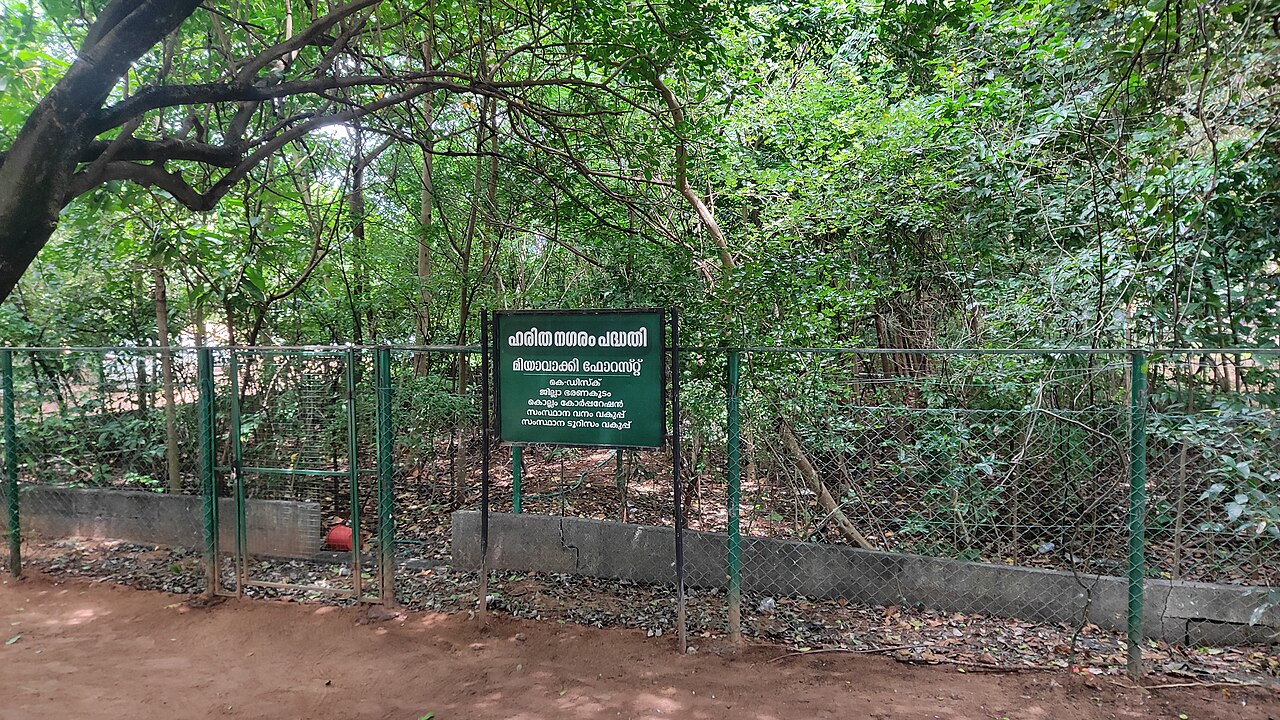
The secret of the Miyawaki method lies in the density. Instead of planting trees spaced apart, the technique places dozens of native species very close together, about three seedlings per square meter, creating from the start a dense native forest that grows competing for every ray of sunlight.
Everything starts with the soil. The land is prepared with organic matter so that the roots go deep, and only then are the small seedlings introduced, randomly mixed, forming the layers of a Miyawaki forest: canopy, understory, shrubs, and ground cover.
The competition is intentional. In the Miyawaki method, many seedlings die, and this is part of the plan: the competition for light forces the survivors to grow quickly upwards, giving the dense native forest the appearance of a closed forest in a short time.
Then comes abandonment. In the first three years, the area receives weeding and care; after this period, the Miyawaki forest is left on its own, without management, to continue growing independently like a natural forest, one of the principles of urban reforestation with the technique.
This logic is what enchants cities. Because it fits in small plots and grows quickly, the Miyawaki method has become a symbol of urban reforestation, with dense native forest sprouting in schoolyards, flowerbeds, and vacant lots in various countries.
The sanctuary forests that inspired it all
The idea did not come out of nowhere. The Miyawaki method was born from observing the sacred groves surrounding Japan’s Shinto shrines, ancient and untouched forests that Akira Miyawaki realized were composed of the region’s true native trees.
These woods have been preserved for centuries. Protected by religion, the sanctuary woods have kept the original dense native forest that existed before human occupation, serving as a living model for what Akira Miyawaki wanted to recreate with the Miyawaki method.
There was also foreign influence. In 1958, in Germany, Akira Miyawaki learned the concept of potential natural vegetation, the idea of discovering which forest would naturally grow in each soil, a theoretical basis that he combined with the observation of sanctuaries to create his Miyawaki forest.
The first major application was industrial. In the 1970s, Akira Miyawaki used the Miyawaki method to reforest the land of a large Japanese steel plant, proving that it was possible to create dense native forest even in degraded industrial areas.
From this meeting of tradition and science, the technique was born. By combining sacred woods, German theory, and a lot of fieldwork, Akira Miyawaki made urban reforestation something replicable, and the Miyawaki method began to spread around the world.
“10x faster”: what is real and what is exaggerated

Here lies the controversy. Headlines about the Miyawaki method often repeat that the Miyawaki forest grows ten times faster, becomes thirty times denser, and a hundred times more biodiverse than a common plantation, numbers that impress but need context.
These multipliers have an owner. The figures of “10x, 30x, and 100x” were popularized mainly by promoters of the technique, and not measured by Akira Miyawaki himself, which already calls for caution when repeating these promises about the dense native forest.
There is an important point of consensus. Even the harshest critics admit that the plantings of the Miyawaki method indeed become forest: the dense native forest really forms, and faster than in a plantation left to chance, on this almost no one disagrees.
The disagreement is about the magnitude. What scientists question is whether the Miyawaki forest grows as fast, as cheaply, and as spectacularly as the marketing claims, or if the round numbers exaggerate the real results of urban reforestation.
Therefore, balance is essential. The Miyawaki method is a serious and useful technique, but treating each “10x” as a proven fact would be misleading; the most honest thing to say is that the dense native forest works, even if the exact multipliers remain in dispute.
What science says about the Miyawaki method
A recent study put the technique to the test. Published in December 2025 in a scientific journal of applied ecology, it reviewed dozens of articles on the Miyawaki method and concluded that there is a lack of rigorous evidence for most of the famous claims of the Miyawaki forest.
The data is revealing. According to the analysis, only a fraction of the studies on the Miyawaki method included quantitative evaluation, few had a comparison group, and even fewer repeated the tests, which weakens the promises about the dense native forest growing so quickly.
The weakest claim is about maturity. The idea that a Miyawaki forest reaches in twenty or thirty years what a natural forest would take centuries was classified by the study as lacking empirical proof, a warning against exaggeration in urban reforestation.
Even so, the study does not condemn the technique. It acknowledges that the Miyawaki method creates forest and accelerates the process, but calls for more serious science and less marketing, so that the dense native forest is evaluated for what it truly delivers.
This counterpoint is healthy. Far from toppling the Miyawaki method, science helps separate real achievement from exaggeration, showing that the Miyawaki forest is worthwhile, as long as no one sells as a miracle what is still a promise being tested in urban reforestation.
More than 40 million trees around the world
The reach of the technique is enormous. Throughout his career, it is estimated that Akira Miyawaki has helped plant more than 40 million trees in about 15 countries and various continents, spreading the Miyawaki method far beyond Japan.
The model traveled the world. From Asia to Europe, companies, NGOs, and municipalities adopted the Miyawaki method to create dense native forest in small plots, transforming the Japanese technique into a global phenomenon of urban reforestation.
Cities are the preferred stage. Because it fits in tight spaces and grows quickly, the Miyawaki forest became a response to urban problems like heat islands and lack of greenery, bringing dense native forest to schoolyards and forgotten corners of metropolises.
There is no single census, however. The total numbers of trees planted with the Miyawaki method come from different organizations and estimates, so they should be treated with care, but they show the scale of a movement that popularized urban reforestation.
Whatever the exact number, the cultural impact is undeniable. The Miyawaki method has changed the way the world thinks about planting forests, proving that a dense native forest doesn’t need large areas, and that Akira Miyawaki left a lasting mark.
Does the Miyawaki method work anywhere?
Here comes an important caveat. Despite its fame, the Miyawaki method is not a universal solution: it was designed for the specific conditions of Japan, and applying it without adaptation in other climates may not yield the promised dense native forest.
The soil context is decisive. The technique depends on knowing the native species of each place, and using the Miyawaki method with the wrong plants or in ecosystems that are naturally not forests, such as grasslands and savannas, would be a mistake in urban reforestation.
The cost also weighs. Preparing the soil and buying thousands of native seedlings makes the Miyawaki forest relatively expensive, and part of the criticism is that the technique has sometimes become a flashy way to spend environmental funds without guaranteeing results.
Therefore, experts call for common sense. The Miyawaki method works best where the forest is the natural ecosystem and with the right species, and calling any standardized planting a dense native forest would oversimplify a delicate process.
In the end, the technique is a tool, not a magic wand. Well applied, the Miyawaki method delivers true dense native forest and accelerates urban reforestation; poorly applied, it becomes just an expensive garden with a fancy name.
What the Miyawaki method has to do with Brazil
Brazil is fertile ground for the idea. With the Atlantic Forest reduced to about 12% of its original coverage, the country has a huge need to recreate dense native forest, and the Miyawaki method appears as a possible restoration tool.
The technique has already arrived here. There are Brazilian initiatives applying the Miyawaki method, including in the Amazon, cataloged as social technology, proof that the Miyawaki forest is being tested on national soil and can inspire urban reforestation in cities.
The urban potential is great. In Brazilian metropolises suffocated by heat and concrete, mini-forests created with the Miyawaki method could bring shade, biodiversity, and freshness, bringing dense native forest to squares, schools, and abandoned lots.
But the lesson of caution is worth noting. Just like in the rest of the world, the Miyawaki method in Brazil needs to use the right native species for each biome and be evaluated with science, so that the Miyawaki forest delivers real results, and not just green marketing.
Finally, here is the inspiration. Seeing a Japanese botanist recreate a dense native forest in tiny spaces shows Brazil that restoring nature is possible, and that urban reforestation with the Miyawaki method can be another weapon in the fight for the Atlantic Forest.


The Miyawaki method is, at the same time, a beautiful idea and a lesson about exaggerations. Created by Akira Miyawaki, it shows that it is possible to recreate a dense native forest in a small space and in a few years, changing the face of urban reforestation worldwide.
More than the round numbers, what matters is the balance. The Miyawaki forest really works, but science demands that the proven achievement be separated from the “10x” promises, so that the technique is used seriously, and not as a slogan.
And you, would you plant a Miyawaki forest in your neighborhood, knowing that the dense native forest grows quickly but not every spectacular number is proven? Do you think Brazil should invest in the Miyawaki method to restore the Atlantic Forest? Tell us in the comments and share with those who love trees.