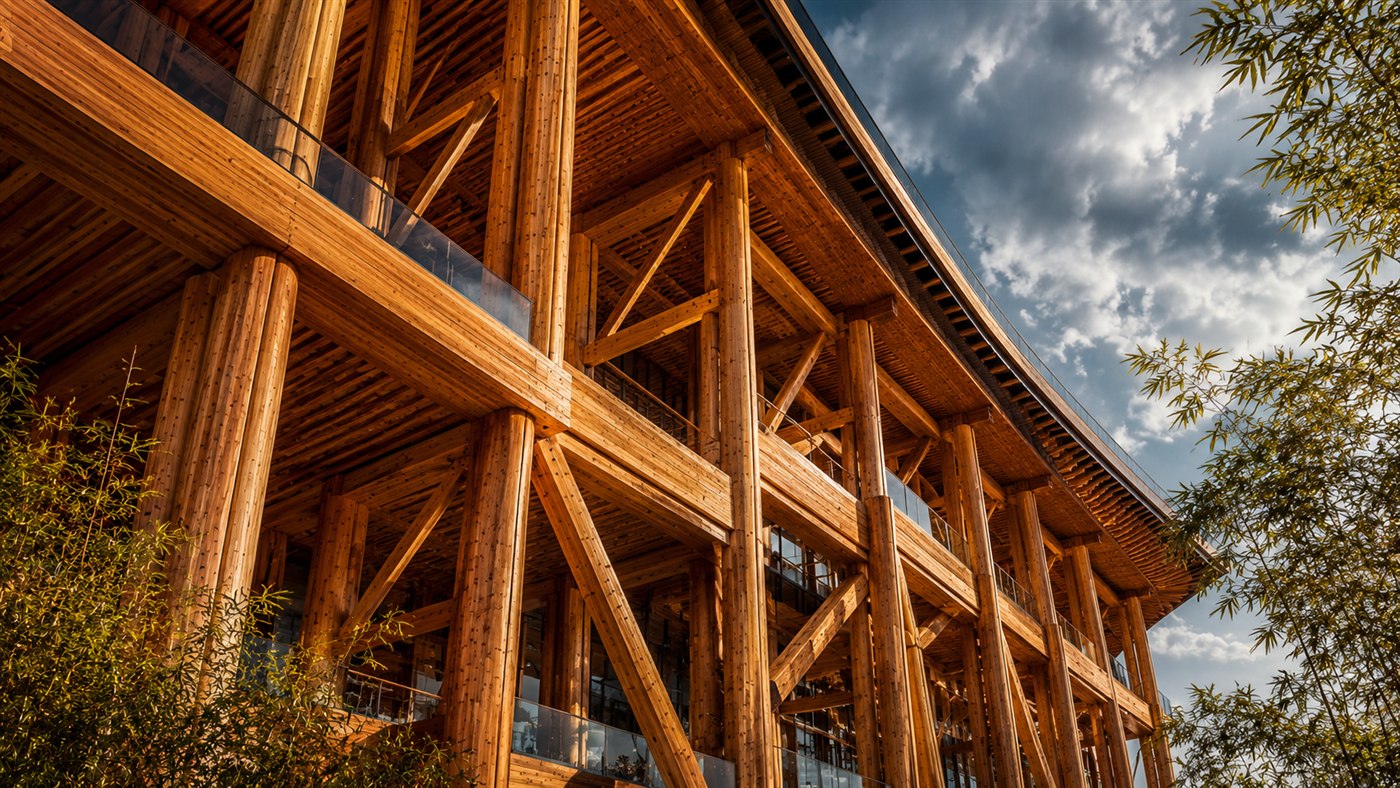

The Snap Shift documentary shows how grinding bamboo into fiber and pressing it with resin solved all the plant’s defects, transforming a discarded grass as a makeshift material into engineered bamboo that already replaces steel and concrete in real constructions
A plant that engineers treated as a joke for almost a century has become one of the most promising construction materials on the planet. According to the Snap Shift channel, in a documentary published in July 2026, engineers in China are erecting seven-story buildings and bridges that withstand trucks with this material, a grass that grows back in less than 10 years and captures carbon instead of releasing it.
The contrast with wood explains the urgency. A good construction tree takes 25 to 75 years to grow, while steel and concrete production accounts for more than 15% of all carbon dioxide the world emits per year, and reconstituted bamboo emerges as the missing third option, fast-growing and climate-friendly, as Snap Shift explains. The challenge was to transform a wild and irregular plant into a reliable factory material.
The grass that grows 1 meter per day
Before becoming a beam, bamboo is already impressive when alive. According to Snap Shift, bamboo is not a tree, but the largest of grasses, capable of growing more than 1 meter in a single day and reaching full strength in 6 to 9 years, compared to decades for a tree.
-
Indonesia to Build 700-Kilometer Sea Wall on Java Island, Investing $80 Billion to Combat Flooding and Erosion

-
Indonesia Plans to Build 5,000 Suspension Bridges by 2026 to Connect Rural Communities to Schools, Health Centers, and Markets

-
Self-assembling 200-ton tower crane climbs skyscrapers floor by floor using hydraulic jacks, dismantles itself without larger cranes.

-
China Constructs Four 20 km Tunnels in World’s Deepest Canyon for Mega Power Plant to Outperform Three Gorges and Power All of Britain

And cutting does not kill the plant. Since bamboo is grass, cutting it does not kill the root, which remains alive and sprouts a new culm without replanting or bare slopes, and its tensile strength exceeds that of steel weight for weight, more than double that of common wood, as Snap Shift details. Asian peoples already knew this and built houses, bridges, and scaffolding from bamboo long before modern engineering.
Why engineers said no for 100 years
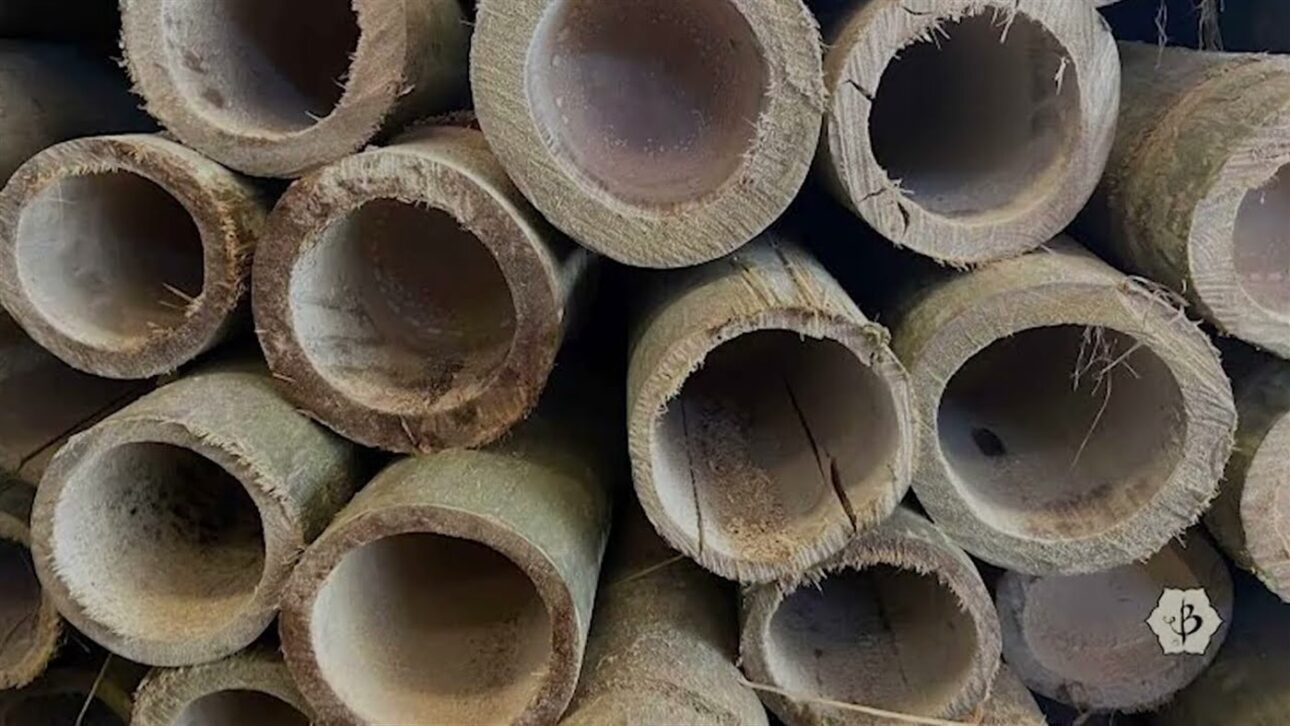
The problem was with the raw culm. According to Snap Shift, natural bamboo is hollow, which makes it difficult to join pieces, it is round, which hinders those working with square beams, and it has inconsistent strength, with one strong culm and another weak one taken from the same plant.
Add to that the cracking and rotting. When receiving a screw or nail, bamboo tends to crack in the middle, and without treatment, it rots quickly and attracts insects, defects that prevented any inspector from approving the plant for a serious construction and earned bamboo the nickname “poor man’s wood,” good for huts but never for the city, as Snap Shift records. It was this label that kept bamboo confined to scaffolding for almost a hundred years.
The idea that changed everything: grind bamboo like flour
The turning point was to stop treating bamboo like wood. According to Snap Shift, instead of cutting the culm into boards, the insight was to treat it as raw material, almost like flour for bread, in a process called bamboo scrimber, or reconstituted bamboo.
The process dismantles the plant to rebuild it better. Machines crush and tear the entire culm along the fibers, in a step called fibrillation, and what comes out looks like loose straw, but when dried, resin-coated, and pressed under extreme pressure and heat, all the defects of bamboo, the hollow, the roundness, the cracking, and the irregular strength, simply disappear, as the Snap Shift channel on YouTube shows. The process utilizes about 80% of the culm, including the crooked parts that would go to waste.
160 and 300 megapascals: stronger than noble wood

The numbers of the reconstituted material are astonishing. According to Snap Shift, high-quality engineered bamboo was tested with compressive strength above 160 megapascals and flexural strength exceeding 300, a performance of noble wood coming from a grass that regrows in less than 10 years.
And the science is not new. The first high-strength version of the material was created in China in 1987, at Nanjing Forestry University, and the chemistry has been improving for almost 40 years, what has changed recently is not the formula, but the ambition to use the material on a massive scale, as Snap Shift points out. The final block can be heavier than water and harder than most woods available today.
7-story building and bridge for trucks
The material has moved from the laboratory to the real construction site. According to Snap Shift, engineers in China have designed and built what is recognized as the first seven-story building made primarily of engineered bamboo, with columns, beams, and slabs of prefabricated pieces, not just wall decoration.
And it didn’t stop with buildings. An engineer working between universities in China and the United States used the same material to erect road bridges strong enough for cars and trucks, and one of them, in the Hunan province, was assembled by a small team in about a week, without heavy equipment, as Snap Shift describes. A bridge made of grass that a truck can drive over is the kind of scene that makes the construction sector stop and take notice.
The national plan and the trillion yuan
China treats bamboo as state policy, not as an experiment. According to Snap Shift, in 2022 the country launched with the International Bamboo and Rattan Organization the initiative “bamboo as a plastic substitute,” and the following year a three-year national plan to scale bamboo in place of high-emission materials like steel and concrete.
The numbers of the plan are gigantic. China holds about one-fifth of all the bamboo in the world, its bamboo forests absorb about 300 million tons of carbon per year just by growing, and the industry aims to be worth 700 billion yuan by 2025 and 1 trillion by 2035, as Snap Shift reports. About two out of every three global manufacturers of structural bamboo are in China, but companies are already emerging in the USA, India, Indonesia, Vietnam, Singapore, and South America.
The honest catch: the resin and the factories
Not everything in this material is pure plant. According to Snap Shift, that dense block is glued with resin, often phenolic, which gives strength and water resistance, but turns the beam into a composite, and there are still questions under study about fire performance, decades-long durability, and the fate of the resin when the building is demolished.
There is also the industrial barrier. Transforming raw bamboo into a structural beam requires factories, fibrillation machines, resin baths, and heavy hydraulic presses, a chain that China took decades to build, and the places that would benefit most from the cheap material are often the ones farthest from the equipment to manufacture it, as Snap Shift ponders. Closing this gap has become less of a science problem and more of an investment, training, and policy issue.
What engineered bamboo means for Brazil


Brazil is sitting on a similar advantage. The country has giant native bamboo species, such as taquara and guadua bamboo, and the documentary itself reminds us that South America is beginning to wake up to the value of bamboo as an export crop and construction material.
The opportunity is both concrete and green at the same time. With an ideal climate for bamboo to grow year-round and a construction industry seeking sustainable alternatives, Brazil could produce engineered bamboo for affordable housing, rural bridges, and lightweight structures, following the path that China has paved, provided it invests in the manufacturing chain that transforms the culm into beams, a context of sustainability and consolidated engineering. From the seven-story building in China to the Brazilian site, the lesson is the same: a grass that regrows before a child finishes school can replace what used to take a lifetime to grow.
The video covers the fibrillation of bamboo, the press that turns it into a reconstituted block, the strength tests, the seven-story building, the Hunan bridge, and the Chinese national plan.
Engineered bamboo proves that the plant specialists ignored for a hundred years can support buildings and trucks. Tell us in the comments: would you live in a seven-story building made of bamboo?