Portuguese
  Spanish


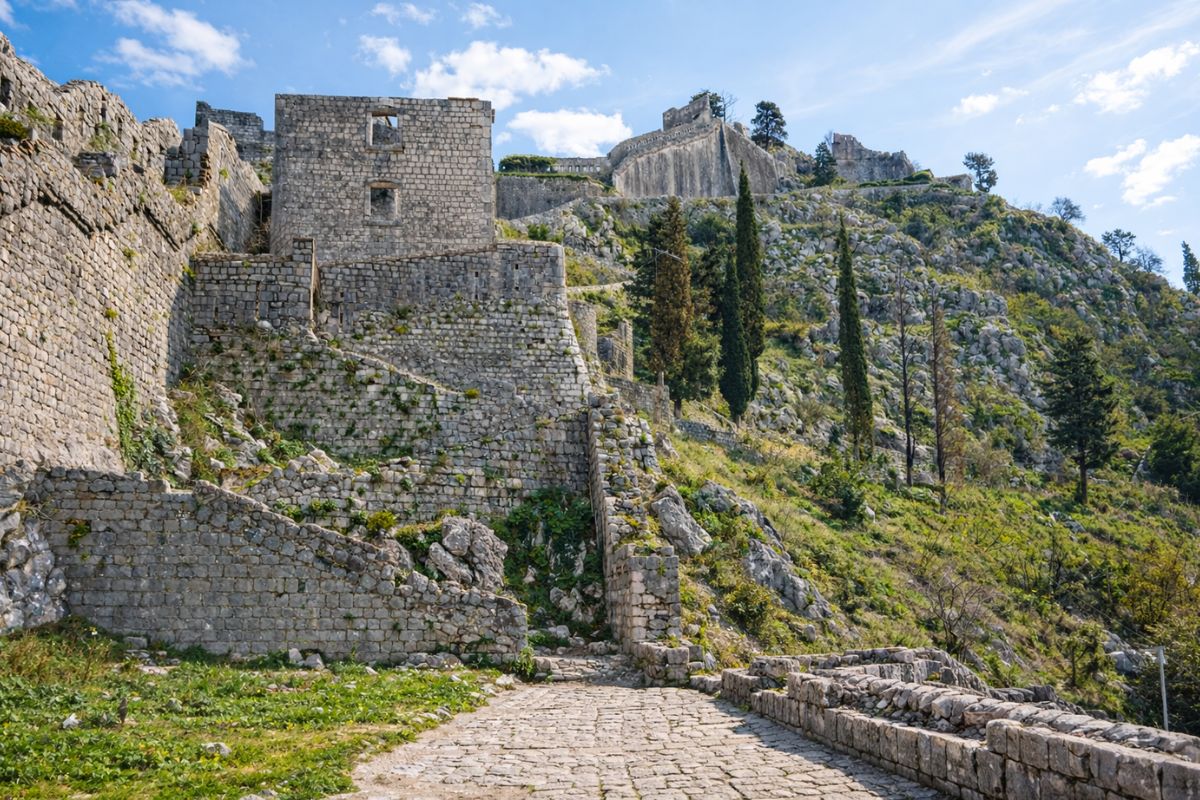

In Kotor, Montenegro, the walls and the drawbridge protect the fortress on Mount San Giovanni and reveal a medieval defensive system
Imagine walking through a medieval town glued to the sea, surrounded by mountains, and realizing that the “castle” is not an isolated building, but a massive set of walls that climbs the slope to a fortress above. This is the case in Kotor, Montenegro, where the walls tell a story of defense, dominance, and strategy.
What is now a promenade and tourist attraction was once a survival system. The walls, the gates, and the elevated position transformed the Bay into a military board, with a wide view to detect danger from afar and close the city when necessary.
Kotor and the castle that is an entire city of walls

Kotor challenges the classic image of a castle. Instead of an isolated fortification, the town functions as a fortified village, with narrow streets, historic mansions, and an entrance leading to an integrated defensive area. The walls are not “next to” the city; they are part of the city itself.
-
Australia Restores 4,450 Dead Trees to the Murray River, Demonstrating River Recovery by Reintroducing Natural Structures Removed by Past Engineering

-
Digestive Health Expert Silvia Gómez Explains How Cold Drinks and Ice Cream Can Slow Digestion and Cause Discomfort in Hot Weather

-
Experts Reveal Surprising Uses for Air Conditioner Drip Water and Common Mistakes to Avoid
-
Brazil’s Paraíba State Builds Senior-Friendly Community with 40 Accessible Homes, Health Center, and Gardens, Replicates Model in 5 Cities, Earns National Merit Award in 2015




Right upon arrival, the narrative highlights the main gate and the feeling of entering a space designed to withstand. It is architecture meant to control passage, protect the population, and at the same time, visually dominate the Bay.
Venetian walls and a defense built over centuries

According to the foundation, the fortifications began during the Byzantine period, around the year 500, but the system we see today took shape between 1300 and 1700.
The Venetian dominance appears as a central piece in this consolidation, with Venice controlling the city from 1420 to 1797.
The logic behind the walls was simple and brutal: those who attacked would have to face stone walls and still climb the mountain, under constant observation. The Bay, viewed from above, becomes a natural corridor, and the walls turn this scenario into a strategic advantage.
Gates, drawbridge, and the mechanism that closed the city

One of the most striking parts of the narrative is the explanation of the gate closure system, with chains, counterweights, and the concept of a drawbridge over water, creating a physical barrier to prevent entry.
The foundation also describes the organization of the accesses: three gates, with the main gate, north gate, and south gate.
In the past, only the main gate held the keys to the city, while the others were used under specific conditions, when the drawbridges were lowered. This shows that the walls were not just a barrier; they were a complete system of movement control.
The climb of 1,000 steps to the fortress on Mount San Giovanni
The most intense experience, according to the foundation, is climbing to the top. There are over 1,000 steps, a demanding walk, but with increasing visual rewards.
At each stretch, the city appears smaller below, the sea enters through the Bay, and the mountains close the horizon like a movie scene.
The most important point is the meaning of this effort. Today it is tourism. In the past, it was defense. The fortress above existed to see any threat in advance, keeping watch over the Bay and approaching routes.
Bay dominated from above and the city as a historical labyrinth

The foundation describes that, viewed from above, Kotor resembles a labyrinth. And this aligns with the medieval logic of protection: streets and accesses that hinder invasion and favor internal control.
Walking along the walls, the narrative emphasizes impressive widths in some sections and the continuity of the system up to higher areas.
There is also the coexistence of past and present: there are residents within the historical perimeter, there are restaurants, markets, and the tourist flow that occupies the space that was once military.
Legends, marks of time, and the curiosity that keeps the place alive
In addition to defensive engineering, the foundation brings legends about the origin of the city, such as the story of a fairy named Alkma who supposedly influenced the first inhabitants to build near the coast.
Even without a guide, the narrative mentions signs, remnants, and details that survive among modernized areas and still rustic points.
This mix helps to understand why Kotor impresses. It is not just “beautiful.” The walls are a physical proof of how the city was shaped by dispute, dominance, and the need for defense, and how this eventually became a visitable heritage.
Would you dare to climb the more than 1,000 steps to see the walls and the Bay from above, or would you prefer to explore the gates and the medieval center down below?