






 Portuguese
  Spanish


Historical deficit in technology helps explain why some degrees remain stronger in the job market, while other careers face greater instability. Health and IT concentrate factors that make professional entry more direct, especially for graduates in areas with persistent demand.
Medicine, Pharmacy, and Information Technology Management are among the courses with the highest employability in Brazil because they combine persistent demand, specific training, and entry barriers that reduce direct competition with professionals from other areas.
In the IV Employability Survey by the Semesp Institute, Medicine leads the ranking, with 92% of graduates working in their field of study; Pharmacy appears with 80.4%, and Information Technology Management, with 78.4%.
The survey, conducted with 5,681 graduates from public and private institutions in all states, shows that health and technology maintain a greater capacity to absorb graduates compared to careers more exposed to broad competition for administrative, operational, or generalist positions.
-
China Tightens Control on Antimony, Driving Prices from $22,000 to Nearly $40,000 per Ton as U.S. Rushes to Bolster Strategic Reserves

-
BlackRock Freezes $1 Billion in Brazilian Renewable Energy, Impacting 1.5 GW of Planned Projects and Highlighting Investor Concerns Over Infrastructure Bottlenecks Cutting Up to 25% of Solar and Wind Generation
-
Labor Shortage: Despite Record Average Salary, 90% of Brazilian Bar and Restaurant Owners Struggle to Hire Key Roles Like Sushi Chefs and Head Cooks

-
Supermarket Deli Counter Attendants in Brazil Could Earn Over $2,100 Monthly by 2026, Plus Benefits Package


In the case of technology, the imbalance is even more visible: Brasscom projected a demand for 797,000 ICT professionals between 2021 and 2025, with an annual average of 159,000 vacancies and the training of about 53,000 people per year.
Why health and technology employ more
The high employability in these careers does not occur only due to social prestige or the promise of good salaries.
Medicine and Pharmacy require a recognized diploma and active professional registration for legal practice, which creates a formal funnel between training, qualification, and hiring.
In Medicine, registration with the Regional Medical Council is indispensable to practice as a doctor.
In Pharmacy, professional practice also depends on registration with the pharmacy council system, especially in technical, clinical, hospital, industrial functions, and responsibility for establishments.
Technology, on the other hand, does not operate with an equivalent professional council for all functions, but it has another decisive factor: demand grows faster than training.
Banks, retail, industry, health, education, and government companies compete for professionals capable of developing systems, protecting data, maintaining infrastructure, and automating processes.
This technical specificity limits simple substitutions.
A doctor cannot be replaced by a bachelor from another field in a clinical setting, just as a pharmacist cannot be freely substituted in the technical responsibility of a pharmacy, and a back-end developer is not interchangeable with a professional without training or experience in programming.
Medicine leads employability ranking
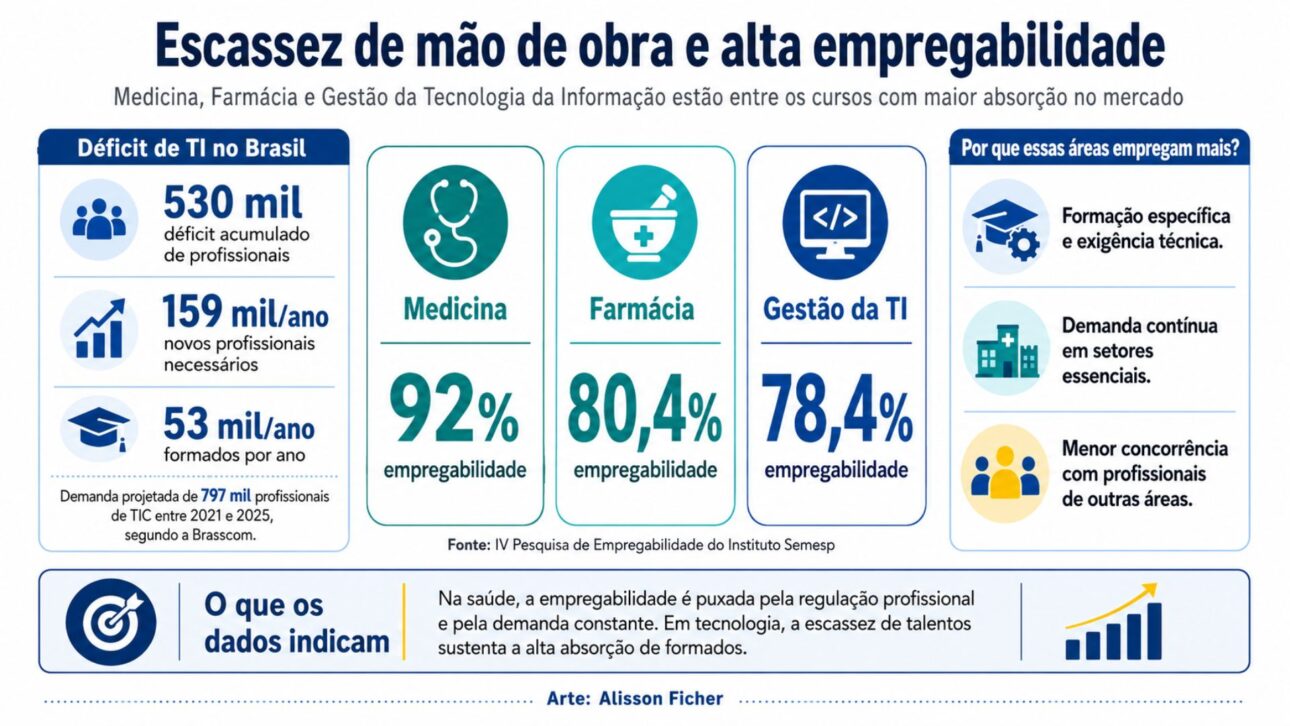
Medicine occupies the first position in the employability ranking, with 92% of graduates working in their field of study, according to the Semesp Institute.
The result reflects a highly regulated career, with demand in hospitals, basic units, clinics, laboratories, health operators, and public services.
The 2024 Medical Demography, released by the Federal Council of Medicine, indicated 575,930 active doctors in Brazil in January of that year, equivalent to 2.81 professionals per thousand inhabitants.
Despite the growth in the total number of doctors, regional distribution remains unequal, with a higher concentration in capitals and in higher-income regions.
However, the training is the longest and most expensive among the three areas analyzed.
The undergraduate course lasts at least six years and, for those seeking specialization, medical residency can add two to five years of dedication, depending on the chosen area.
The resident doctor is entitled to a minimum scholarship of R$ 4,106.09, as informed by the Ministry of Education.
Since residency requires intense hours, balancing it with another regular career, such as teaching in a public school, tends to be practically limited.
Outside of residency, newly graduated doctors can work in shifts, primary care, clinics, and emergency services, but the values vary according to region, type of contract, hours, and sector.
Therefore, salary estimates need to be read with caution, especially when mixing CLT hiring, legal entity, shifts, and temporary contracts.
Pharmacy combines regulation and broad market
Pharmacy appears in second place in the ranking, with 80.4% employability in the field of study.
The career benefits from professional regulation, the national presence of pharmacies and drugstores, the growth of pharmaceutical clinical services, and performance in hospitals, laboratories, distributors, and industry.
The Federal Pharmacy Council reported in 2025 that the country has nearly 400,000 pharmacists, distributed across different sectors of activity.
The entity also points to the expansion of recognized areas and the existence of more than 140 specializations, which helps explain the diversity of professional paths.
Pharmaceutical retail continues to be one of the main entry points for recent graduates.
Market estimates indicate an initial salary generally in the range of R$ 3,000 to R$ 4,000, with significant variation by state, collective agreement, company size, and work schedule.


A survey of collective agreements cited by Panorama Farmacêutico in January 2026 showed state salary floors between R$ 3,465.76 and R$ 6,416.23, which reinforces the regional difference within the same profession.
Salary data based on Caged, private platforms, and job advertisements should be compared carefully, as each source uses its own methodology.
For Chemistry or Biology teachers, Pharmacy may have greater curricular overlap than Medicine and require less financial investment.
Even so, the return depends on the institution, the city, the type of employment, and the area chosen after graduation.
Information Technology has a structural deficit
Information Technology Management appears with 78.4% employability, but the most relevant data is the size of the mismatch between demand and training.
Brasscom estimated that Brazil would need 159,000 ICT professionals per year between 2021 and 2025, while training about 53,000 people annually in technology-related courses.
This deficit helps explain why many technology students secure internships, junior positions, or employment before completing the course.
The demand spreads across software development, data, cloud, information security, networks, infrastructure, specialized technical support, and digital project management.
The Robert Half 2026 Salary Guide points to technology as one of the areas monitored in its salary projections and hiring trends.
According to the consultancy, the salaries listed in the guide are based on professionals connected by the company to employers in Brazil, in addition to research conducted by an independent company for non-salary data.
For those already working as teachers, higher education technology courses may be more compatible with the professional routine.
Many have a shorter duration than traditional bachelor’s degrees, lower tuition fees, and strong adherence for teachers of Mathematics, Physics, Computer Science, or related areas.
High employability does not guarantee a high salary at the beginning
The comparison between Medicine, Pharmacy, and Information Technology shows that employability and initial remuneration do not mean the same thing.
A course can open doors quickly and still offer a lower entry salary than another with similar employability.
Pharmacy is the most evident example.
The employment rate in the area is high, but the initial remuneration is usually lower than some technology positions and very distant from the possible earnings in Medicine, especially after specialization or working on shifts.
In IT, the entry cost can be lower, but progression depends on portfolio, practical experience, certifications, English, technical mastery, and the ability to constantly update.
Medicine requires a longer and more rigid investment, while Pharmacy occupies an intermediate position in terms of training time, cost, and remuneration.
Data shows differences between the three careers
The three courses appear at the top of employability for different reasons.
Medicine has strict regulation, continuous demand, and strong professional barriers; Pharmacy combines legal requirements, retail capillarity, and expansion of fields of activity; Information Technology responds to a talent shortage that spans practically all sectors of the economy.
The decision to migrate to one of these areas, especially for those already working in the public education network, requires comparing course duration, total cost, the possibility of studying without giving up current income, probable initial salary, and the time needed to achieve better financial return.
It is also important to note that the available research uses different methodologies.
The employability of Semesp measures performance in the area of training, while salary surveys from consultancies, private platforms, and formal employment databases portray different market segments.


