Portuguese
  Spanish


Swimming crab found alive inside a plastic bottle near Okinawa reveals how common debris can become permanent traps for small marine animals
A swimming crab found alive inside a plastic bottle in the sea, near Okinawa, Japan, caught the attention of researchers from Hiroshima University.
The case revealed a still little-known effect of plastic pollution in the oceans: small debris can turn into permanent traps for marine animals.
The episode was recorded in July 2022, during a scientific expedition near Sesoko Island. The results were published in April 2026 in the scientific journal Ecosphere.
-
Esperanza’s Bamboo Barrier in Oaxaca Redirects River and Reduces Erosion by 85% in Five Years

-
Family Builds Homemade Wind Turbine to Power Off-Grid Home, Video Reaches 555,000 Views on Ngô Thị Huyền’s Channel
-
Indian Brand Creates Sneakers from Recycled PET Bottles and Discarded Tires, Repurposing Over 1 Million Bottles and Raising $4 Million for Expansion

-
Brazilian Innovator Uses 3D-Printed Device to Cool Two Rooms with One Air Conditioner





Animal entered young into the bottle and grew until it couldn’t get out
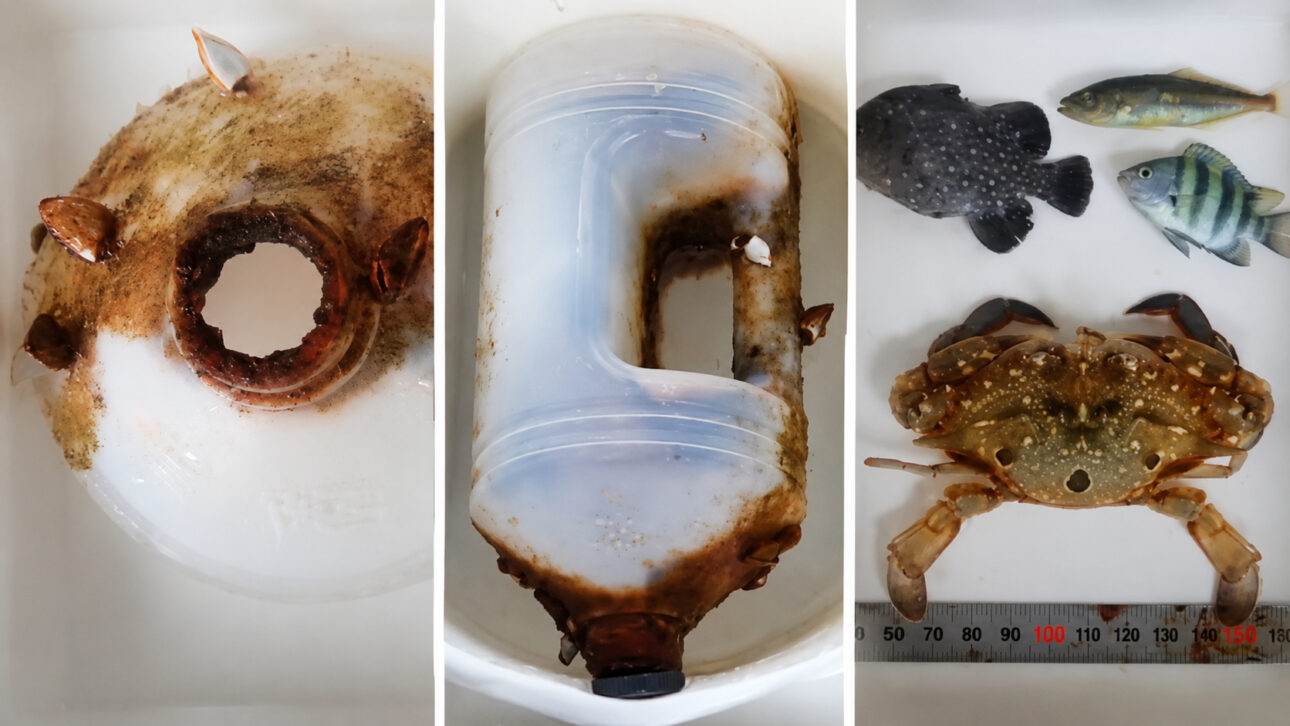
During a survey of juvenile fish, the researchers found a Shaoxing wine bottle made of high-density polyethylene, known as HDPE.
The container was floating on the sea surface, about 500 meters from Sesoko Island, in Okinawa.
Upon collecting the bottle, the scientists noticed that there was a large live crab inside it.
The opening of the packaging was only 24 millimeters. The animal, however, measured 88.23 millimeters in carapace width.
Additionally, the crustacean was 40.31 millimeters long and weighed 42.06 grams.
Therefore, it was necessary to cut the bottle to remove the animal.
According to the researchers, the crab probably entered the container while still young. Then, it continued to grow until it became too large to escape.
Stomach DNA showed how the crab survived
To understand how the animal survived for so long, the team analyzed the stomach contents using DNA metabarcoding.
Fragments of scales, small bones, remains of juvenile fish, and algae were found.
The analyses indicated that the crab fed on triggerfish, of the species Canthidermis maculata.
There were also signs of Indo-Pacific sergeant, Abudefduf vaigiensis, or a very similar species.
Additionally, researchers identified Ulva compressa and Myrionema strangulans algae, which likely grew inside the bottle itself.
With this, the authors concluded that the animal survived by capturing juvenile fish that entered the container and consuming available algae.
Study estimated about 62 days adrift in the ocean
Scientists used two main clues to estimate the time of entrapment.
The first was the known growth rate of the species. The second was the presence of 159 Lepas anserifera barnacles attached to the outside of the bottle.
The largest barnacle measured about 20.7 millimeters. Considering the average water temperature of 28.1 °C, the researchers calculated approximately 62 days adrift.
This period coincided with the estimated time for the crab to grow from the size needed to enter the container to the observed dimensions.
Crab remained healthy but lost the chance to reproduce
Despite the confinement, the animal showed no signs of malnutrition.
On the contrary, its weight was above what was expected for individuals of the same species.
Additionally, examinations showed that the crab was of a size compatible with sexually mature females.
Its ovaries also showed developing oocytes.
Even so, survival did not represent an ecological advantage.
Trapped inside the bottle, the animal could not return to the natural environment, find partners, or reproduce.
Thus, its reproductive success was practically nullified.
Plastic pollution can create invisible traps in the sea
For the authors, the case shows that plastic bottles and other floating debris can function as permanent traps for small crustaceans.
This impact receives less attention than cases involving turtles, seabirds, seals, and other large animals affected by plastic.
However, according to the study, small organisms also suffer severe effects, even if less visible.
Researchers remind us that HDPE bottles can remain intact for decades in the marine environment.
This increases the chance of similar episodes occurring in the oceans.
Case recalls Japanese tale about trapped animal
In the introduction of the study, the scientists compared the episode to the tale “The Salamander,” by Japanese writer Masuji Ibuse.
In the story, a salamander grows so much inside its burrow that it becomes unable to leave.
In the case observed in Okinawa, however, the trap was not natural.
It was a plastic bottle discarded by humans.
The episode highlights how seemingly common waste can have unexpected consequences for marine life.
Moreover, it shows the impressive survival capability of the crab during the period it remained trapped.
In light of this case, how many other small marine animals might be trapped in plastic waste without anyone noticing?