






 Portuguese
  Spanish


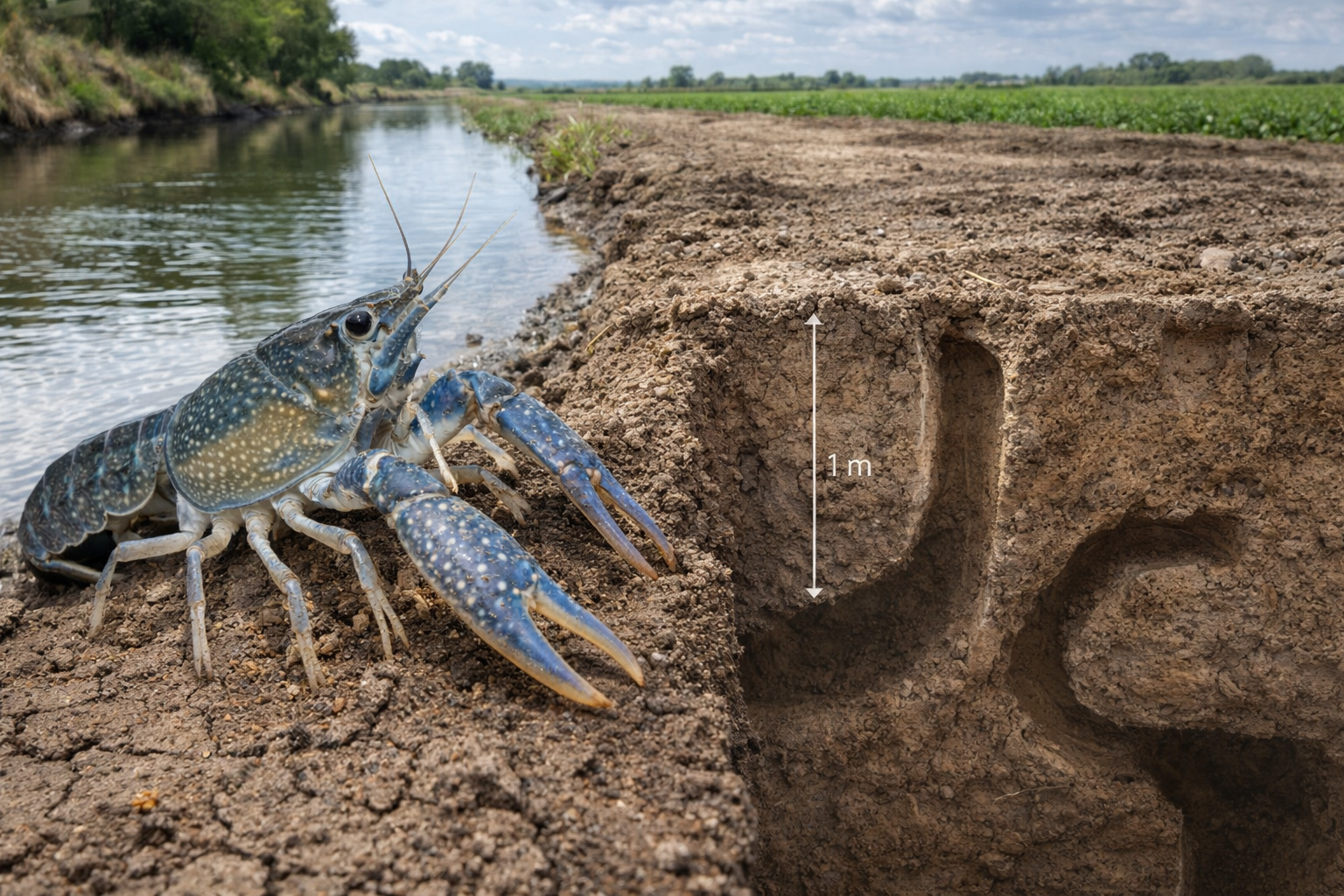


The Yabby Crayfish Digs 1-Meter Tunnels, Survives Drought, and Alters Rivers as It Expands with Agricultural Irrigation; Researchers Warn of Ecological Impacts in Australia and Europe.
It is not a fish in the biological sense — it is a crustacean — but it behaves like a “subterranean fish” to those observing the ecology of Australian rivers: it lives in water, breathes through gills, colonizes beds, competes for space with native fish, and alters the watercourse by digging deep tunnels in the soil. We are talking about the Cherax destructor, commonly known as the Yabby, a freshwater crayfish native to Australia that is drawing the attention of hydrologists, ecologists, and environmental authorities.
What makes the Yabby so unique — and at the same time so problematic — is the combination of ecological engineering, water resistance, and silent expansion, a rare evolutionary package for a freshwater animal. It not only survives the temporary end of rivers (something unthinkable for conventional fish), but also digs galleries up to 1 meter deep, altering drainage, retaining water underground, and creating tunnel networks that directly interfere with the hydrological behavior of streams, ponds, and agricultural channels.
Yabby: Extreme Drought Tolerance and Ability to “Disappear” into the Ground
The Yabby is native to semi-arid and arid regions of Australia, where torrential rivers disappear for part of the year. This has led the animal to develop a survival mechanism that intrigues researchers: when the water dries up, it digs tunnels until it reaches moisture, entering a state of low metabolic activity. In practice, this means that the Yabby:
-
Detectorist found a 900-year-old silver coin

-
A newly discovered caterpillar in Hawaii wears the remains of its prey that it devoured as a macabre armor, stitching bones and insect shells to its own back for camouflage.

-
She heard for decades that space was not a place for women, became a pioneer in aviation, was part of the Mercury 13, and at 82, finally traveled with Jeff Bezos before dying at 87.
-
Scientists investigate microplastics in the airways of patients with sleep apnea and reveal a new focus for research on environmental pollution, human exposure, and possible impacts on breathing quality.



- Survives for weeks or months without rain
- Remains buried away from the sun
- Resumes its normal cycle when the water returns
This behavior has been documented by Australian scientific institutions, including CSIRO (Commonwealth Scientific and Industrial Research Organisation) and studies published in journals like Aquatic Conservation. This is one of the reasons why the Yabby is informally called the “fish that disappears in the ground”.

Tunnels of Up to 1 Meter: Direct Impact on Hydrology and Erosion
The Yabby’s tunnels primarily serve to maintain a film of water around the gills and prevent dehydration. However, for environmental engineers, the problem is different: tunnels connect shallow aquifers, alter drainage flows, and weaken riverbanks, especially in irrigated agricultural areas. Hydrologists warn of effects such as:
- Bank Erosion
- Pond Collapse
- Loss of Small Dams
- Water Turbidity
- Involuntary Subterranean Channelization
These impacts have already been observed in irrigation systems in the interior of Australia, where channels that functioned perfectly began to exhibit invisible water losses attributed to networks of tunnels made by Yabbies.
Agriculture and Irrigation Accelerate the Expansion of the Yabby
Interestingly, what is driving the expansion of this animal is not only its natural behavior but also a human activity: agricultural irrigation. The expansion of the Yabby follows this cycle:
- Artificial channels and reservoirs are built
- Constant water creates ideal microhabitats
- Yabbies quickly colonize
- Tunnels begin to appear
- The water system alters without warning
In Australia, irrigation has transformed areas that were originally desert into habitable zones for the crustacean. The result is that the species is advancing toward regions where it never existed, either through natural displacement or via human activity (such as water transport, boats, equipment, and even recreational fishing).
From Australia to the World: How the “Fish of the Land” Reaches Europe
Another point of concern is the international expansion of the Yabby, especially to Europe, where there are already records of established populations. Countries like Spain, Italy, and Germany have reported sightings of the Yabby in lakes and rivers where native fish and local crustaceans do not possess evolutionary mechanisms to compete with the invader. What makes the species an ecological risk outside of Australia is the combination of:
- Rapid Growth
- Efficient Reproduction
- Subterranean Capability
- Thermal Tolerance
- Absence of Local Predators
In other words, the Yabby gathers typical characteristics of successful invasive organisms.
Ecological Impact: From Trophic Imbalance to Species Replacement
In ecosystems where the Yabby settles, researchers report impacts such as:
- Competition for shelter with native fish
- Predation of eggs and larvae
- Increased turbidity affecting filter feeders
- Alteration of underwater vegetation
- Reduction of amphibian and macroinvertebrate species
The cumulative impacts lead hydrologists and ecologists to use a strong term: invasive ecological engineering, as the Yabby is not just a predator or competitor — it alters the physical environment, influencing who can or cannot survive there.

Why Is It Confused with a “Fish”?
When environmental headlines use the term “fish,” the intention is not taxonomic but ecological. The Yabby:
- Lives in rivers
- Breathes through gills
- Is present in the aquatic food chain
- Competes for space with native fish
- Is caught and consumed as fish in some places
From an environmental impact perspective, it occupies the same niche as many invasive fish, such as carp, African catfish, and snakehead fish. For this reason, its study is often compared to that of fish, and its presence alters hydrology and fishing, which brings it closer to the fishing domain.
Monitoring, Research, and Control Strategies
Australia and some European countries are already discussing measures for control and monitoring, such as:
- Population Tracking
- Physical Barriers in Channels
- Watering Monitoring
- Control of Equipment Movement
- Awareness Campaigns
Researchers highlight that total eradication is unlikely, as the Yabby can seal itself in tunnels and survive long periods out of sight of controllers.
An Animal That Forces the World to Rethink Water, Invasions, and Agriculture
The Yabby is not just a biological curiosity. It is a warning sign about how climate change, irrigation, and agriculture are redefining who inhabits our rivers — and how “fish” can exist far beyond the water.
For dry countries with intensive agriculture, the advance of the Yabby represents:
- Hydrological Risk
- Ecological Risk
- Agricultural Risk
- Economic Risk
And, at the same time, a scientific opportunity to understand a world where water is intermittent and subterranean ecosystems gain strategic importance.






If you tried to eradicate the yabbi in Australia it would just create another ecological disaster as all our native animals have a purpose in this beautiful ecology.
Make good eating, easy to catch, easy to cook, crayfish salad, lovely.
El cangrejo es un crustáceo!