






 Portuguese
  Spanish


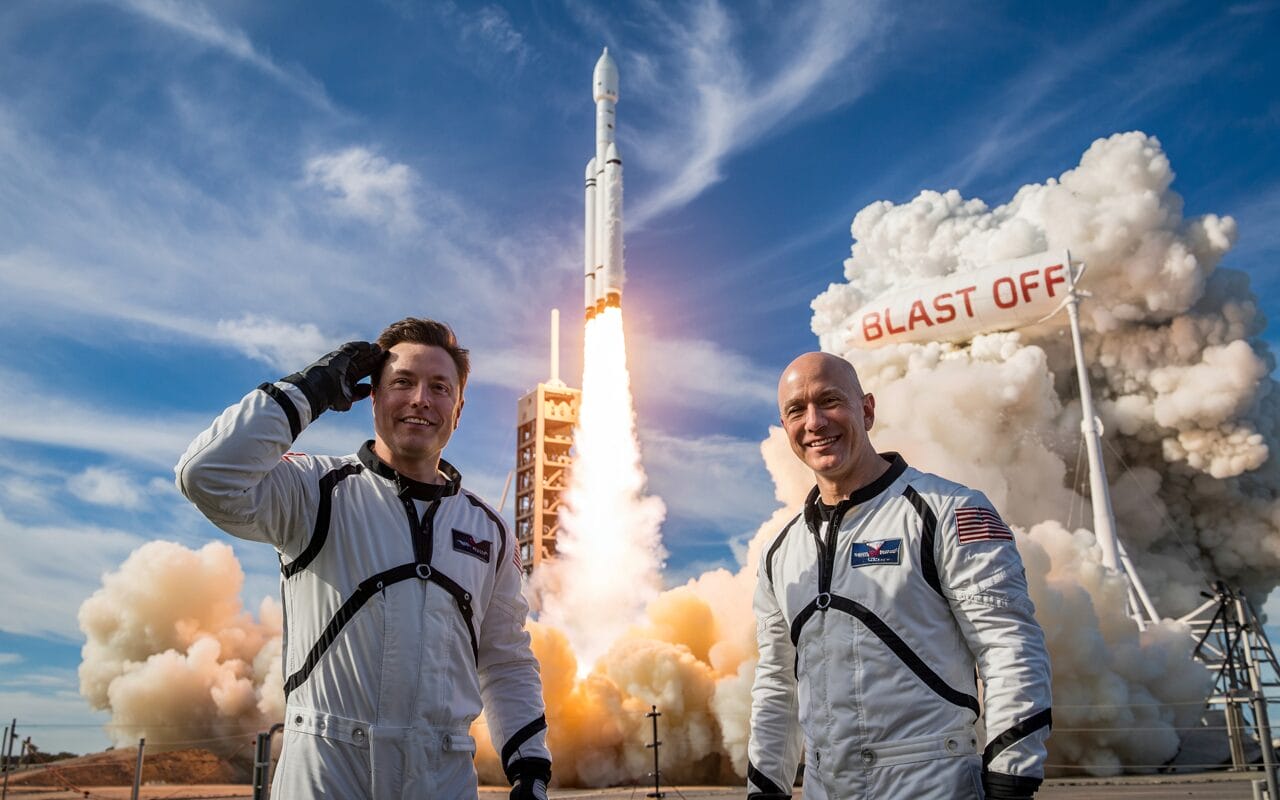


With a cost that can exceed US$ 8 million per minute, every second of a space launch becomes an event of extremely high value. Even for billionaires like Elon Musk and Jeff Bezos, the challenge is not just technological, but also financial. Discover why putting a rocket in space costs so much — and what is being done to change that.
Launching a rocket costs up to US$ 8 million per minute and is not just a matter of pressing a button. Behind each liftoff are years of planning, teams of engineers, hundreds of sensors, rigorous testing, and tons of fuel. According to data from NASA, SpaceX, and ULA, the average cost of an orbital launch ranges from US$ 62 million (in the case of SpaceX’s Falcon 9) to over US$ 500 million (like the rockets from the former Saturn V mission).
Some launches cost up to US$ 8 million per minute of flight, considering from the ignition of the engines to the end of the mission. This includes:
- Fuel (such as liquid oxygen and RP-1 or liquid hydrogen)
- Transportation logistics
- Security teams
- Ground control
- Mission insurance
- Reusability (when applicable)
Every Second Is Gold: A Race Against Time (and Money) Understand How Launching a Rocket Costs Up to US$ 8 Million Per Minute


If we divide the total cost of a US$ 80 million launch by a 10-minute mission to orbit, each second costs approximately US$ 133 thousand. This amount includes all the technological, safety, and logistical support apparatus.
-
Plastic Waste from Beaches and Poor Communities in Kenya Transformed into School Desks, Replacing Wood in Classrooms and Turning Marine Litter into Durable Study Tables

-
Your Old Gmail Address Might Be Obsolete Soon: Google Introduces Feature Changing Account Usage.

-
Lost Fossil Found in Brazil Unveils 240-Million-Year-Old Reptile Predating Dinosaurs, Redefines Evolutionary Map and Highlights Southern Brazil’s Role in Understanding Crocodile and Dinosaur Ancestors

-
China to Drill 15 Kilometers into the Earth, Set to Break Russia’s Record for Deepest Man-Made Hole


This means that any delay, even for seconds, can represent million-dollar losses, not to mention the technical risks.
That’s why private companies like SpaceX and Blue Origin operate under extremely strict schedules and minimal margins for error. Any sensor failure, unexpected wind, or technical problem can delay the launch — and multiply costs.
Elon Musk, Jeff Bezos, and the Space Economy Dilemma
Elon Musk, CEO of SpaceX, has stated multiple times that the main goal of his company is to drastically reduce the cost per launch. “We want to make space accessible. This will only be possible with reusable rockets and mass production,” he said in an interview with MIT Technology Review.
Today, SpaceX charges about US$ 62 million per launch of the Falcon 9, but there are estimates that this amount will decrease to less than US$ 30 million with future versions of the Starship, the rocket designed to take humans to Mars.
Jeff Bezos, founder of Amazon and Blue Origin, invests billions in his New Shepard project focusing on suborbital tourism. The flight lasts only 11 minutes — and it is estimated that each ticket could cost between US$ 200 thousand and US$ 500 thousand per person. In other words, the cost per minute exceeds US$ 45 thousand per passenger.
Elon Musk has expressed concerns about the high costs of space launches and has been actively working to reduce them. He stated that he is “highly confident” that SpaceX’s Starship rocket launches will cost less than US$ 10 million in the next two to three years. Musk also mentioned that in the future, the cost per launch could be just a few million dollars, or even as low as US$ 1 million per flight, which would represent a significant reduction from current launch costs that can exceed US$ 60 million per mission.
Main Components That Increase the Cost of a Space Launch
- Propulsion
- Fuel accounts for up to 70% of the total launch cost. RP-1 (rocket kerosene) and liquid oxygen are expensive and require cryogenic storage.
- Rocket Structure
- Even with composite materials and aerospace aluminum, manufacturing the airframe is still expensive, especially for disposable rockets.
- Onboard Technology
- Onboard computers, sensors, navigation systems, and thermal shields cost millions. The Crew Dragon capsule’s escape system, for example, alone represents tens of millions.
- Safety and Logistics
- Each launch involves hundreds of professionals: technicians, meteorologists, engineers, airbase personnel, journalists, and controllers.
- Insurance
- Any orbital mission is insured for amounts reaching US$ 500 million, depending on the type of cargo and destination.
How Much Does a Launch Cost with Different Rockets?
Here is an average estimate of launch costs:
| Rocket | Manufacturer | Cost Per Launch (Estimated) | Cost Per Minute of Flight |
|---|---|---|---|
| Falcon 9 | SpaceX | US$ 62 million | US$ 6.2 million |
| Starship (Future) | SpaceX | US$ 10 to 20 million (Estimated) | US$ 1.5 to 3 million |
| SLS | NASA | US$ 4.1 billion | US$ 273 million |
| New Glenn | Blue Origin | US$ 500 million (Estimated) | US$ 50 million |
| Electron | Rocket Lab | US$ 7.5 million | US$ 750 thousand |
Source: FAA, SpaceX, Blue Origin, Rocket Lab, NASA (2024-2025)
The Cost of Time in Space: Beyond Launch
It’s not just the launch that is expensive. The time in space also weighs on the wallet — and the calculations. This is because:
- Every second in orbit costs energy, especially to maintain life (in stations like the ISS)
- Communication or military satellites are worth billion dollars, and any delay in activation can mean loss of contracts or coverage of critical areas
- In manned flights, life support (oxygen, food, temperature) needs to be maintained without fail
According to estimates from NASA, keeping an astronaut on the ISS costs about US$ 7.5 million per day. This includes transportation, food, scientific experiments, communication, and technical support. In other words, every minute of human presence in space exceeds US$ 5,000.
Space Tourism: A Race That Is Also Billionaire
Companies such as Virgin Galactic, SpaceX, and Blue Origin have already conducted the first space tourist flights. But this leisure is not for everyone. Prices range between:
- Virgin Galactic: US$ 450 thousand per suborbital flight
- Blue Origin: US$ 200 thousand to US$ 500 thousand
- SpaceX Crew Dragon (orbital flight): up to US$ 55 million per person
In these missions, the flight time can last from 11 minutes up to 3 days, meaning that each second is among the most expensive ever experienced by a human being.
How to Reduce Costs? Reusability and New Technologies
The key to reducing costs lies in two pillars:
Reusability
- Rockets like the Falcon 9 and the future Starship land back on Earth and can be used again, like airplanes. This drastically decreases the cost per launch.
- Blue Origin also reuses its New Shepard vehicle.
3D Printing Technology
- Companies like Relativity Space already print 90% of their rockets with industrial 3D printers, saving time and resources.
Launches from the Stratosphere
- Projects like SpaceShipTwo (Virgin Galactic) start the journey in aircraft that climb up to 15 km, before releasing the rocket. This reduces fuel expenditure at launch.
The Economic and Scientific Impact
Despite the high cost, the benefits of launching rockets into space are incalculable:
- Climate Monitoring
- Global Satellite Internet (like Starlink)
- National Defense and Security
- Scientific Exploration
- Asteroid Detection
- International Cooperation
Additionally, the aerospace sector generates over US$ 500 billion annually, according to the Space Foundation. By 2030, this figure could exceed US$ 1 trillion, primarily driven by lunar exploration, missions to Mars, and constellations of commercial satellites.
Every Second in Space Costs Millions — But It’s Worth It
Launching a rocket costs up to US$ 8 million per minute, and even billionaires like Elon Musk and Jeff Bezos know that this price needs to drop to make the future of space viable. However, every second marked on a mission’s clock represents not only a financial investment but humanity’s advancement towards new frontiers.
Slowly, costs have been decreasing. But until then, space will continue to be one of the costliest, most challenging, and fascinating environments in the known universe.


