Portuguese
  Spanish


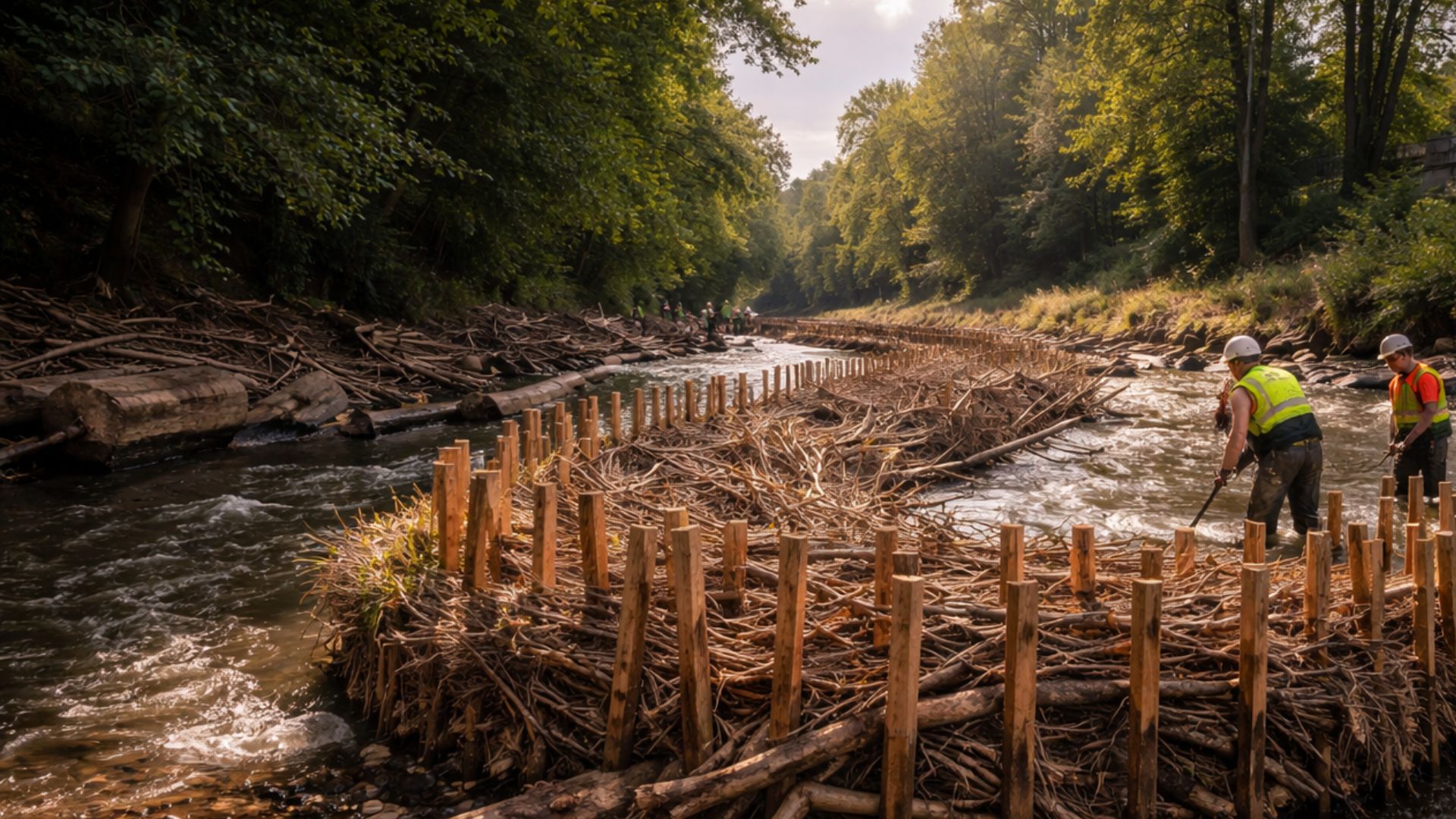

Restoration Intervention in London Uses Branches, Stakes, and Wood to Reorganize the Flow of the Beverley Brook, Stimulate Sediment Deposition, and Recreate Natural Banks. Project Changes the Dynamics of 1.25 km of Urban River, Expands Habitats and Reintroduces Ecological Processes Previously Lost Due to Historical Canal Rectification.
A section of 1.25 kilometers of the Beverley Brook, in southwest London, underwent restoration that replaced rigid solutions with structures made of branches and wood to reorganize the watercourse itself.
During the intervention, 34 branch berms were built with over 1,200 sweet chestnut stakes, in a setup that occupies about 1,200 square meters and includes more than 520 meters within the channel.
The project was led by Barnes Common Limited, through Barnes Conservation, with support from the Rewild London Fund.
-
Man Spends Weeks Clearing Overgrown Land, Faces Equipment Failures, and His Story on Scott Harrison’s Channel Reaches 94,000 Views

-
Engineer Builds Star Farm Resort on $250,000 Plot Near U.S. National Park, Projected to Reach $6 Million Value by 2030
-
In the Amazon Flood Season, Life Transforms: Riverside Family Near Parintins Relies on Fishing Nets, Stingrays in the Yard, and Canoe-Only Transport
-
Man Converts Water Tank into $20,000 Luxury Boat, DIY Video Reaches 571,000 Views on World Tech Channel

According to the organization, the goal was to recover natural processes in a historically altered river, creating more variation in depth, speed, width, and shelter areas in a stretch that had lost physical and ecological diversity over time.
How Branch Berms Change the River Flow
The central point of the project lies in how the berms act within the bed.
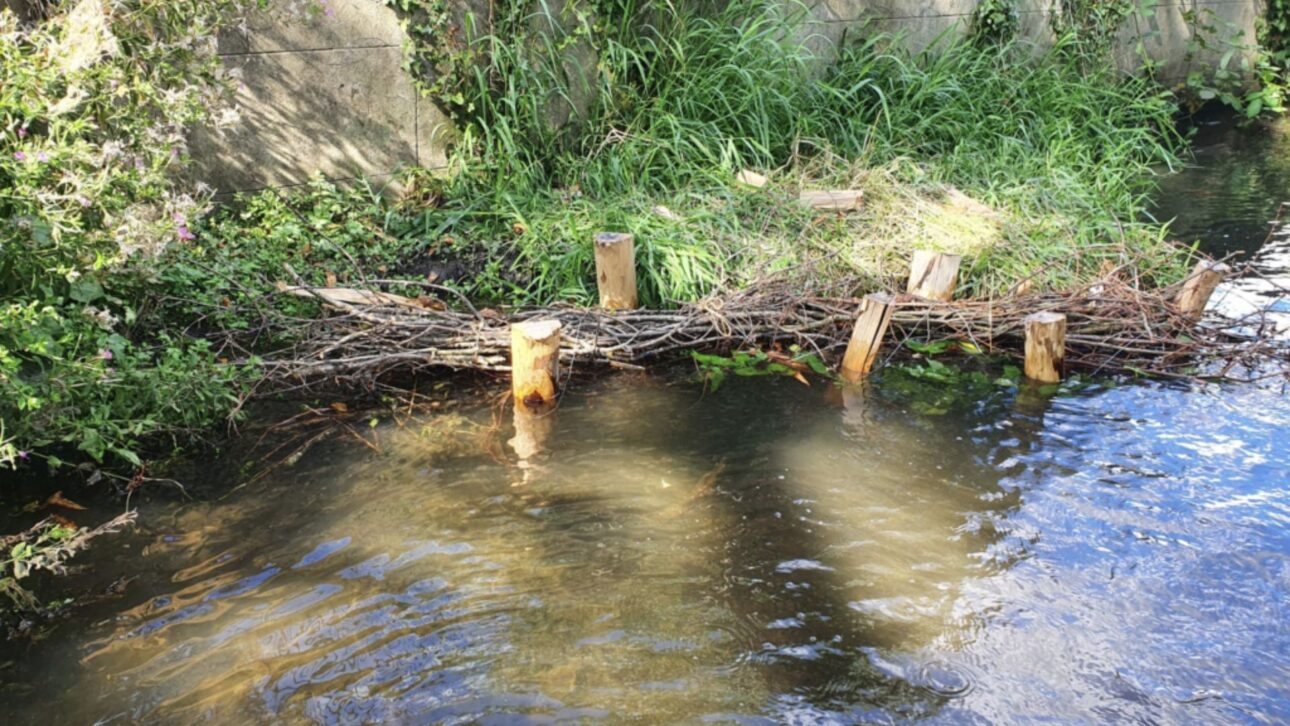
Instead of containing the water with hard edges, the structures work as dense filters.
The current flows more slowly past these obstacles, depositing suspended sediments while simultaneously eroding other points of the bottom, which helps expose previously covered gravel.
Over time, this accumulated material forms a favorable base for the growth of riparian vegetation.
In practice, sediment is no longer treated solely as excess carried by the current, and takes on a constructive role.
The river begins to redraw small internal edges, create shallow areas, and increase the heterogeneity of the channel without relying solely on heavy engineering.
The logic of restoration stems precisely from this attempt to return dynamism to a watercourse that had been simplified.
This design was complemented by the installation of 81 large woody trunks within the channel.
The material amounts to over 400 meters of large wood, in addition to 80 meters of bundles of branches.
More than 200 meters of old wooden embankments were also removed, over 4 tons of waste were cleared, and 6 tons of local gravel were added to the watercourse.
The execution totaled 944 hours of volunteer work, according to the update released by the responsible organization.
History of the Rectification of the Beverley Brook
The Beverley Brook is about 14.3 kilometers long and flows through areas such as Wimbledon Common, Richmond Park, Barnes Common, and Putney Lower Common before emptying into the Thames.
Information gathered by environmental organizations indicates that nearly the entire river has been modified at some point.


Sections have been widened, deepened, rectified, or confined, which reduced the habitat complexity along the channel.
In this sector between Upper Richmond Road and the edge of Richmond Park, the restoration sought to confront this history of standardization.
Reports from Barnes Common indicate that the more winding route was previously replaced by a straighter, controlled configuration.
By reintroducing berms, wood in the bed, and vegetation management, the project attempts to reinstate erosion and deposition mechanisms that shape banks, curves, and shallow zones in less artificial rivers.
The City of London stated, when announcing projects funded by the rewilding fund, that the initiative in Palewell Beverley Brook aimed to encourage natural processes along the waterway.
The plan was also presented as a way to enhance habitats for insects, fish, bats, and birds.
In addition, the intervention seeks to enhance ecological connectivity between Richmond Park National Nature Reserve and Barnes Common Local Nature Reserve.
Vegetation, Wood, and New Micro-Habitats in the Canal
Another important aspect of the restoration was the management of vegetation along the banks.
Barnes Common reported that invasive tree species were removed and that light entry was increased in several points along the water corridor.
Some of the woody material resulting from this work was repurposed within the canal itself.
This wood helps diversify the flow of water and create new micro-habitats.
The change has a direct effect on the occupancy of the riverbanks.
With less excessive shading and the gradual formation of new fine sediment surfaces over the berms, the possibility of establishing marginal and semi-aquatic vegetation increases.
Before the intervention, this type of vegetation was limited in several stretches due to the slope of the banks and the lack of suitable areas for rooting.
There was also a specific focus on fauna.
The project update records the installation of 16 bat boxes and two tree sparrow boxes.
In addition, more than 30 cavities in trees were opened to increase the availability of shelter.
Also, 15 willows and three alders were planted, with plans to strengthen the marginal aquatic vegetation as the berms accumulate more sediment.
Scientific Monitoring Tracks the Evolution of the River
The intervention was not treated as a finished project at the time of installation.
According to project leaders and local authorities, the site continues to be under continuous environmental monitoring.
Among the methods used are acoustic surveys, SmartRivers program research, electrofishing, and studies of emerging invertebrates.
The intention is to verify how the reorganization of the channel affects habitat quality and fauna response over time.
This monitoring is relevant because the expected outcome is not a more uniform or visually “tidied” river.
The goal is precisely to create a more irregular system, with contrasts in current, depth, and substrate within a few meters.
In healthy rivers, this variety supports different niches for fish, insects, and plants.
This type of diversity tends to disappear when the bed is transformed into a predictable and homogeneous channel.
In recent years, the Beverley Brook has already received other recovery actions in different sections.
Records from environmental organizations indicate previous work that helped improve the flow diversity and expose cleaner gravels for fish in parts of the watercourse.
In the case of East Sheen and Palewell, however, the extensive use of branch berms drew attention for demonstrating how simple materials can induce significant geomorphological changes even in a densely populated urban environment.
More than a one-time intervention, the project has come to be viewed as an example of an approach that seeks to work with the natural energy of the river.
Instead of nullifying current, sediment, and erosion, the restoration utilizes these processes to rebuild new living banks, create space for vegetation, and restore ecological complexity to a stretch that has been excessively controlled for decades.