Portuguese
  Spanish


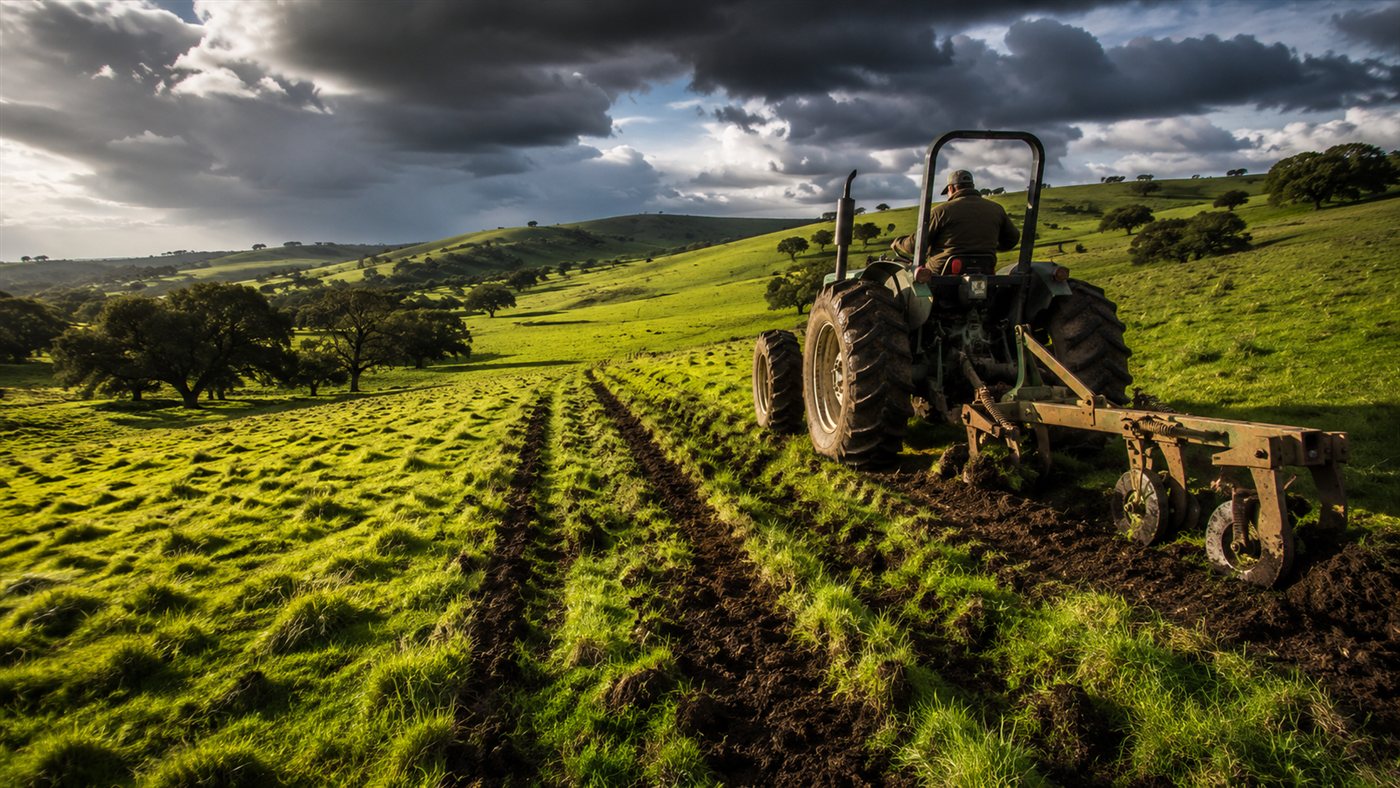

A tractor dragging blades that tear up the pasture seems the opposite of regenerative agriculture, and that’s exactly the provocation. According to the Symbiosis TX channel, in a 15-minute video published on March 9, 2026, which already has over 102,000 views, specialist Adam Russell demonstrates the keyline plow, the tool regenerative farmers use to hydrate pastures underground, and details the cases where it can make things worse.
The measure of the result is impressive. Every 30 centimeters of open furrow holds at least 1 gallon of water, about 3.8 liters, directly in the subsoil, away from evaporation, as calculated by Symbiosis TX. Multiplied by an entire pasture marked with furrows, the volume is equivalent to a cistern that no surface pond could fit there.
The Australian invention of 1958 to shield farms against drought
The technique has a creator, date, and certificate. According to Symbiosis TX, the keyline plow was born from the keyline system developed by P.A. Yeomans in 1958, in Australia, with a declared goal: to make any property drought-proof.
-
Bicolor Pumpkin Resembling Hand-Painted Art Discovered by Brazilian Researchers in the Capital Due to “Spontaneous Mutation”

-
In China, a 26-story building produces 1.2 million pigs annually, revolutionizing livestock farming with tube feeding and AI surveillance.

-
With Nearly 60% Desert, Israel Desalinates Seawater and Recycles 90% of Wastewater to Build a Billion-Dollar Agricultural Powerhouse in Dates and Cotton
-
74-Hour Barbecue in Brazil Sets World Record: 3.4 Tons of Meat, 10,500 Meals Served



Yeomans’ legacy goes beyond the machine. His greatest contribution to farm planning was the scale of permanence, which orders decisions from the most difficult to the easiest to change: climate, topography, water, roads, trees, buildings, divisions, fences, and lastly, the soil, as explained by the Symbiosis TX channel on YouTube. The embedded conclusion is a paradigm shift for many in the field: the soil is precisely the quickest item to transform.
How the keyline plow works inside
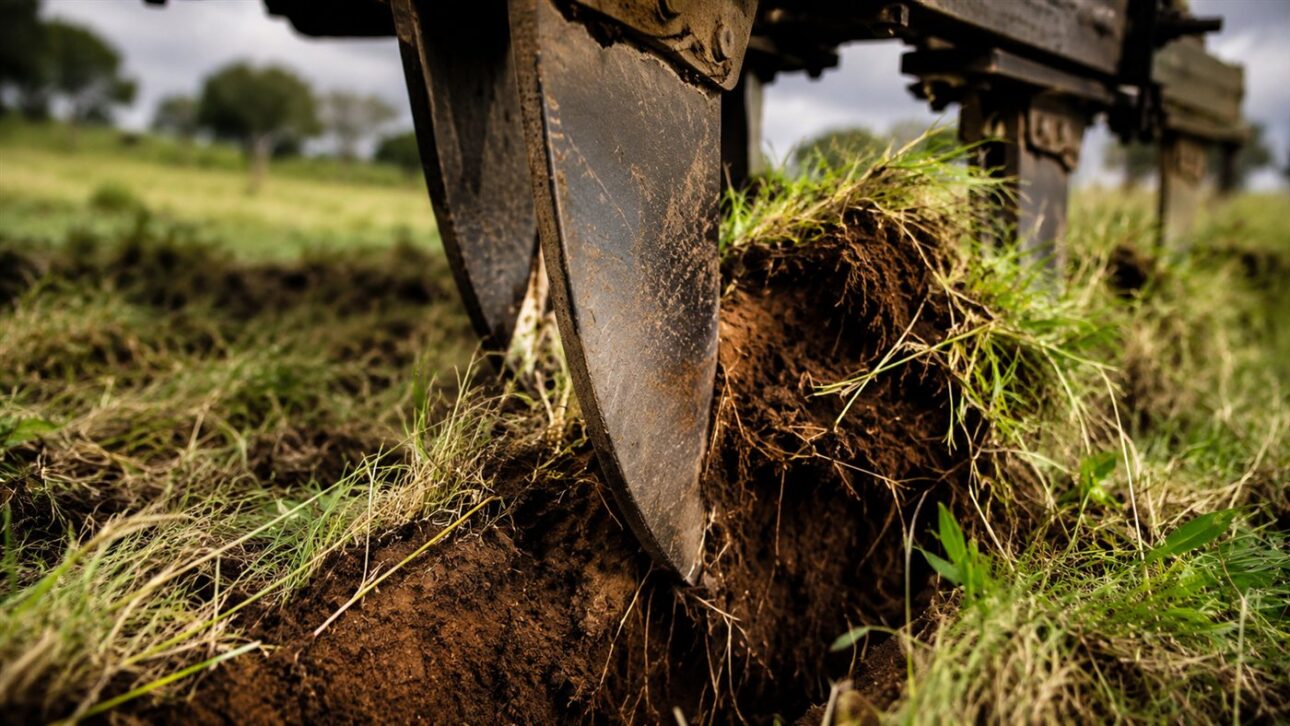
The mechanics of the tool are a lesson in precision. According to Symbiosis TX, the subsoiler shaft descends with a shoe that lifts and opens the soil from below, without overturning the layers as a disc plow would; in front, a cutting disc slices the grass layer with a clean cut and also deflects stones, essential in the rocky terrain of the Texas interior where the team works.
The engineering details continue. Side wheels regulate the depth, which varies from 20 to 40 centimeters, and a shear pin breaks if the shaft hits a large rock, protecting the equipment, as Symbiosis TX shows: just replace the pin, tighten the screws, and continue working. The central point is that the pasture, plants, and seed bank remain intact, and the aerobic and anaerobic layers of the soil do not mix.
The geometry of water: from the valley to the summit
What sets this tool apart from a common subsoiler is not the blade, but the direction of the cut. According to Symbiosis TX, water naturally flows from the summits to the valleys, leaving the valleys waterlogged and the high parts dry and eroded, and the keyline furrows are deliberately traced slightly off the contour line, guided by a laser level, to reverse this flow and direct the water from the valley towards the summit.
In the Texas climate, the effect is double protection. The region alternates long periods of drought with flash floods, and the compacted and cracked clay soil causes rain to sheet flow directly to the streams, as the Symbiosis TX channel on YouTube describes. The furrows force the water to zigzag across the property, slowly entering the subsoil instead of escaping through the drain at the bottom of the valley.
The invisible cistern that no pond can replace
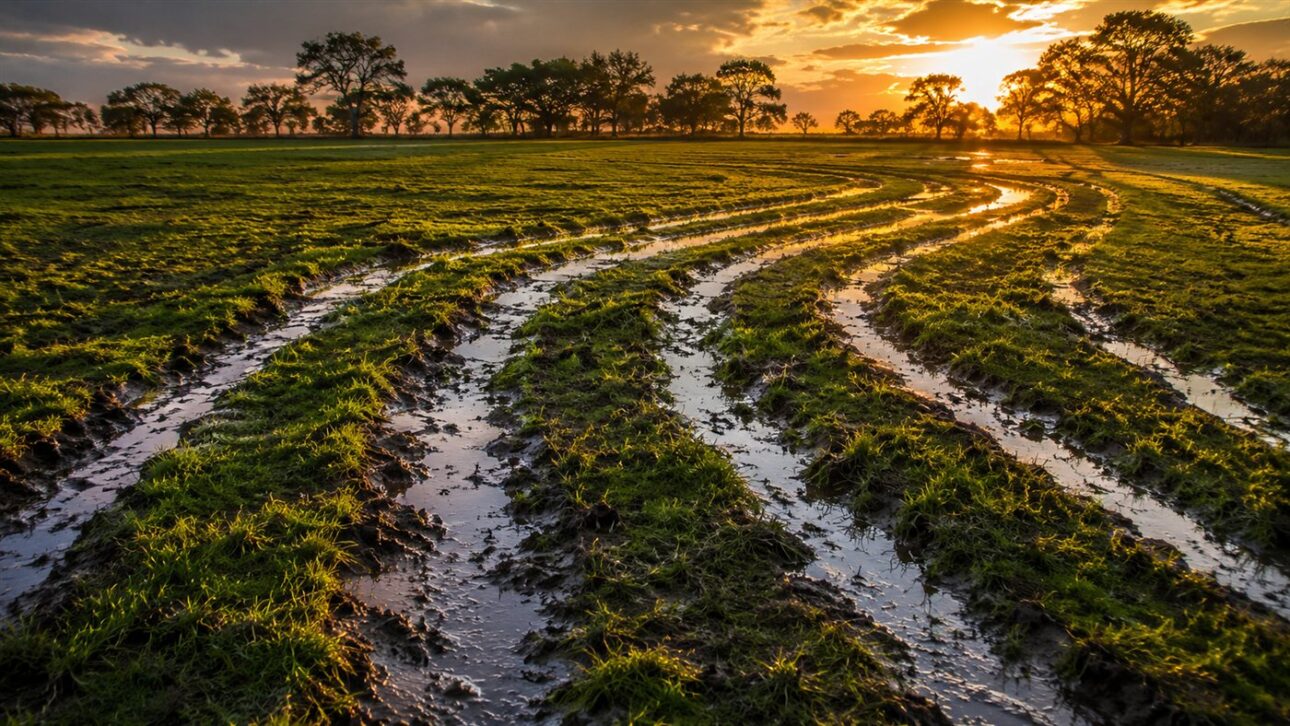
The comparison with traditional water harvesting techniques is the strongest argument of the video. According to Symbiosis TX, branch barriers, mini dams, and conservation terraces hold water on the surface, where part of it evaporates, while the underground furrows store everything below ground.
The cost-benefit calculation closes quickly. In the pasture of the video, a day and a half of plowing created an underground storage volume that would require conservation terraces every 3 meters to be equaled on the surface, according to Symbiosis TX, an investment that would not make economic sense. With furrows 30 to 35 centimeters deep in that plot, rainwater enters, descends, and remains available to the roots for weeks.
What goes inside the furrow: basalt, compost, and biology
The tear in the soil also becomes an entry point for inputs. According to Symbiosis TX, the furrows allow injecting biofertilizers and materials like volcanic basalt powder and biochar into the deep layers, instead of letting them interact only with the top 3 to 5 centimeters.
The recipe applied in the video is detailed. Basalt powder rich in fines, a fermented compound with a high content of humic acids and fungi, at the economical dose of 1 to 2 cubic yards per acre, and a cover of ground wood bark to facilitate spreading, as listed by the Symbiosis TX channel on YouTube, all distributed with an adapted limestone spreader. The logic is twofold: the mineral feeds the biology, and the biology builds soil. Combined with rotational grazing, cattle manure descends almost 30 centimeters through the furrows, accelerating the formation of fertile land.
Pros and cons: when the keyline plow becomes a problem
The rarest part of the video is the list of cons, stated by the technique’s own seller. According to Symbiosis TX, used at the wrong time the plow dries out the pasture instead of hydrating it, because the open furrows without rain in the forecast evaporate the moisture the soil had; the service is expensive, requiring about 25 horsepower per shank on the tractor and can break buried water pipes and electrical cables if no one checks beforehand.
The final warning is against the silver bullet. The keyline plow is a tool within a toolbox, not the complete solution, and needs to be combined with clear goals, planned grazing, and climate reading, as Symbiosis TX insists, citing the maxim that the tool should be used like a scalpel: in the right place, at the right time, for the right reason. Out of the proper context, it loses money and worsens the pasture.
What this has to do with Brazilian pasture


Brazil is the country with one of the largest pasture areas on the planet, and much of it suffers from the same problem described in the video: soil compacted by trampling, rain that runs off without infiltrating, and grass that withers at the first drought. Contour subsoiling is already known here, and the keyline design, with furrows that carry water from the valley to the ridge, is the next step that Brazilian regenerative producers are beginning to test.
The transferable lesson does not depend on importing machinery. Water that infiltrates is worth more than water that runs off, and any technique that increases infiltration without turning the soil over works in favor of the pasture, the water table, and the wallet, whether it’s a keyline plow, or good old well-done terracing. The video’s message is equally valid in both hemispheres: first the plan, then the iron.
Watch the keyline plow demonstration
The video shows the machine in action, the furrow tracing with laser level, the application of inputs, and the honest list of pros and cons.
In the end, the keyline plow sums up regenerative agriculture in one image: a 30-centimeter cut that, made in the right direction, transforms escaping rain into grass that stays. Tell us in the comments: does your pasture suffer more from the water that is missing or from the water that runs off?