






 Portuguese
  Spanish
  4 min of reading
  0 comments


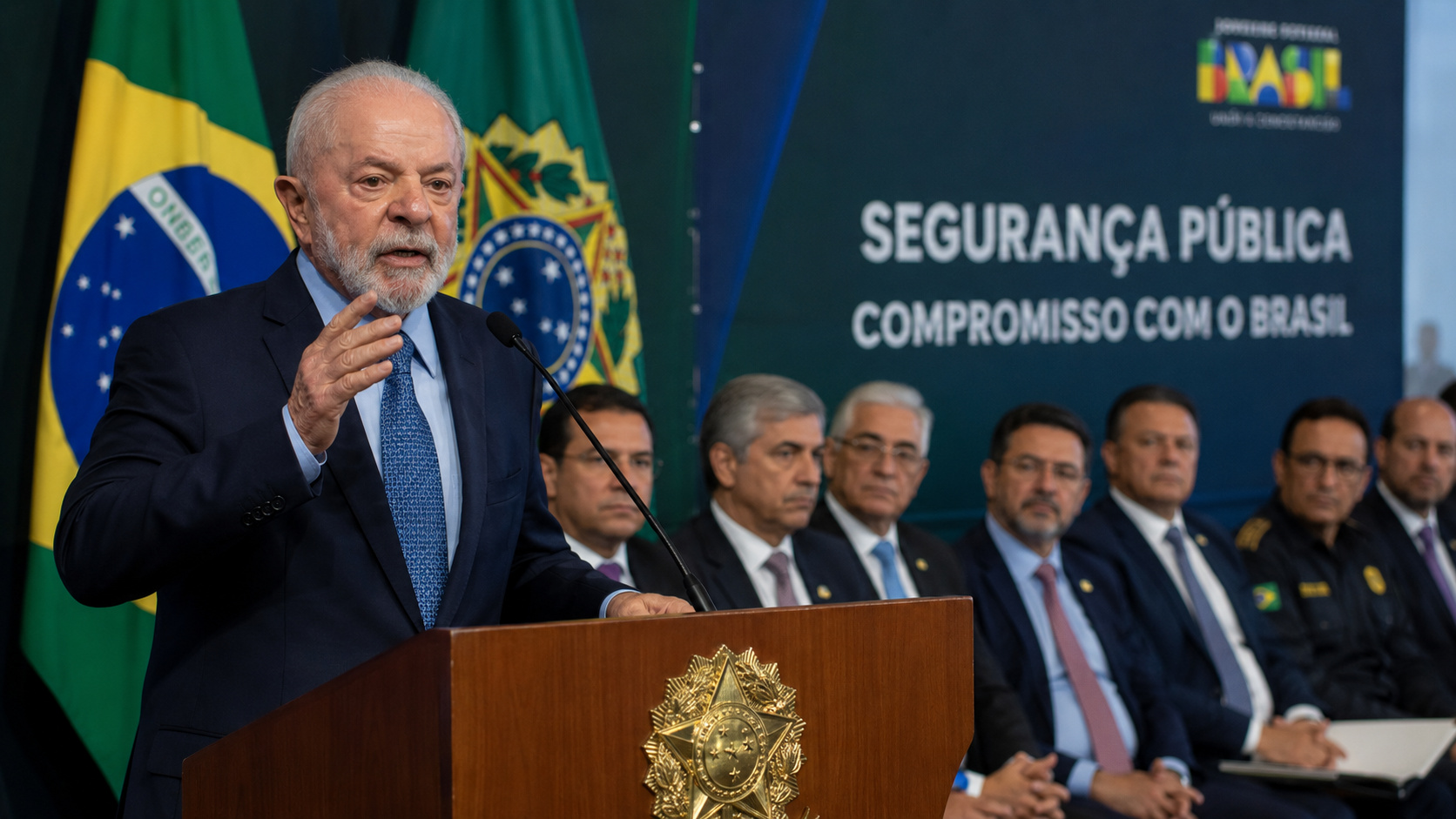
Federal government wants to expand integration between the Union and states in combating criminal factions while PEC faces political resistance in the Senate
The information was released by a “national news portal,” with details about the political backstage involving the Public Security Constitutional Amendment Proposal (PEC) and the federal government’s plans to expand its actions in combating organized crime in Brazil.
President Luiz Inácio Lula da Silva stated that the government intends to create a Ministry of Public Security as soon as the Senate approves the so-called Security PEC. The declaration occurred during the launch of the “Brazil Against Organized Crime” program, an initiative created by the federal government to reinforce actions to confront criminal organizations in the country.
According to Lula, the creation of the ministry directly depends on the proposal’s progress in the National Congress. During the speech, the president stated that approval could occur “in the coming days,” although the text is still stalled in the Senate awaiting dispatch to begin processing.
-
Detran RJ starts requiring a toxicological test for those obtaining their first driver’s license in the car and motorcycle category starting June 29; see who will be affected.

-
Florida takes TikTok to court and accuses the Chinese giant ByteDance of ignoring the law that bars minors under 14, while parents and authorities demand more protection for children on social networks.
-
Chamber approves constitutional amendment reducing the age of criminal responsibility from 18 to 16 years; what now?

-
Justice confirms that old debts in tax executions that have been stalled for more than 15 years can no longer be collected through judicial or administrative means.


“The day the Senate approves the Security PEC, in the coming days, we will create a Ministry of Public Security in this country,” declared the president.
Government wants to expand federal participation in public security

In addition to advocating for the creation of the new ministry, Lula explained that historically he always had resistance to the idea of a Ministry of Public Security without a clear definition of the federal government’s role in the area.
According to the president, the 1988 Constitution concentrated the responsibility for public security in the states as a reaction to the military dictatorship period, when security policy was strongly centralized by the federal government.
Now, however, Lula states that the scenario has changed. According to him, the growth of interstate and international criminal organizations demands more integrated action among the Union, states, and police forces.
In this sense, the president emphasized that the federal government does not intend to remove autonomy from governors nor occupy the space of state police forces. Nevertheless, he advocated for stronger national coordination to confront the advance of organized crime.
“Now, we are feeling the need for the federal government to actively participate again, but with criteria and determination, because we do not want to occupy the space of governors nor the space of state police. But the concrete fact is that if we don’t work together, we cannot win. And organized crime takes advantage of our division,” Lula stated.
The proposal presented by the government foresees greater integration between the Union and states, in addition to the constitutionalization of the Unified Public Security System (Susp), a mechanism created to unify security strategies and actions throughout the country.
Security PEC faces political resistance in the Senate
Despite the government’s gamble, the Security PEC faces strong political resistance both in Congress and among opposition governors.
Lawmakers critical of the project argue that the proposal could excessively expand the federal government’s actions over competencies that currently belong to the states.
Furthermore, opposition governors express concern about a possible centralization of public security in Brasília. Thus, the debate surrounding the PEC has also become a political dispute over the limits of action between the Union and the states.
Currently, the text awaits dispatch from the President of the Senate, Davi Alcolumbre, to officially begin its processing in the House.
Another factor that increased political tension was the recent strain between Lula and Alcolumbre. The relationship between the two worsened after the Senate rejected the nomination of the Attorney General of the Union, Jorge Messias, for a vacancy in the Supreme Federal Court (STF), in April.
The government’s unprecedented defeat deepened the political crisis between the Planalto Palace and sectors of the Senate, leading the government to reduce direct contact between Lula and Alcolumbre. Since then, communication has primarily occurred through ministers and pro-government leaders.
Government bets on national plan to unlock negotiations
Even in the face of political resistance, the government believes that the launch of the “Brazil Against Organized Crime” program can help accelerate negotiations around the PEC.
Palácio do Planalto believes that isolated measures adopted by the states are no longer able to confront criminal organizations that operate in an integrated manner in different regions of the country and even internationally.
Therefore, the government’s strategy involves creating national mechanisms for coordination, intelligence, and cooperation between state police forces and federal agencies.
Furthermore, the launch event brought together important authorities from the Brazilian political and legal scene. Among those present were the Minister of Justice and Public Security, Wellington César Lima e Silva, the President of the Chamber of Deputies, Hugo Motta, and the Attorney General of the Republic, Paulo Gonet.
Davi Alcolumbre’s absence, however, drew attention in political circles and reinforced signs of distancing between the Senate and the federal government.
Even so, Palácio do Planalto continues to bet that social pressure for combating organized crime may facilitate the approval of the PEC and pave the way for the creation of the new Ministry of Public Security.
Finally, the proposal once again places public security at the center of the national debate, especially at a time when the advance of criminal factions worries authorities, business owners, and the population in various regions of the country.
Do you believe that a Ministry of Public Security can truly help in the fight against organized crime in Brazil?






Be the first to react!