Portuguese
  Spanish


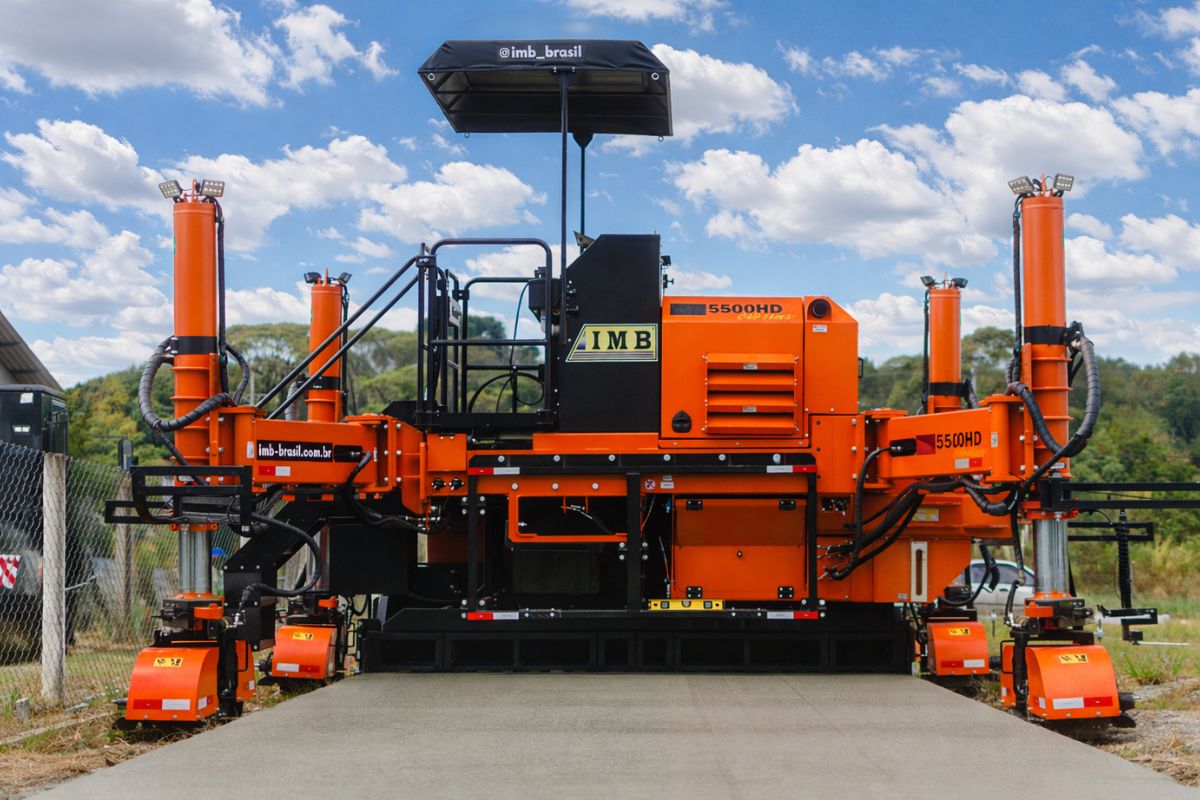

Showcased at Pavin Expo 2025, the Brazilian paver executes up to 4.60 m of concrete pavement, accepts different “shapes,” and automates level and thickness for a finish closer to perfect
The concrete pavement is already present in some of the country’s most complex infrastructure works, including internal tunnel applications, where precision and execution control make a difference in the final result. To achieve this level of quality and meet technical standards, there is a specific type of equipment, and that was what caught attention at Pavin Expo 2025 in São Paulo.
At the IMB Brasil booth, the star was the IMB 5500 HD, a high-precision paver for concrete pavement within the rigid paving logic, a method that has been growing in Brazil and is already well adopted in Europe, mainly due to its durability.
What is the IMB 5500 HD and why has it become a highlight

The IMB 5500 HD is a paver aimed at rigid paving, capable of executing concrete pavement with control over distribution, vibration, and material shaping within the “form” of work.
-
Unable to secure a mortgage as a self-employed single mother, she designed her own floating home from a 20-meter boat and now lives “off-grid” with her two children and solar panels on an English canal.

-
Man Transforms Rusty Shipping Container into Luxury Home with Insulated Walls, Large Windows, and Drywall Finish, Surprising Onlookers

-
“Super Grass” Miscanthus Grows Rapidly Without Pesticides, Replacing Heating Oil in Europe and Now Used in Carbon-Capturing Concrete and Walls in World’s First “Bale House”
-
Abandoned House Renovation Fixes Decades-Long Leak in Two Days with Red Steel Roof Installation




The proposal is to deliver a result already very close to the final, reducing corrections and leaving only finishing stages for later.
According to the team presented at the event, the machine positions itself as a robust and versatile piece of equipment, designed for roadworks and services associated with concrete, with configurations that adapt to the project.
Execution width and setups that change the type of service

One of the central numbers of the equipment is the capacity to execute concrete pavement of up to 4.60 m. At the time of the demonstration, the machine was equipped with a 3.60 m form, width equivalent to a traffic lane, and the configuration itself allows for a combination of lane with shoulder, varying according to the arrangement of the form.
In addition, the IMB 5500 HD can work with the form below, in the center, or with the form on the side, which expands the types of delivery in the field.
In practice, this opens up space for different solutions, such as:
concrete pavement, New Jersey barrier, and drainage channel, among other possibilities, since the manufacturer also produces the forms and can adapt models according to customized projects.
How concrete enters, is distributed and compacted until it becomes pavement

At the front of the set, the pavement form includes a screw conveyor, responsible for distributing the concrete.
The concrete arrives poured directly in front of the machine, by concrete mixer or dump truck, and the paver advances distributing the material.
Next, hydraulic vibrators come into play, which compact the concrete, making it more fluid to fill the mold and take shape.
In the shown configuration, there were eight vibrators, with the possibility of reaching ten, achieving rotation of 10,000 rpm. The goal is straightforward: to uniform and consolidate the concrete so that the concrete pavement comes out with more stable geometry and consistency.
Closed cabin, air conditioning and the difference in the operator’s day-to-day
A differentiating factor pointed out by IMB is the fact that the machine is enclosed. This allows the operator to work in air conditioning, with more comfort and protection against temperature, noise, and dust.
On site, this is not a detail, because it affects fatigue, attention, and ultimately, the quality of execution of the concrete pavement throughout the shift.
Trimble 3D system and level control to maintain constant thickness
Another point highlighted in the demonstration was the use of the Trimble 3D system, presented as part already integrated into the equipment when purchased with this technology.
The machine can operate following this 3D control, but it can also work with a cable system, using sensors that read a steel cable and maintain the reference path.
The purpose is to solve a classic construction problem: unevenness and variations in the base. In this scenario, the machine balances and makes corrections, filling level differences to maintain constant working height and thickness, aiming for a concrete pavement that is more uniform from start to finish.
Finishing with brooming and grooves to improve adhesion
In the simulation shown behind the equipment, the logic of the process becomes clear: the concrete enters at the front, is distributed, vibrated, shaped, and exits formed.
Then, brooming tends to be left for the finish, which creates grooves and prevents a surface that is too smooth, helping with tire adhesion. It’s the kind of detail that transforms “finished floor” into a safe floor, especially on highways with constant traffic.
How much it costs and what changes by being manufactured in Brazil
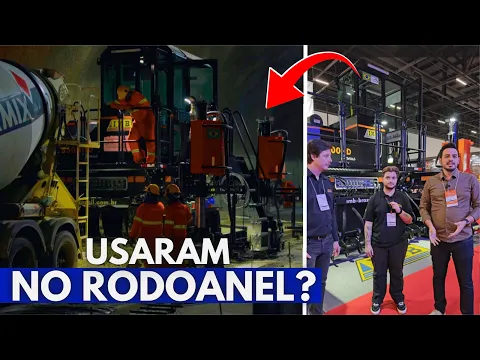

When the topic turned to cost, the reported value for the IMB 5500 HD was R$ 3,260,000. The machine is 100% manufactured in Brazil, with national technology combined with components and solutions from abroad.
The main practical advantage pointed out was maintenance and support “at home,” with local availability for service and replacement, in addition to a cost considered lower compared to imported machines.
For those who execute concrete pavement on a large scale, this weighs both on the investment and on the downtime of the machine.
Where this paver can make a difference
From what has been presented, the IMB 5500 HD targets typical applications of rigid paving and roadworks: execution of concrete pavement in lanes, shoulders, ditches, barriers, and molded services, with the promise of precision, repeatability, and operational comfort.
And you, if you could choose, would you apply concrete pavement on more highways in Brazil or do you still prefer asphalt on most stretches?